Question
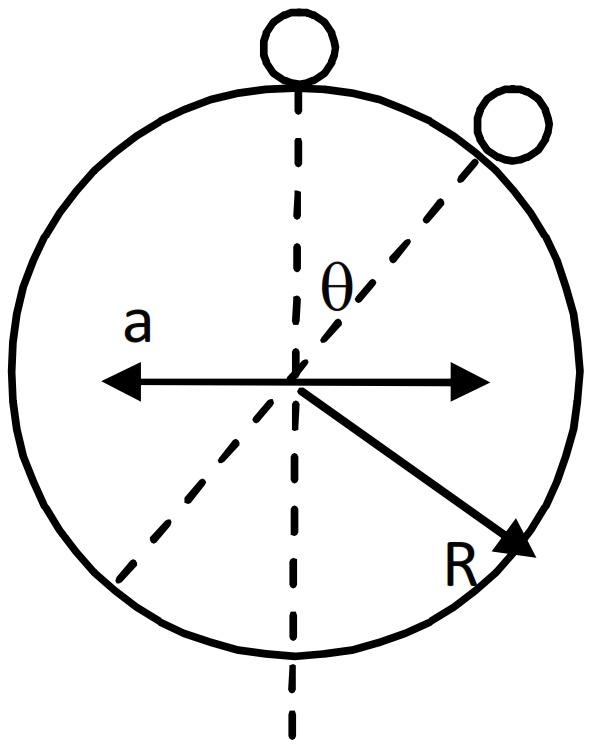
A smooth sphere of radius R is made to translate in a straight line with a constant acceleration a. A particle kept on the top of the sphere is released from there at zero velocity with respect to the sphere. Find the speed of the particle with respect to the sphere as a function of the angle $\theta$ it slides.
Answer


Let the sphere move towards left with an acceleration ‘a'
Let m = mass of the particle
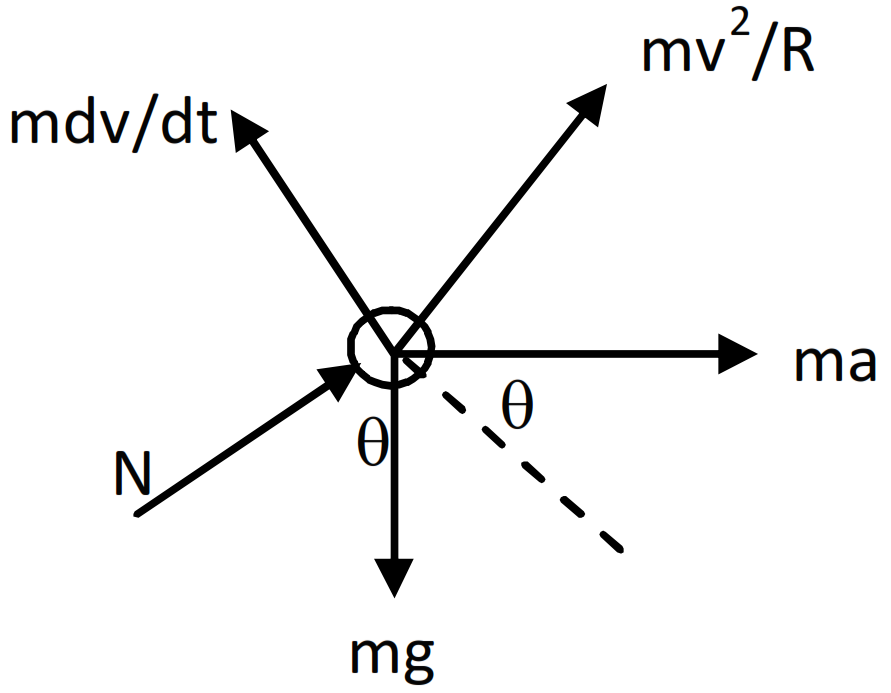
The particle ‘m’ will also experience the inertia due to acceleration ‘a’ as it is on the sphere. It will also experience the tangential inertia force $\Big(\text{m}\Big(\frac{\text{dv}}{\text{dt}}\Big)\Big)$ and centrifugal force $\Big(\frac{\text{mv}^2}{\text{R}}\Big).$
$\text{m}\frac{\text{dv}}{\text{dt}}=\text{ma}\cos\theta+\text{mg}\sin\theta$
$\Rightarrow\text{mv}\frac{\text{dv}}{\text{dt}}=\text{ma}\cos\theta\Big(\text{R}\frac{\text{d}\theta}{\text{dt}}\Big)+\text{mg}\sin\theta\Big(\text{R}\frac{\text{d}\theta}{\text{dt}}\Big)$
Because, $\text{v}=\text{R}\frac{\text{d}\theta}{\text{dt}}$
$\Rightarrow\text{vdv}=\text{aR}\cos\theta\text{ d}\theta+\text{gR}\sin\theta\text{ d}\theta$
Integrating both sides we get,
$\frac{\text{v}^2}{2}=\text{aR}\sin\theta-\text{gR}\sin\theta+\text{C}$
Given that, at $\theta=0,\text{v}=0$
So, $\text{C}=\text{gR}$
So, $\frac{\text{v}^2}{2}=\text{aR}\sin\theta-\text{gR}\sin\theta+\text{gR}$
$\therefore\ \text{v}^2=2\text{R}(\text{a}\sin\theta+\text{g}-\text{g}\cos\theta)$
$\Rightarrow\text{v}=[2\text{R}(\text{a}\sin\theta+\text{g}-\text{g}\cos\theta)]^\frac{1}{2}$

Need a full question paper?

Generate a complete, print-ready paper with questions like this in minutes — across 16+ boards, with answer keys.

Start Generating Free

Similar questions

A gas is initially at a pressure of $100kPa$ and its volume is $2.0m^3$. Its pressure is kept constant and the volume is changed from $2.0m^3$ to $2.5m^3$​​​​​​​. Its volume is now kept constant and the pressure is increased from $100kPa$ to $200kPa$. The gas is brought back to its initial state, the pressure varying linearly with its volume.
  1. Whether the heat is supplied to or extracted from the gas in the complete cycle?
  2. How much heat was supplied or extracted?
State triangle law of vector addition. Give analytical treatment to find the magnitude and direction of a resultant vector by using this law.
Compute the bulk modulus of water from the following data: Initial volume = $100.0$ litre, Pressure increase = 100.0 atm ($1\ atm = 1.013 × 10⁵ Pa$), Final volume = $100.5$ litre. Compare the bulk modulus of water with that of air (at constant temperature). Explain in simple terms why the ratio is so large.
A particle A having a charge of $2.0 \times 10^{-6}C$ is held fixed on a horizontal table. A second charged particle of mass $80g$ stays in equilibrium on the table at a distance of $10cm$ from the first charge. The coefficient of friction between the table and this second particle is $\mu=0.2.$ Find the range within which the charge of this second particle may lie.
A particle of charge $2.0 \times 10^{-8} \mathrm{C}$ and mass $2.0 \times 10^{-10} \mathrm{~g}$ is projected with a speed of $2.0 \times 10^3 \mathrm{~m} / \mathrm{s}^{-1}$ in a region with a uniform magnetic field of 0.10 T . The velocity is perpendicular to the field. Find the radius of the circle formed by the particle and also the time period.
A current of 1.0A is established in a tightly wound solenoid of radius 2cm having 1000 turns/ metre. Find the magnetic energy stored in each metre of the solenoid.
A brass boiler has a base area of $0.15 \mathrm{~m}^2$ and thickness 1.0 cm . It boils water at the rate of $6.0 \mathrm{~kg} / \mathrm{min}$ when placed on a gas stove. Estimate the temperature of the part of the flame in contact with the boiler. Thermal conductivity of brass $=109 \mathrm{~J} \mathrm{~s}^{-1} \mathrm{~m}^{-1} \mathrm{~K}^{-1} ;$ Heat of vaporisation of water $=2256 \times 103 \mathrm{~J} \mathrm{~kg}^{-1}$.
The track shown in figure is frictionless. The block B of mass $2m$ is lying at rest and the block A of mass m is pushed along the track with some speed. The collision between A and B is perfectly elastic. With what velocity should the block A be started to get the sleeping man awakened?
A circular disc of mass $10kg$ is suspended by a wire attached to its centre. The wire is twisted by rotating the disc and released. The period of torsional oscillations is found to be $1.5s$. The radius of the disc is $15cm$. Determine the torsional spring constant of the wire. (Torsional spring constant $\alpha$ is defined by the relation $\text{J}=-\alpha\theta,$ where J is the restoring couple and $\theta$ the angle of twist).
Write Hooke's law. On what does the value of co-efficient of elasticity depend? Draw a graph between stress and strain with in the elastic limit.###Write Hooke's law. How to determine the coefficient of elasticity of a material of wire in the laboratory? Explain. Make necessary diagram also Compare the Young's Modulus of elasticity of different material.