Question
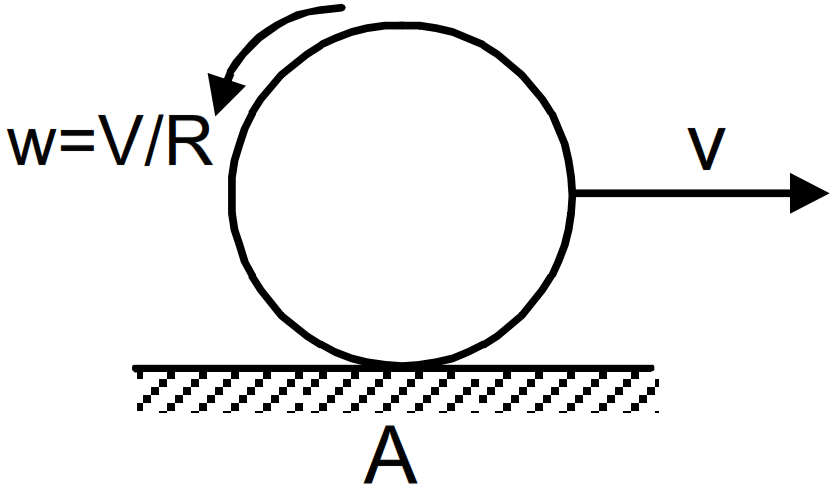
A solid sphere is set into motion on a rough horizontal surface with a linear speed v in the forward direction and an angular speed $\frac{\text{v}}{\text{R}}$ in the anticlockwise direction as shown in figure. Find the linear speed of the sphere:
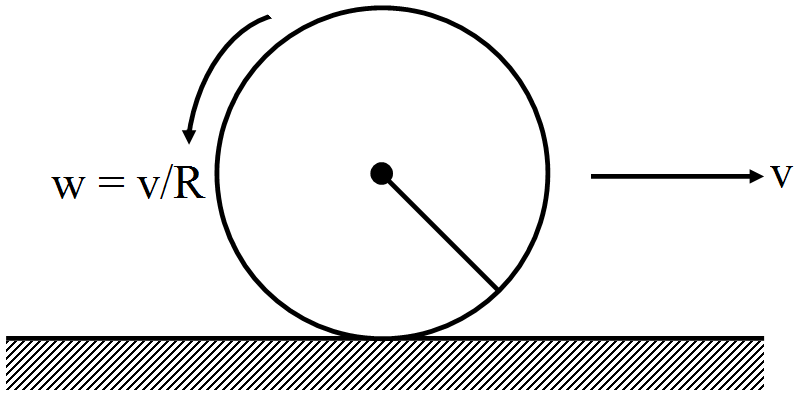
  1. When it stops rotating.
  2. When slipping finally ceases and pure rolling starts.
Answer


  1. If we take moment at A then external torque will be zero.

Therefore, the initial angular momentum = the angular momentum after rotation stops (i.e. only leniar velocity exits)

$\text{Mv}\times\text{R}-\ell\omega=\text{Mv}_0\times\text{R}$

$\Rightarrow\text{MvR}-\frac{2}{5}\times\frac{\text{MR}^2\text{V}}{\text{R}}=\text{Mv}_0\text{R}$

$\Rightarrow\text{v}_0=\frac{\text{3V}}{5}$

  1. Again, after some time pure rolling starts

Therefore,

$\Rightarrow\text{M}\times\text{v}_0\times\text{R}=\Big(\frac{2}{5}\Big) \text{MR}^2\times\Big(\frac{\text{V}'}{\text{R}}\Big)+\text{Mv}'\text{R}$

$\Rightarrow\text{m}\times\Big(\frac{\text{3V}}{5}\Big)\times\text{R}=\Big(\frac{2}{5}\Big)\text{Mv}'\text{R}+\text{Mv}'\text{R}$

$\Rightarrow\text{V}'=\frac{3\text{V}}{7}$

Need a full question paper?

Generate a complete, print-ready paper with questions like this in minutes — across 16+ boards, with answer keys.

Start Generating Free

Similar questions

A long, straight wire carries a current. Is Ampere's law valid for a loop that does not enclose the wire? That encloses the wire but is not circular?
A circular loop of radius r carrying a current i is held at the centre of another circular loop of radius R(>> r) carrying a current I. The plane of the smaller loop makes an angle of 30° with that of the larger loop. If the smaller loop is held fixed in this position by applying a single force at a point on its periphery, what would be the minimum magnitude of this force?
  1. Draw a plot showing the variation of photoelectric current with collector potential for different frequencies but same intensity of incident radiation.
  2. Use Einstein’s photoelectric equation to explain the observations from this graph.
  3. What change will you observe if intensity of incident radiation is changed but the frequency remains the same?
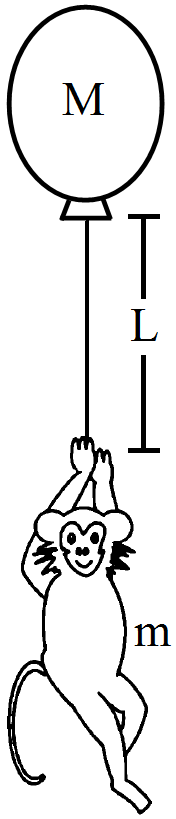
The balloon, the light rope and the monkey shown in figure are at rest in the air. If the monkey reaches the top of the rope, by what distance does the balloon descend ? Mass of the balloon = M, mass of the monkey = m and the length of the rope ascended by the monkey = L.

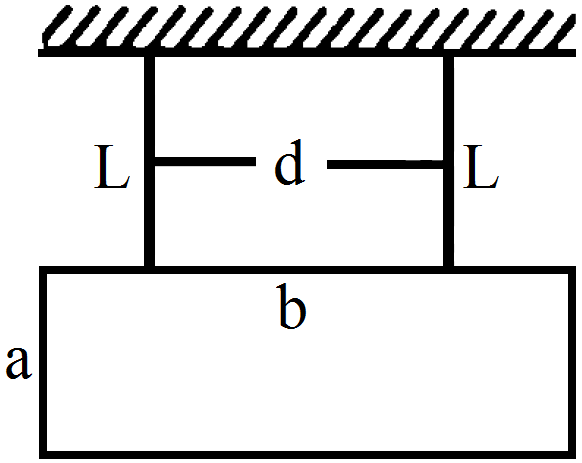
A rectangular plate of sides a and b is suspended from a ceiling by two parallel strings of length L each figure The separation between the strings is d. The plate is displaced slightly in its plane keeping the strings tight. Show that it will execute simple harmonic motion. Find the time period.

A point charge of 2.0 μC is at the centre of a cubic Gaussian surface 9.0 cm on edge. What is the net electric flux through the surface?
A man is sitting on the shore of a river. He is in the line of a 1.0m long boat and is 5.5m away from the centre of the boat. He wishes to throw an apple into the boat. If he can throw the apple only with a speed of 10m/s, find the minimum and maximum angles of projection for successful shot. Assume that the point of projection and the edge of the boat are in the same horizontal level.
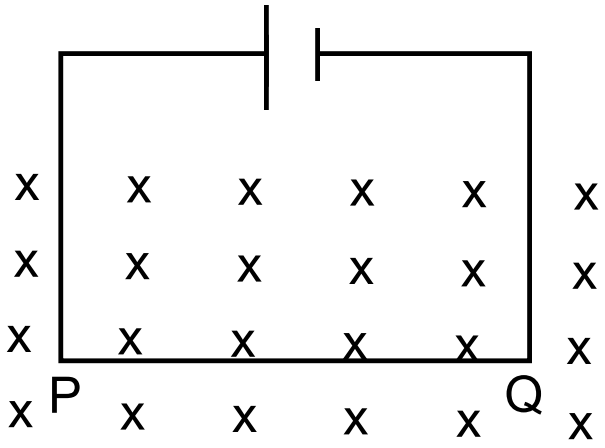
A current of 5.0A exists in the circuit shown in the figure. The wire PQ has a length of 50cm and the magnetic field in which it is immersed has a magnitude of 0.20T. Find the magnetic force acting on the wire PQ.

A rod is inserted as the core in the current-carrying solenoid of the previous problem.
  1. What is the magnetic intensity H at the centre?
  2. If the magnetization I of the core is found to be 0.12Nm, find the susceptibility of the material of the rod.
  3. Is the material paramagnetic, diamagnetic or ferromagnetic?
What is meant by nuclear fusion? What happens in this reaction?