A spherical conductor of radius $2m$ is charged to a potential of $120\, V$. It is now placed inside another hollow spherical conductor of radius $6m$. Calculate the potential to which the bigger sphere would be raised......$V$
Easy
Download our app for free and get started
(d) If charge acquired by the smaller sphere is $Q$ then it’s potential $120 = \frac{{kQ}}{2}$ ..$ (i)$
Also potential of the outer sphere
$V = \frac{{kQ}}{6}$.....$(ii)$
From equation $(i)$ and $(ii)$ $V = 40\, volt$
Also potential of the outer sphere
$V = \frac{{kQ}}{6}$.....$(ii)$
From equation $(i)$ and $(ii)$ $V = 40\, volt$

Download our appand get started for free
Experience the future of education. Simply download our apps or reach out to us for more information. Let's shape the future of learning together!No signup needed.*
Similar Questions
- 1A $5.0\, \mu F$ capacitor is charged to a potential difference $800\, V$ and discharged through a conductor. The energy(in $J$) given to a conductor during the discharge isView Solution
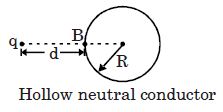
- 2View SolutionFor the situation shown in the figure below, mark out the correct statement
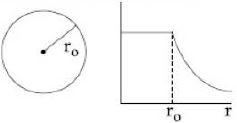
- 3The give graph shown variation (with distance $r$ from centre) ofView Solution
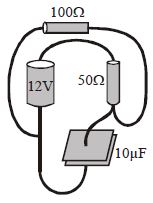
- 4View SolutionIn the circuit shown in figure
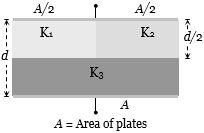
- 5A parallel plate capacitor of area $A$, plate separation $d$ and capacitance $C$ is filled with three different dielectric materials having dielectric constants ${k_1},{k_2}$ and ${k_3}$ as shown. If a single dielectric material is to be used to have the same capacitance $C$ in this capacitor, then its dielectric constant $k$ is given byView Solution
- 6Concentric metallic hollow spheres of radii $R$ and $4 R$ hold charges $Q _{1}$ and $Q _{2}$ respectively. Given that surface charge densities of the concentric spheres are equal, the potential difference $V ( R )- V (4 R )$ isView Solution
- 7The capacitance of a parallel plate capacitor is $5\, \mu F$ . When a glass slab of thickness equal to the separation between the plates is introduced between the plates, the potential difference reduces to $1/8$ of the original value. The dielectric constant of glass isView Solution
- 8Find the equivalent capacitance of the circuit between point $A$ and $B$.View Solution
- 9The electric potential at a point $(x,\;y)$ in the $x - y$ plane is given by $V = - kxy$. The field intensity at a distance $r$ from the origin varies asView Solution
- 10A charge of $40\,\mu \,C$ is given to a capacitor having capacitance $C = 10\,\mu \,F$. The stored energy in ergs isView Solution