MCQ
A spring whose unstretched length is $\ell $ has a force constant $k$. The spring is cut into two pieces of unstretched lengths $\ell_1$ and $\ell_2$ where, $\ell_1 = n\ell_2$ and $n$ is an integer. The ratio $k_1/k_2$ of the corresponding force constants, $k_1$ and $k_2$ will be
  • A
    $n$
  • B
    $\frac{1}{n^2}$
  • C
    $n^2$
  • $\frac{1}{n}$

Answer

Correct option: D.
$\frac{1}{n}$
d
$\begin{array}{l}
{k_1} = \frac{C}{{{\ell _1}}}\\
{k_2} = \frac{C}{{{\ell _2}}}\\
\frac{{{k_1}}}{{{k_2}}} = \frac{{C{\ell _2}}}{{{\ell _1}C}} = \frac{{{\ell _2}}}{{n{\ell _2}}} = \frac{1}{n}
\end{array}$

Need a full question paper?

Generate a complete, print-ready paper with questions like this in minutes — across 16+ boards, with answer keys.

Start Generating Free

Similar questions

$125\, ml$ of gas $A$ at $0.60$ atmosphere and $150\, ml$ of gas $B$ at $0.80$ atmosphere pressure at same temperature is filled in a vessel of $1$ litre volume. What will be the total pressure of mixture at the same temperature ............... $\mathrm{atmosphere}$
A cylinder with a movable piston contains $3\,moles$ of hydrogen at standard temperature and pressure. The walls of the cylinder are made of a heat insulator, and the piston is insulated by having a pile of sand on it. By what factor does the pressure of the gas increases if the gas is compressed to half its original volume? 
The specific heat capacity of a body depends on:
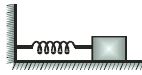
Spring of spring constant $1200\, Nm^{-1}$ is mounted on a smooth frictionless surface and attached to a block of mass $3\, kg$. Block is pulled $2\, cm$ to the right and released. The angular frequency of oscillation is .... $ rad/sec$
The time period of a mass suspended from a spring is $T$. If the spring is cut into four equal parts and the same mass is suspended from one of the parts, then the new time period will be
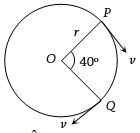
A particle is moving on a circular path of radius $r$ with uniform velocity $v$. The change in velocity when the particle moves from $P$ to $Q$ is $(\angle POQ = 40^\circ )$
If $\overrightarrow{ F }=(20 \hat{i}+15 \hat{j}-5 \hat{k})$ and $\overrightarrow{ v }=(6 \hat{i}-4 \hat{j}+3 \hat{k}) m / s$ then the instantaneous power will be :
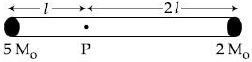
A rigid massless road of length $3l$ has tow masses attached at each end as shown in the figure. The rod is pivoted at point $P$ on the horizontal axis (see figure). When released from initial horizontal position, its instantaneous angular acceleration will be
A bullet is fired with a speed of $1000\,\,m/\sec $ in order to hit a target 100 m away. If $g = 10\,\,m/{s^2}$, the gun should be aimed
Huygens' principle of secondary wavelets may be used to:
  1. Find the velocity of light in vacuum.
  2. Explain the particle behaviour of light.
  3. Find the new position of a wavefront.
  4. Explain Snell's law.