A uniform disc of radius R is put over another uniform disc of radius 2R of the same thickness and density. The peripheries of the two discs touch each other. Locate the centre of mass of the system.
Download our app for free and get started
Let the centre of the bigger disc be the origin. 2R = Radius of bigger disc R = Radius of smaller disc $\text{m}_1=\pi\text{R}^2\times\text{T}\times\rho$ $\text{m}_2=\pi(\text{2R})^2\times\text{T}\times\rho$ where T = Thickness of the two discs $\rho=$ Density of the two discs $\therefore$ The position of the centre of mass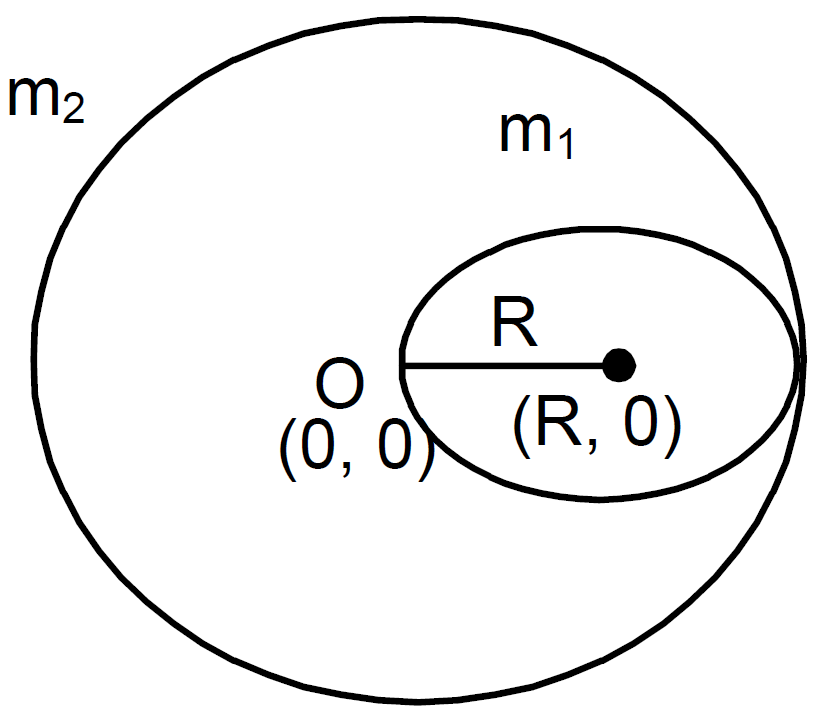
$\Big(\frac{\text{m}_1\text{x}_1+\text{m}_2\text{x}_2}{\text{m}_1+\text{m}_2},\frac{\text{m}_1\text{y}_1+\text{m}_2\text{y}_2}{\text{m}_1+\text{m}_2}\Big)$ $\text{x}_1=\text{R},\ \text{y}_1=0$ $\text{x}_2=0,\ \text{y}_2=0$ $\Big(\frac{\pi\text{R}^2\text{T}\rho\text{R}+0}{\pi\text{R}^2\text{T}\rho+\pi(2\text{R})^2\text{T}\rho},\frac{0}{\text{m}_1+\text{m}_2}\Big)=\Big(\frac{\pi\text{R}^2\text{T}\rho\text{R}}{5\pi\text{R}^2\text{T}\rho},0\Big)=\Big( \frac{\text{R}}{5},0\Big)$ At $\frac{\text{R}}5{}$ from the centre of bigger disc towards the centre of smaller disc.
$\Big(\frac{\text{m}_1\text{x}_1+\text{m}_2\text{x}_2}{\text{m}_1+\text{m}_2},\frac{\text{m}_1\text{y}_1+\text{m}_2\text{y}_2}{\text{m}_1+\text{m}_2}\Big)$ $\text{x}_1=\text{R},\ \text{y}_1=0$ $\text{x}_2=0,\ \text{y}_2=0$ $\Big(\frac{\pi\text{R}^2\text{T}\rho\text{R}+0}{\pi\text{R}^2\text{T}\rho+\pi(2\text{R})^2\text{T}\rho},\frac{0}{\text{m}_1+\text{m}_2}\Big)=\Big(\frac{\pi\text{R}^2\text{T}\rho\text{R}}{5\pi\text{R}^2\text{T}\rho},0\Big)=\Big( \frac{\text{R}}{5},0\Big)$ At $\frac{\text{R}}5{}$ from the centre of bigger disc towards the centre of smaller disc.

Download our appand get started for free
Experience the future of education. Simply download our apps or reach out to us for more information. Let's shape the future of learning together!No signup needed.*
Similar Questions
- 1View SolutionFind the components along the x, y, z axes of the angular momentum l of a particle, whose position vector is r with components x, y, z and momentum is p with components px, py and pz. Show that if the particle moves only in the x-y plane the angular momentum has only a z-component.
- 2A comet revolves around the sun in a highly elliptical orbit having a minimum distance of $7 \times 10^{10}m$ and a maximum distance of $1.4 \times 10^{13}m$. If its speed while nearest to the Sun is $60km s^{-1}$, find its linear speed when situated farthest from the Sun.View Solution
- 3A car weighs $1800kg$. The distance between its front and back axles is $1.8m$. Its centre of gravity is $1.05m$ behind the front axle. Determine the force exerted by the level ground on each front wheel and each back wheel.View Solution
- 4A uniform wheel of radius R is set into rotation about its axis at an angular speed $\omega.$ This rotating wheel is now placed on a rough horizontal surface with its axis horizontal. Because of friction at the contact, the wheel accelerates forward and its rotation decelerates till the wheel starts pure rolling on the surface. Find the linear speed of the wheel after it starts pure rolling.View Solution
- 5Two cylindrical hollow drums of radii R and 2R, and of a common height h, are rotating with angular velocities $\omega$ (anti-clockwise) and $\omega$ (clockwise), respectively. Their axes, fixed are parallel and in a horizontal plane separated by $(3\text{R}+\delta).$ They are now brought in contact $(\delta\rightarrow0){:}$View Solution
- Show the frictional forces just after contact.
- Identify forces and torques external to the system just after contact.
- What would be the ratio of final angular velocities when friction ceases?
- 6Establish the relation $\theta=\omega_0\text{t}+\frac{1}{2}\alpha\text{t}^2$ where the letters have their usual meanings.View Solution
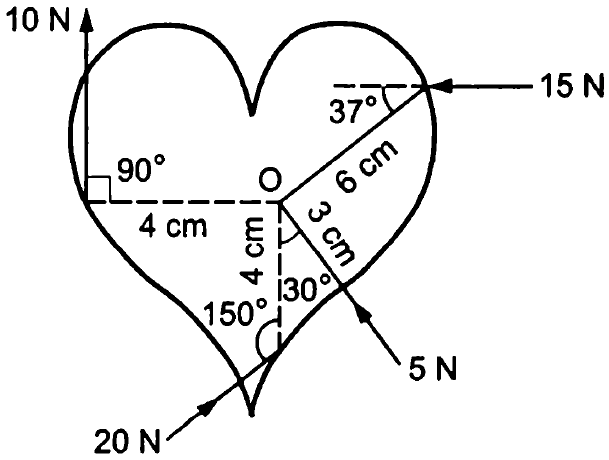
- 7View SolutionCalculate the total torque acting on the body shown in figure about the point O.
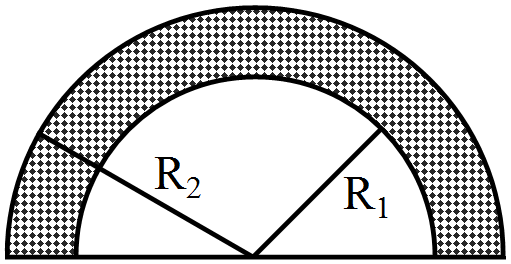
- 8Find the centre of mass of a uniform plate having semicircular inner and outer boundaries of radii $R_1$ and $R_2$.View Solution
- 9View SolutionA metre stick is balanced on a knife edge at its centre. When two coins, each of mass 5g are put one on top of the other at the 12.0cm mark, the stick is found to be balanced at 45.0cm. What is the mass of the metre stick?
- 10Two particles of mass $2kg$ and $1kg$ are moving along the same line with speeds $2ms-1$ and $5ms^{-1}$ respectively. What is the speed of the centre of mass of the system if both the particles are moving (a) in same direction (b) in opposite direction?View Solution