MCQ
A system exhibiting S.H.M. must possess
  • A
    Inertia only
  • Elasticity as well as inertia
  • C
    Elasticity, inertia and an external force
  • D
    Elasticity only

Answer

Correct option: B.
Elasticity as well as inertia
b
(b) System should be elastic and must possess inertia

Need a full question paper?

Generate a complete, print-ready paper with questions like this in minutes — across 16+ boards, with answer keys.
Start Generating Free

Similar questions

A steel wire of length ' $L$ ' at $40^{\circ}\,C$ is suspended from the ceiling and then a mass ' $m$ ' is hung from its free end. The wire is cooled down from $40^{\circ}\,C$ to $30^{\circ}\,C$ to regain its original length ' $L$ '. The coefficient of linear thermal expansion of the steel is $10^{-5} { }^{\circ}\,C$, Young's modulus of steel is $10^{11}\, N /$ $m ^2$ and radius of the wire is $1\, mm$. Assume that $L \gg $ diameter of the wire. Then the value of ' $m$ ' in $kg$ is nearly
Jet aircrafts fly at altitudes above $30000 \,ft$, where the air is very cold at $-40^{\circ} C$ and the pressure is $0.28 \,atm$. The cabin is maintained at $1 \,atm$ pressure by means of a compressor which exchanges air from outside adiabatically. In order to have a comfortable cabin temperature of $25^{\circ} C$, we will require in addition 
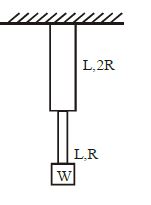
Two wires of the same material (Young's modulus  $Y$ ) and same length $L$  but radii  $R$  and  $2R$  respectively are joined end to end and a weight  $W$  is suspended from the combination as shown in the figure. The elastic potential energy in the system is
A projectile is thrown with velocity $U=20\ m/s ± 5\%$ at an angle $60^o.$ If the projectile falls back on the ground at the same level then    ......... $m$ of following can not be a possible answer for range.
A particle of mass $m$ is under the influence of the gravitational field of a body of mass $M(\gg m)$. The particle is moving in a circular orbit of radius $r_0$ with time period $T_0$ around the mass $M$. Then, the particle is subjected to an additional central force, corresponding to the potential energy $V_c(r)=m \alpha / r^3$, where $\alpha$ is a positive constant of suitable dimensions and $r$ is the distance from the center of the orbit. If the particle moves in the same circular orbit of radius $r_0$ in the combined gravitational potential due to $M$ and $V_c(r)$, but with a new time period $T_1$, then $\left(T_1^2-T_0^2\right) / T_1^2$ is given by [ $G$ is the gravitational constant.]
The initial pressure of a gas is P. It is adiabatic compressed due to which its density becomes four times its initial density. The final pressure of the gas will be: ${\gamma = 1.5}$
A simple pendulum consisting of a light inextensible string of length $\ell$ attached to a heavy small bob of mass $m$ is at rest. The bob is imparted a horizontal impulsive force which gives it a speed of $\sqrt{4 g \ell}$. The speed of the bob at its highest point is ( $g$ is the accelaration due to gravity)
A shell is fired from a cannon with a velocity V at an angle $\theta$ with the horizontal direction. At the highest point in its path, it explodes into two pieces of equal masses. One of the pieces retraces its path to the cannon. The speed of the other piece immediately after the explosion is:
A hollow sphere is filled with water through a small hole in it. It is then hung by a long thread and made to oscillate. As the water slowly flows out of the hole at the bottom, the period of oscillation will
An open pipe is in resonance in its $2^{nd}$ harmonic with tuning fork of frequency ${f_1}$. Now it is closed at one end. If the frequency of the tuning fork is increased slowly from ${f_1}$ then again a resonance is obtained with a frequency ${f_2}$. If in this case the pipe vibrates ${n^{th}}$ harmonics then