Question
A transformer is essentially an a.c. device. It cannot work on d.c. It changes altemating voltages or currents. It does not affect the frequency of a.c. It is based on the phenomenon of mutual induction. A transformer essentially consists of two coils of insulated copper wire having different number of tums and wound on the same soft iron core.
The number of turns in the primary and secondary coils of an ideal transfonner are 2000 and 50 respectively. The primary coil is connected to a main supply of 120V and secondary coil is connected to a bulb of resistance $0.6\Omega.$
  1. The value of voltage across the secondary coil is:
  1. 5V
  2. 2V
  3. 3V
  4. 10V
  1. The value of current in the bulb is:
  1. 7A
  2. 15A
  3. 3A
  4. 5A
  1. The value of current in primary coil is:
  1. 0.125A
  2. 2.52A
  3. 1.51A
  4. 3.52A
  1. Power in primary coil is:
  1. 20W
  2. 5W
  3. 10W
  4. 15W
  1. Power in secondary coil is:
  1. 15W
  2. 20W
  3. 7W
  4. 8W

Answer

  1. (c) 3V

Explanation:

As, $\frac{\text{E}_\text{s}}{\text{E}_\text{p}}=\frac{\text{n}_\text{s}}{\text{n}_\text{p}}$

$\Rightarrow\text{E}_\text{s}=\text{E}_\text{p}\times\frac{\text{n}_\text{p}}{\text{n}_\text{p}}$

$=\frac{120\times50}{2000}=3\text{V}$

  1. (d) 5A

Explanation:

$\text{I}_0=\frac{\text{E}_\text{S}}{\text{R}}\Rightarrow\text{I}_0=\frac{3}{0.6}=5\text{A}$

  1. (a) 0.125A

Explanation:

As, $\frac{\text{I}_\text{P}}{\text{I}_\text{S}}=\frac{\text{E}_\text{S}}{\text{E}_\text{P}}$

$\Rightarrow\text{I}_\text{p}=\frac{\text{E}_\text{S}}{\text{E}_\text{P}}\times\text{I}_\text{S}=\frac{3}{120}\times5=0.125\text{A}$

  1. (d) 15W

Explanation:

Power in primary, P= EP × I= 120 × 0.125

= 15W

  1. (a) 15W

Explanation:

Power in secondary coil, PS = ES × IS = 3 × 5

= 15W

Need a full question paper?

Generate a complete, print-ready paper with questions like this in minutes — across 16+ boards, with answer keys.

Start Generating Free

Similar questions

A hot body is placed in a closed room maintained at a lower temperature. Is the number of photons in the room increasing?
An electron in hydrogen atom revolving in a radius of $5.29 \times 10^{-11} m$ around the nucleus. According to the condition of Bohr's allowed electron orbits, find the principle quantum number corresponds to this orbit.
$\begin{array}{l}
h=6.625 \times 10^{-34} JS, e=1.6 \times 10^{-19} C \\
\varepsilon=8.85 \times 10^{-12} MKS, m=9.1 \times 10^{-31} kg
\end{array}$
Find out conclusion from your answer.
The magnetic moment of the assumed dipole at the earth's centre is 8.0 × 1022 A-m2. Calculate the magnetic field B at the geomagnetic poles of the earth. Radius of the earth is 6400km.
Derive an electric potential at a distance $r(r >> a)$ due to an electric dipole. Also write potential on the axis and in the equatorial plane.
Mention the changes occurring in the geomagnetic components.
An ideal gas is pumped into a rigid container having diathermic walls so that the temperature remains constant. In a certain time interval, the pressure in the container is doubled. Is the internal energy of the contents of the container also doubled in the interval?
In an electromagnetic wave both the electric and magnetic fields are perpendicular to the direction of propagation, that is why electromagnetic waves are transverse in nature. Electromagnetic waves carry energy as they travel through space and this energy is shared equally by the electric and magnetic fields. Energy density of an electromagnetic waves is the energy in unit volume of the space through which the wave travels.
  1. The electromagnetic waves propagated perpendicular to both $\vec{\text{E}}$ and $\vec{\text{B}}.$ The electromagnetic waves travel in the direction of.
  1. $\vec{\text{E}}\times\vec{\text{B}}$
  2. $\vec{\text{E}}\times\vec{\text{B}}$
  3. $\vec{\text{B}}\times\vec{\text{E}}$
  4. $\vec{\text{B}}\times\vec{\text{E}}$
  1. Fundamental particle in an electromagnetic wave is:
  1. Photon
  2. Electron
  3. Phonon
  4. Proton
  1. Electromagnetic waves are transverse in nature is evident by:
  1. Polarisation
  2. Interference
  3. Reflection
  4. Diffraction
  1. For a wave propagating in a medium, identify the property that is independent of the others.
  1. Velocity
  2. Wavelength
  3. Frequency
  4. All these depend on each other.
  1. The electric and magnetic fields of an electromagnetic waves are:
  1. In opposite phase and perpendicular to each other.
  2. In opposite phase and parallel to each other.
  3. In phase and perpendicular to each other.
  4. In phase and parallel to each other.
What is fundamental difference between electric dipole and magnetic dipole.
A child has near point at 10cm. What is the maximum angular magnification the child can have with a convex lens of focal length 10cm?

According to Einstein, when a photonoflight offrequencyu or wavelength $\lambda$ is incident on a photosensitive metal surface of work function $\phi_0$, where $\phi_0<\text{h}\upsilon$ (here, h is Planck's constant), then the emission of photoelectrons takes place. The maximum kinetic energy of the emitted photoelectrons is given by $\text{K}_\text{max}=\text{h}\upsilon-\phi_0$. If the frequency of the incident light is $\upsilon_0$ called thresold frequency, the photoelectrons are emitted from metal without any kinetic energy. So $\text{h}\upsilon_0=\phi_0$.

  1. A metal of work function 3.3eV is illuminated by light of wavelength 300nm. The maximum kinetic energy of photoelectrons emitted is (taking h = 6.6 × 10⁻³⁴ Js).
  1. 0.413eV
  2. 0.825eV
  3. 1.65eV
  4. 1.32eV
  1. The variation of maximum kinetic energy (Kmax) of the variation of maximum kinetic energy ($\upsilon$) of the incident radiations can be represented by:

  1. The variation of photoelectric current (i) with the intensity of the incident radiation (I) can be represented by:

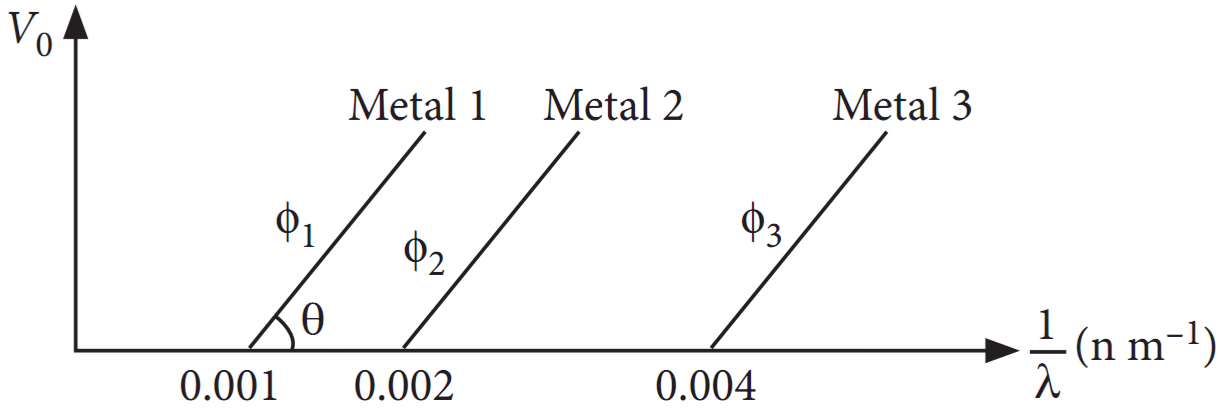
  1. The graph between the stopping potential (V0) and $\Big(\frac{1}{\lambda}\Big)$ is shown in the figure. $\phi_1,\phi_2,\phi_3$ are work function. Which of the following options is correct?

  1. $\phi_1:\phi_2:\phi_3=1:2:3$

  2. $\phi_1:\phi_2:\phi_3=4:2:1$

  3. $\phi_1:\phi_2:\phi_3=1:2:4$

  4. Ultraviolet tight can be used to emit photoelectrons from metal 2 and metal 3 only.
  1. Which of the following figures represent the variation of particle momentum and the associated de-Broglie wavelength?