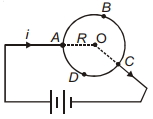
A uniform circular wire loop is connected to the terminals of a battery. The magnetic field induction at the centre due to $A B C$ portion of the wire will be (length of $A B C=l_1$, length of $A D C=l_2$ )
Medium
Download our app for free and get started
(a)
Let current in part $A B C$ is $i_1$ and in part $A D C$ is $i_2$
$i=\frac{i l_2}{l_1+l_2}$ (As $A B C$ and $A D C$ part are in parallel connection) and subtended by $A B C$ at centre $O$ will be $=\left(\frac{2 \pi}{l_1+l_2}\right)\left(l_1\right)$
so using $B=\frac{\mu_0 i}{2 a}\left(\frac{\theta}{2 \pi}\right)$
$B=\frac{\mu_0}{2 R}\left(\frac{i l_2}{l_1+l_2}\right) \frac{2 \pi}{\left(l_1+l_2\right)} \frac{\left(l_1\right)}{2 \pi}$

Download our appand get started for free
Experience the future of education. Simply download our apps or reach out to us for more information. Let's shape the future of learning together!No signup needed.*
Similar Questions
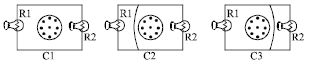
- 1A solenoid is oriented end-on so that its opening is perpendicular to the circuit containing the two light bulbs as drawn in figure $C_1.$ For figure $C_2$ and $C_3,$ a shorting wire of negligible resistance is added as shown. Assume that the magnetic field from the solenoid, shown coming out of the plane of the page, decreases uniformly with time at the same rate for each circuit. Rank the circuits for the brightness of the bulb labeled $R_1$ from brightest to dimmest.View Solution
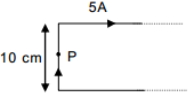
- 2Find force per unit length at $P$.View Solution
- 3A circular coil of $30$ turns and radius $8.0\, cm$ carrying a current of $6.0\, A$ is suspended vertically in a uniform horizontal magnetic field of magnitude $1.0\, T$. The field lines make an angle of $60^o$ with the normal of the coil. Calculate the magnitude of the counter torque that must be applied to prevent the coil from turning.....$Nm$View Solution
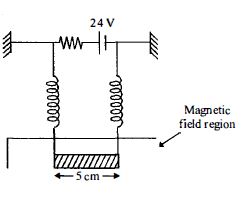
- 4The circuit in figure consists of wires at the top and bottom and identical springs as the left and right sides. The wire at the bottom has a mass of $10\, g$ and is $5\, cm$ long. The wire is hanging as shown in the figure. The springs stretch $0.5\, cm$ under the weight of the wire and the circuit has a total resistance of $12\, \Omega $. When the lower wire is subjected to a static magnetic field, the springs, stretch an additional $0.3\, cm$. The magnetic field isView Solution
- 5View SolutionAssertion: To convert a galvanometer into an ammeter a small resistance is connected in parallel with it.
Reason: The small resistance increases the combined resistance of the combination.
- 6Statement $-1$ : Ampere law can be used to find magnetic field due to finite length of a straight current carrying wire.View Solution
Statement $-2$ : The magnetic field due to finite length of a straight current carrying wire is symmetric about the wire.
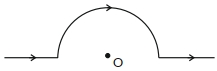
- 7A straight wire carrying a current of $14\,A$ is bent into a semicircular are of radius $2.2\,cm$ as shown in the figure. The magnetic field produced by the current at the centre $(O)$ of the arc. is $.........\,\times 10^{-4}\, T$View Solution
- 8When a resistance of $5\,\Omega$ is shunted with a moving coil galvanometer, it shows a full scale deflection for a current of $250\,mA$, however when $1050\,\Omega$ resistance is connected with it in series, it gives full scale deflection for $25$ volt. The resistance of galvanometer is $......\,\Omega$.View Solution
- 9In an ionised sodium atom, an electron is moving in a circular path of radius $r$ with angular velocity $\omega $. The magnetic induction in $wb/m^2$ produced at the nucleus will beView Solution
- 10What is the magnetic field at a distance $R$ from a coil of radius $r$ carrying current $I$ ?View Solution