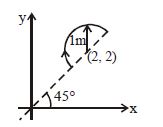
A uniform magnetic field $\vec B = \left( {3\hat i + 4\hat j + \hat k} \right)$ exists in region of space. A semicircular wire of radius $1\,m$ carrying current $1\,A$ having its centre at $(2, 2, 0)$ is placed in $x-y$ plane as shown in figure. The force on semicircular wire will be
Diffcult


Download our appand get started for free
Experience the future of education. Simply download our apps or reach out to us for more information. Let's shape the future of learning together!No signup needed.*
Similar Questions
- 1A metal ring of radius $r = 0.5 \,\,m $ with its plane normal to a uniform magnetic field $B$ of induction $0.2 T$ carries a current $I = 100\,\, A$. The tension in newtons developed in the ring is:View Solution
- 2Two long straight parallel conductors separated by a distance of $0.5\,m$ carry currents of $5\,A$ and $8\,A$ in the same direction. The force per unit length experienced by each other isView Solution
- 3View SolutionIf the radius of a coil is halved and the number of turns doubled, then the magnetic field at the centre of the coil, for the same current will
- 4A particle of mass $m$ and charge $q$ moving with velocity $v$ enters a region of uniform magnetic field $B.$ ThenView Solution
- 5A current of $0.1\, A$ circulates around a coil of $100$ $turns$ and having a radius equal to $5\,cm$. The magnetic field set up at the centre of the coil is ($\mu_0 = 4\pi \times 10^{-7} weber/amp-metre$)View Solution
- 6In the previous question, if the current is $i$ and the magnetic field at $D$ has magnitude $B$,View Solution
- 7Two long and parallel wires are at a distance of $0.1\, m$ and a current of $5\, A$ is flowing in each of these wires. The force per unit length due to these wires will beView Solution
- 8A current of $1\,A$ is flowing on the sides of an equilateral triangle of side $4.5\times10^{-2}\,m$ . The magnetic field at the centre of the triangle will beView Solution
- 9View SolutionA charged particle enters a uniform magnetic field perpendicular to it. The magnetic field
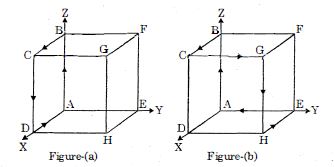
- 10Current $I$ is flowing along the path $ABCDA$ consisting of four edges of a cube (figure $-a$), produces a magnetic field $B_0$ at the centre of the cube. Find the magnetic field $B$ produced at the center of the cube by a current $I$ flowing along the path of the six edges $ABCGHEA$ (figure $b$)View Solution