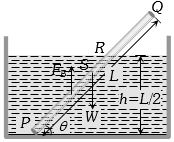
A uniform rod of density $\rho $ is placed in a wide tank containing a liquid of density ${\rho _0}({\rho _0} > \rho )$. The depth of liquid in the tank is half the length of the rod. The rod is in equilibrium, with its lower end resting on the bottom of the tank. In this position the rod makes an angle $\theta $ with the horizontal
Diffcult


Download our appand get started for free
Experience the future of education. Simply download our apps or reach out to us for more information. Let's shape the future of learning together!No signup needed.*
Similar Questions
- 1Equal masses of water and a liquid of density $ 2$ are mixed together, then the mixture has a density of ........ $ g / cm^3$View Solution
- 2An open glass tube is immersed in mercury in such a way that a length of $8\ cm$ extends above the mercury level. The open end of the tube is then closed and sealed and the tube is raised vertically up by additional $46\ cm$. What will be length of the air column above mercury in the tube now ....... $cm$ ?View Solution
( Atmospheric pressure = $76\ cm$ of $Hg$)
- 3An open $U$-tube contains mercury. When $13.6 \,cm$ of water is poured into one of the arms of the tube, then the mercury rise in the other arm from its initial level is ....... $cm$View Solution
- 4Three identical vessels are filled with equal masses of three different liquids $A, B$ and $C$ $({\rho _A} > {\rho _B} > {\rho _C})$. The pressure at the base will beView Solution
- 5View SolutionIncrease in pressure at one point of the enclosed liquid in equilibrium of rest is transmitted equally to all other points of liquid. This is as per ...........
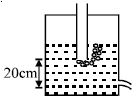
- 6View SolutionA tube is attached as shown in closed vessel containing water. The velocity of water coming out from a small hole is :
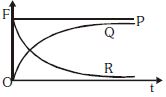
- 7A heavy spherical ball is dropped near surface in a long column of viscous liquid. Which of the following graphs represent the variation ofView Solution
$(i)$ Gravitational force with time
$(ii)$ Viscous force with time
$(iii)$ Net force acting on the ball with time
- 8A small hole of area of cross-section $2\; \mathrm{mm}^{2}$ is present near the bottom of a fully filled open tank of height $2\; \mathrm{m} .$ Taking $\mathrm{g}=10 \;\mathrm{m} / \mathrm{s}^{2},$ the rate of flow of water through the open hole would be nearly ......... $\times 10^{-6} \;m^{3} /s$View Solution
- 9If $W$ be the weight of a body of density $\rho $ in vacuum then its apparent weight in air of density $\sigma $ isView Solution
- 10A small ball of mass $m$ and density $\rho$ is dropped in a viscous liquid of density $\rho_0$. After sometime, the ball falls with constant velocity. The viscous force on the ball is:View Solution