A heavy spherical ball is dropped near surface in a long column of viscous liquid. Which of the following graphs represent the variation of
$(i)$ Gravitational force with time
$(ii)$ Viscous force with time
$(iii)$ Net force acting on the ball with time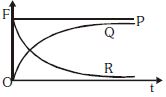
Medium
Download our app for free and get started
Gravitational force remains contant Therefore, $P$ is the correct graph for the gravitational force.
Net force acting on the ball will keep on decrease because the buoyancy force will keep on increasing as the ball achieves more and more depth. So, a time will come when the forces become equal and the ball attains a constant velocity. Therefore, $R$ is the correct graph for the net force acting on the bass with time And finally, viscous force will keep on increasing as the no. of layers of liquid will keep on increasing as the ball moves deeper inside the liquid.

Download our appand get started for free
Experience the future of education. Simply download our apps or reach out to us for more information. Let's shape the future of learning together!No signup needed.*
Similar Questions
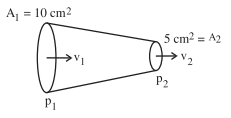
- 1Glycerine of density $1.25 \times 10^3\,kg\,m ^{-3}$ is flowing through the conical section of pipe. The area of cross-section of the pipe at its ends is $10\,cm ^2$ and $5\,cm ^2$ and pressure drop across its length is $3\,Nm ^{-2}$. The rate of flow of glycerine through the pipe is $x \times 10^{-5} m ^3 s ^{-1}$. The value of $x$ is $..............$.View Solution
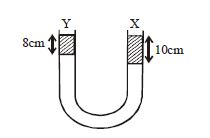
- 2A liquid $X$ of density $3.36\ g/cm^3$ is poured in a $U-$ tube, which contains $Hg$. Another liquid $Y$ is poured in left arm with height $8\ cm$, upper levels of $X$ and $Y$ are same. What is density of $Y$ .......... $g/cc$View Solution
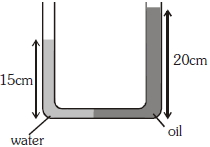
- 3In a $U-$tube as shown in figure, water and oil are in the left side and right side of the tube respectively. The helghts from the bottom for water and oil columns are $15\; \mathrm{cm}$ and $20\; \mathrm{cm}$ respectively. The density of the oil is......$kg/{m}^{3}$View Solution
[take $\rho_{water} \left.=1000 \;\mathrm{kg} / \mathrm{m}^{3}\right]$
- 4View SolutionFigures below show water flowing through a horizontal pipe from left to right. Note that the pipe in the middle is narrower. Choose the most appropriate depiction of water levels in the vertical pipes.
- 5Acylindrical vessel open at the top is $20$ $cm$ high and $10$ $cm$ in diameter.Acircular hole whose cross-sectional area $1$ $cm^2$ is cut at the centre of the bottom of the vessel. Water flows from a tube above it into the vessel at the rate $100$ $cm^3s^{^{-1}}$. The height of water in the vessel under steady state is ....... $cm$ (Take $g=1000 $ $ cms^{^{-2}})$View Solution
- 6A small solid ball is dropped from a height above the free surface of a liquid. It strikes the surface of the liquid at $t = 0$. The density of the material of the ball is $500\ kg/m^3$ and that of liquid is $1000\ kg/m^3$ If the ball comes momeritariiy at rest at $t = 2\ sec$ then initial height of the ball from surface of liquid was ..... $m$ (neglect viscosity)View Solution
- 7A ball of mass $m$ and radius $ r $ is gently released in a viscous liquid. The mass of the liquid displaced by it is $m' $ such that $m > m'$. The terminal velocity is proportional toView Solution
- 8A vertical tank, open at the top, is filled with a liquid and rests on a smooth horizontal surface.$A$ small hole is opened at the centre of one side of the tank. The area of cross-section of the tank is $N$ times the area of the hole, where $N$ is a large number. Neglect mass of the tank itself. The initial acceleration of the tank isView Solution
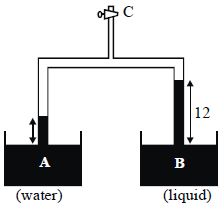
- 9The limbs of a $U$ -tube glass are lowered into vessels $A$ and $B, A$ containing water. Some air is pumped out through the top of the tube $C$. The liquids in the left hand limb $A$ and the right hand limb $B$ rise to heights of $10\, cm$ and $12\, cm$ respectively. The density of liquid $B$ is ........ $g/cm^3$View Solution
- 10Two capillaries of same length and radii in the ratio $1 : 2$ are connected in series. A liquid flows through them in streamlined condition. If the pressure across the two extreme ends of the combination is $ 1 m$ of water, the pressure difference across first capillary is...... $m$View Solution