An open glass tube is immersed in mercury in such a way that a length of $8\ cm$ extends above the mercury level. The open end of the tube is then closed and sealed and the tube is raised vertically up by additional $46\ cm$. What will be length of the air column above mercury in the tube now ....... $cm$ ?
( Atmospheric pressure = $76\ cm$ of $Hg$)
JEE MAIN 2014, Medium
Download our app for free and get started
Length of the air column above mercury in the tube is,
$p + x = {P_0}$
$ \Rightarrow p = \left( {76 - x} \right)$
$ \Rightarrow 8 \times A \times 76 = \left( {76 - x} \right) \times A \times \left( {54 - x} \right)$
$\therefore \,x = 38$
Thus, lenght of air column $=54-38=16\,cm.$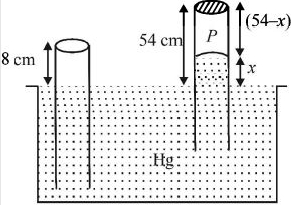

Download our appand get started for free
Experience the future of education. Simply download our apps or reach out to us for more information. Let's shape the future of learning together!No signup needed.*
Similar Questions
- 1There is a $1$ $mm $ thick layer of glycerine between a flat plate of area $100$ $cm^2$ $\&$ a big fixed plate. If the coefficient of viscosity of glycerine is $1.0$ $kg/m^{-s}$ then ....... $N$ force is required to move the plate with a velocity of $7$ $cm/s$ ?View Solution
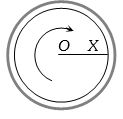
- 2The diagram shows a cup of tea seen from above. The tea has been stirred and is now rotating without turbulence. A graph showing the speed $ v$ with which the liquid is crossing points at a distance $ X$ from $O $ along a radius $XO$ would look likeView Solution
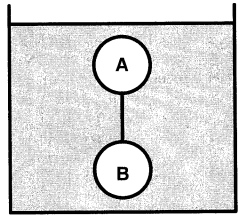
- 3Two solid spheres $A$ and $B$ of equal volumes but of different densities $d_A$ and $d_B$ are connected by a string. They are fully immersed in a fluid of density $d_F$. They get arranged into an equilibrium state as shown in the figure with a tension in the string. The arrangement is possible only ifView Solution
$(A)$ $d_Ad_F$ $(B)$ $d_B > d_F$ $(C)$ $d_A>d_F$ $(D)$ $d_A+d_B=2 d_F$
- 4Water from a tap emerges vertically downwards with an initial speed of $1.0\,ms^{-1}.$ The cross-sectional area of the tap is $10^{-4}\,m^2.$ Assume that the pressure is constant throughout the stream of water and that flow is streamlined. The cross-sectional area of the stream, $0.15\,m$ below the tap would be: (take $g = 10\,ms^{-2}$ )View Solution
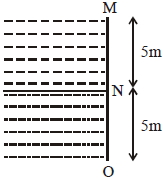
- 5Two liquids of densities $\rho_{1}$ and $\rho_{2}\left(\rho_{2}=2 \rho_{1}\right)$ are filled up behind a square wall of side $10\; \mathrm{m}$ as shown in figure. Each liquid has a height of $5 \;\mathrm{m} .$ The ratio of the forces due to these liquids exerted on upper part $MN$ to that at the lower pait $NO$ is (Assume that the liquids are not mixing)View Solution
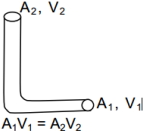
- 6A liquid enter at point $A_{1}$ with speed $3.5 m / s$ and leaves at point $A _{2} .$ Then find out the height attained by the liquid above point $A _{2}$ (in $cm$)View Solution
- 7A submarine has a window of area $30 \times 30 \,cm ^2$ on its ceiling and is at a depth of $100 \,m$ below sea level in a sea. If the pressure inside the submarine is maintained at the sea-level atmosphere pressure, then the force acting on the window is ............. $N$ (consider density of sea water $=1.03 \times 10^3 \,kg / m ^3$, acceleration due to gravity $=10 \,m / s ^2$ )View Solution
- 8A cylindrical vessel filled with water upto height of $H$ stands on a horizontal plane. The side wall of the vessel has a plugged circular hole touching the bottom. The coefficient of friction between the bottom of vessel and plane is $\mu$ and total mass of water plus vessel is $M$. What should be minimum diameter of hole so that the vessel begins to move on the floor if plug is removed (here density of water is $\rho$ )View Solution
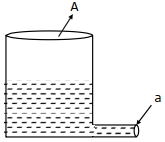
- 9A light cylindrical vessel is kept on a horizontal surface. Area of base is A. A hole of crosssectional area $'a'$ is made just at its bottom side. The minimum coefficient of friction necessary to prevent sliding the vessel due to the impact force of the emerging liquid is $(a\,<\,<\,A)$View Solution
- 10A light semi cylindrical gate of radius $R$ is piovted at its mid point $O$, of the diameter as shown in the figure holding liquid of density $\rho $. The force $F$ required to prevent the rotation of the gate is equal toView Solution