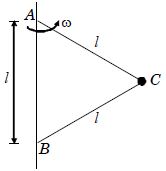
Which one of the following statements is incorrect?
NEET 2018, Easy


Download our appand get started for free
Experience the future of education. Simply download our apps or reach out to us for more information. Let's shape the future of learning together!No signup needed.*
Similar Questions
- 1An isolated rail car originally moving with speed $v_0$ on a straight, frictionles, level track contains a large amount of sand. $A$ release valve on the bottom of the car malfunctions, and sand begins to pour out straight down relative to the rail car. What happens to the speed of the rail car as the sand pours out?View Solution
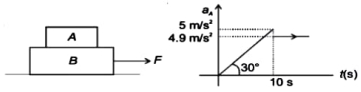
- 2Acceleration of block $A$ varies with time as shown in figure the value of coefficient of kinetic friction between block $A$ and $B$ is the value of coefficient of kinetic friction between block $A$ and $B$ is ..............View Solution
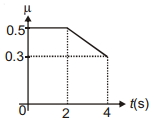
- 3A block is projected with speed $20 \,m / s$ on a rough horizontal surface. The coefficient of friction $(\mu)$ between the surfaces varies with time $(t)$ as shown in figure. The speed of body at the end of $4$ second will be ............ $m / s$ ( $g=$ $10 \,m / s ^2$ )View Solution
- 4A body of mass $4\, kg$ is at rest on a horizontal table. The coefficient of friction between the body and the table is $0.2$ . A horizontal force of $6N$ is applied on the body. The acceleration of the body is .......... $m/s^2$View Solution
- 5A car is moving on a circular path and takes a turn. If ${R_1}$ and ${R_2}$ be the reactions on the inner and outer wheels respectively, thenView Solution
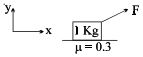
- 6A $\vec F\,\, = \,\,\hat i\, + \,4\hat j\,$ acts on block shown. The force of friction acting on the block is :View Solution
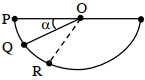
- 7A ball is released from rest from point $P$ of a smooth semi-spherical vessel as shown in figure. The ratio of the centripetal force and normal reaction on the ball at point $Q$ is $A$ while angular position of point $Q$ is $\alpha$ with respect to point $P$. Which of the following graphs represent the correct relation between $A$ and $\alpha$ when ball goes from $Q$ to $R$ ?View Solution
- 8A box is lying on an inclined plane what is the coefficient of static friction if the box starts sliding when an angle of inclination is $60^o $View Solution
- 9View SolutionA car when passes through a convex bridge exerts a force on it which is equal to
- 10As shown in the figure, two strings of length $l$ each are attached with a vertical axis $AB$ of length $l$. Strings are $AC$ and $BC$. At point $C$ a point mass m is attached. Mass rotates about axis with angular velocity. Tensions in $AB$ and $BC$ are $T_1$ and $T_2$ respectively. Choose the $CORRECT$ alternative :-View Solution