A very high magnetic field is applied to a stationary charge. Then the charge experiences
Easy


Download our appand get started for free
Experience the future of education. Simply download our apps or reach out to us for more information. Let's shape the future of learning together!No signup needed.*
Similar Questions
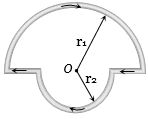
- 1In the figure shown there are two semicircles of radii ${r_1}$ and ${r_2}$ in which a current $i$ is flowing. The magnetic induction at the centre $O$ will beView Solution
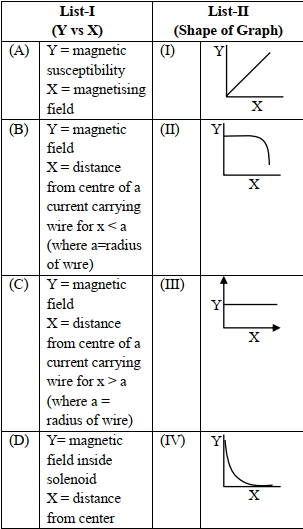
- 2Match List-$I$ with List-$II$View Solution
Choose the correct answer from the options given below :
- 3An electron is moving with a speed of ${10^8}\,m/\sec $ perpendicular to a uniform magnetic field of intensity $B$. Suddenly intensity of the magnetic field is reduced to $B/2$. The radius of the path becomes from the original value of $r$View Solution
- 4A charge $Q$ is uniformly distributed over the surface of nonconducting disc of radius $R$. The disc rotates about an axis perpendicular to its plane and passing through its centre with an angular velocity $\omega$. As a result of this rotation a magnetic field ofinduction $B$ is obtained at the centre of the disc. If we keep both the amount of charge placed on the disc and its angular velocity to be constant and vary the radius of the disc then the variation of the magnetic induction at the centre of the disc will be represented by the figureView Solution
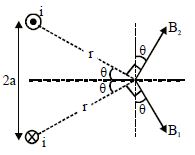
- 5Two parallel wires situated at a distance $2a$ are carrying equal currents $‘i’$ in opposite direction as shown in figure. The value of magnetic filed at a point $P$ situated at equal distances from both the wires will beView Solution
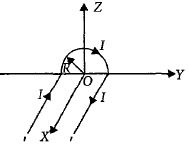
- 6A wire carrying current $I$ has the shape as shown in adjoining figure.Linear parts of the wire are very long and parallel to $X-$axis while semicircular portion of radius $R$ is lying in $Y-Z$ plane. Magnetic field at point $O$ isView Solution
- 7A long solenoid carrying a current produces a magnetic field $B$ along its axis. If the current is doubled and the number of turns per cm is halved, the new value of the magnetic field isView Solution
- 8Five very long, straight wires are bound together to form a small cable. Currents carried by the wires are ${I_1} = 20\,A,$ ${I_2} = - \,6\,A,$ ${I_3} = 12\,A,\,{I_4} = - 7\,A,\,{I_5} = 18\,A.$ The magnetic induction at a distance of $10\, cm$ from the cable isView Solution
- 9A small coil of $N$ $turns$ has an effective area $A$ and carries a current $I$. It is suspended in a horizontal magnetic field $\overrightarrow B $ such that its plane is perpendicular to $\overrightarrow B $. The work done in rotating it by $180^\circ $ about the vertical axis isView Solution
- 10View SolutionThe resistance of an ideal voltmeter is