Question
A wheel rotating with uniform angular acceleration covers 50 revolutions in the first five seconds after the start. Find the angular acceleration and the angular velocity at the end of five seconds.

Answer

$\theta=100\pi;\ \text{t}=5\text{sec}$$\theta=\frac{1}{2}\alpha\text{t}^2$
$\Rightarrow100\pi=\frac{1}2{}\alpha25$
$\Rightarrow\alpha=8\pi\times5=40\pi\text{rad/s}=20\text{rev/s}$
$\therefore\alpha=8\pi\text{rad/s}^2=4\text{rev/s}^2$
$\omega=40\pi\text{rad/s}^2=20\text{rev/s}^2$

Need a full question paper?

Generate a complete, print-ready paper with questions like this in minutes — across 16+ boards, with answer keys.

Start Generating Free

Similar questions

A circular loop of radius $20\ cm$ carries a current of $10A$. An electron crosses the plane of the loop with a speed of $2.0 \times 10^6m/s$. The direction of motion makes an angle of $30^\circ$ with the axis of the circle and passes through its centre. Find the magnitude of the magnetic force on the electron at the instant it crosses the plane.
Figure. shows a cylindrical tube with adiabatic walls and fitted with a diathermic separator. The separator can be slid in the tube by an external mechanism. An ideal gas is injected into the two sides at equal pressures and equal temperatures. The separator remains in equilibrium at the middle. It is now slid to a position where it divides the tube in the ratio of 1 : 3. Find the ratio of the pressures in the two parts of the vessel.
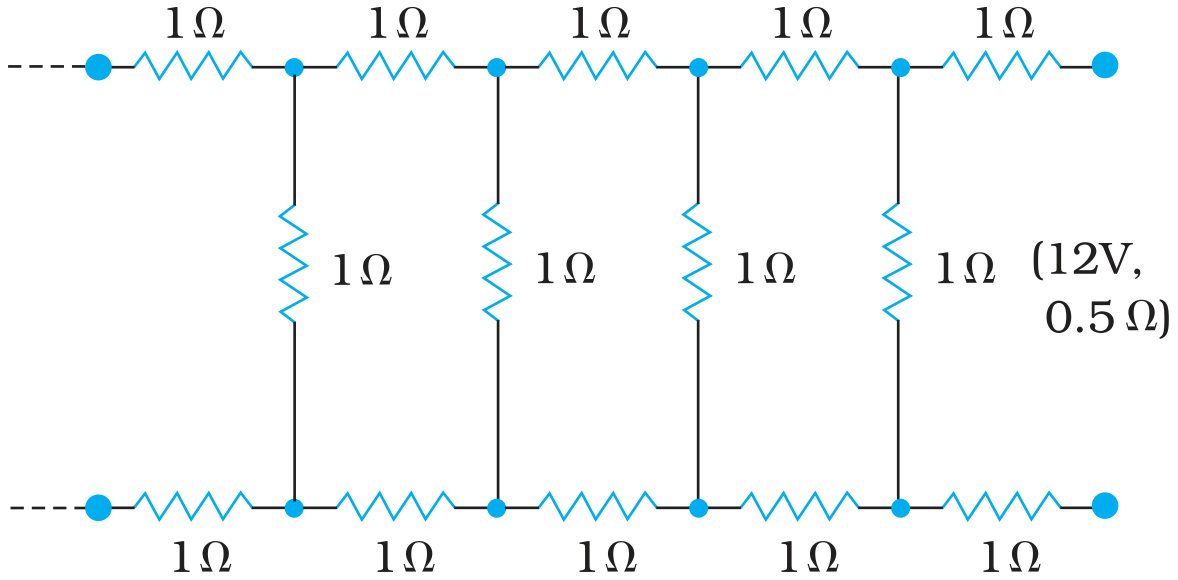
Determine the current drawn from a 12 V supply with internal resistance $0.5\ \Omega$ by the infinite network shown in Fig. Each resistor has $1\ \Omega$ resistance.
We have valence electrons and conduction electrons in a semiconductor. Do we also have 'valence holes' and 'conduction holes'?
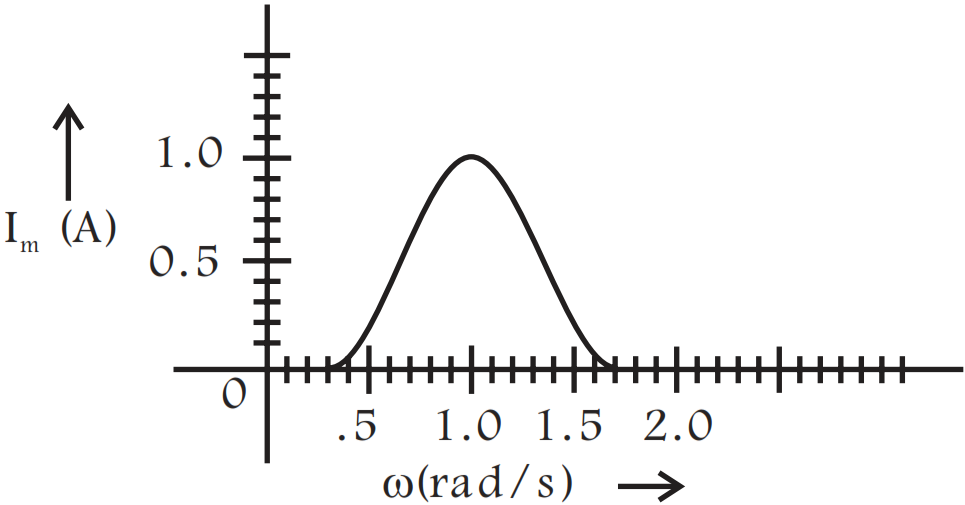
In series $\text{LCR}$ circuit, the plot of $I_{max}$ vs $\omega$ is shown in Fig. Find the bandwidth and mark in the figure.
Write Faraday's laws of electromagnetic induction.
  1. Draw a ray diagram depicting the formation of the image by an astronomical telescope in normal adjustment.
  2. You are given the following three lenses. Which two lenses will you use as an eyepiece and as an objective to construct an astronomical telescope? Give reason.
Lenses Power $(D)$ Aperture $(cm)$
$L_1$ $3$ $8$
$L_2$ $6$ $1$
$L_3$ $10$ $1$
An electron and alpha particle have the same kinetic energy. How are the de Broglie wavelengths associated with them related?
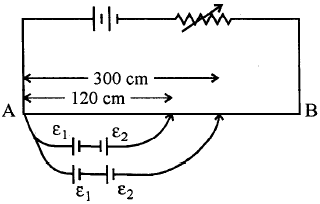
In the figure a long uniform potentiometer wire $AB$ is having a constant potential gradient along its length. The null points for the two primary cells of emfs $\varepsilon_{1}$ and $\varepsilon_{2}$
connected in the manner shown are obtained at a distance of $120 \ cm $ and $300 \ cm$ from the end $A$.
Find $(i) \varepsilon_{1} / \varepsilon_{2}$ and $(ii)$ position of null point for the cell $\varepsilon_{1}$. How is the sensitivity of a potentiometer increased?
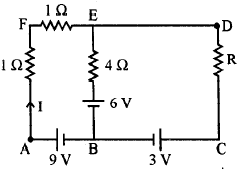
Using Kirchoffs rules determine the value of unknown resistance $R$ in the circuit so that no current flows through 4 $\Omega$ resistance. Also find the potential difference between $A$ and $D.$
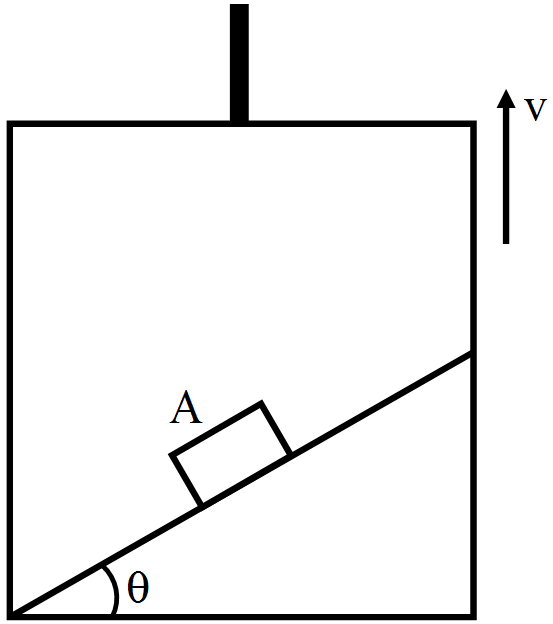
A block A can slide on a frictionless incline of angle $\theta$ and length l, kept inside an elevator going up with uniform velocity v. Find the time taken by the block to slide down the length of the incline if it is released from the top of the incline.