Question
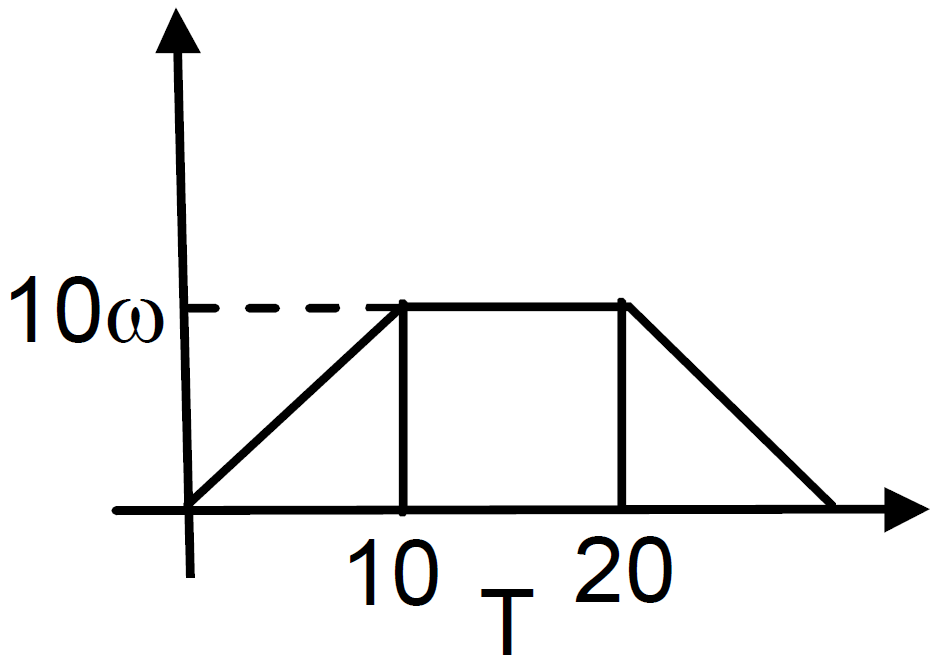
A wheel starting from rest is uniformly accelerated at $4 \text{ rad/-s}^2$ for $10$ seconds.It is allowed to rotate uniformly for the next $10$ seconds and is finally brought to rest in the next $10$ seconds. Find the total angle rotated by the wheel.
Answer

Area under the curve will decide the total angle rotated
$\therefore$ Maximum angular velocity $= 4 \times 10 = 40 \text{ rad/-s}$
Therefore, area under the curve $=\frac{1}2{}\times10\times40+40\times10+\frac{1}{2}\times40\times10$
$=800\text{ rad}$
$\therefore$ Total angle rotated $= 800\ \text{ rad}.$
​​​​​​​

Need a full question paper?

Generate a complete, print-ready paper with questions like this in minutes — across 16+ boards, with answer keys.

Start Generating Free

Similar questions

A hydrogen atom emits ultraviolet radiation of wavelength 102.5nm. What are the quantum numbers of the states involved in the transition?
Explain the quantisation of angular momentum for an electron orbiting a nucleus.
Write second postulate of Bohr's model and De-Broglie's explanation of it.
A circular ring of radius r made of a nonconducting material is placed with its axis parallel to a uniform electric field. The ring is rotated about a diameter through $180^\circ$ . Does the flux of electric field change? If yes, does it decrease or increase?
Define radioactivity.
Two primary cells of emfs wire $\varepsilon_1$ and $\varepsilon_2(\varepsilon_1>\varepsilon_2)$ are connected to a potentiometer wire AB as shown in fig. If the balancing lengths for the two combinations of the cells are 250cm and 400cm, find the ratio of $\varepsilon_1$ and $\varepsilon_2.$
Why is the mass of a nucleus always less than the sum of the masses of its constituents, neutrons and protons?If the total number of neutrons and protons in a nuclear reaction is conserved, how then is the energy absorbed or evolved in the reaction? Explain.
Write Einstein's photoelectric equation in terms of the stopping potential and the threshold frequency for a given photosensitive material. Draw a plot showing the variation of stopping potential $vs$. the frequency of incident radiation.
What is the advantage of using thick metallic strips to join wires in a potentiometer?
A $p-n$ photodiode is fabricated from a semiconductor with band gap of $2.8\ eV$. Can it detect a wavelength of $6000\ nm$?
Find the moment of inertia of a uniform square plate of mass m and edge a about one of its diagonals.