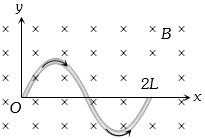
A wire carrying a current $i$ is placed in a uniform magnetic field in the form of the curve $y = a\sin \,\left( {\frac{{\pi x}}{L}} \right)\,0 \le x \le 2L.$ The force acting on the wire is
Easy
Download our app for free and get started
(c) The given portion of the curved wire may be treated as a straight wire of length $2L$ which experiences a magnetic force ${F_m} = Bi(2L)$

Download our appand get started for free
Experience the future of education. Simply download our apps or reach out to us for more information. Let's shape the future of learning together!No signup needed.*
Similar Questions
- 1A wire carrying current $I$ and other carrying $2I$ in the same direction produces a magnetic field $B$ at the mid point. What will be the field when $2I$ wire is switched offView Solution
- 2View SolutionIn a cyclotron, a charged particle
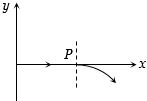
- 3For a positively charged particle moving in a $x-y$ plane initially along the $x$-axis, there is a sudden change in its path due to the presence of electric and/or magnetic fields beyond $P$. The curved path is shown in the $x-y$ plane and is found to be non-circular. Which one of the following combinations is possibleView Solution
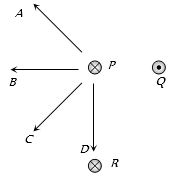
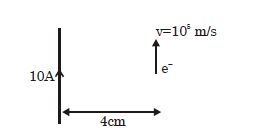
- 4An $e^-$ is moving parallel to a long current carrying wire as shown. Force on electron isView Solution
- 5The resistance of a galvanometer is $25\, ohm$ and it requires $50\,\mu A$ for full deflection. The value of the shunt resistance required to convert it into an ammeter of $5\, amp$ isView Solution
- 6A current of $1.5\, {A}$ is flowing through a triangle, of side $9\, {cm}$ each. The magnetic field at the centroid of the triangle isView Solution
(Assume that the current is flowing in the clockwise direction.)
- 7One of the two identical conducing wires of length $L$ is bent in the form of a circular loop and the other one into a circular coil of $N$ identical turns. If the same current is passed in both, the ratio of the magnetic field at the central of the loop $(B_L)$ to that at the centre of the coil $(B_C),$; $.\,\frac {B_L}{B_C}$ will beView Solution
- 8An arbitrary shaped closed coil is made of a wire of length $L$ and a current $I$ ampere is flowing in it. If the plane of the coil is perpendicular to magnetic field $\mathop B\limits^ \to $, the force on the coil isView Solution
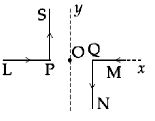
- 9As shown in the figure, two infinitely long, identical wires are bent by $90^o$ and placed in such a way that the segments $LP$ and $QM$ are along the $x-$ axis, while segments $PS$ and $QN$ are parallel to the $y-$ axis. If $OP = OQ = 4\, cm$, and the magnitude of the magnetic field at $O$ is $10^{-4}\, T$, and the two wires carry equal current (see figure), the magnitude of the current in each wire and the direction of the magnetic field at $O$ will be $(\mu_ 0 = 4\pi \times10^{-7}\, NA^{-2})$View Solution
- 10In figure shows three long straight wires $P, Q$ and $R$ carrying currents normal to the plane of the paper. All three currents have the same magnitude. Which arrow best shows the direction of the resultant force on the wire $P$View Solution