A wire of radius $r$ has resistance $R$. If it is stretched to a radius of $\frac{{3r}}{4}$, its resistance becomes
Medium


Download our appand get started for free
Experience the future of education. Simply download our apps or reach out to us for more information. Let's shape the future of learning together!No signup needed.*
Similar Questions
- 1Infinite number of cells having $emf$ and internal resistance $\left( {E,r} \right)$, $\left( {\frac{E}{n},\frac{r}{n}} \right)$, $\left( {\frac{E}{{{n^2}}},\frac{r}{{{n^2}}}} \right)$, $\left( {\frac{E}{{{n^3}}},\frac{r}{{{n^3}}}} \right)$..... are connected in series in same manner across an external resistance of $\frac{{nr}}{{n + 1}}$ . Current flowing through the external resistor isView Solution
- 2An electron (charge $= 1.6 × 10^{-19}$ coulomb) is moving in a circle of radius $5.1 × 10^{-11}\,m$ at a frequency of $6.8 × 10^{15} $ revolutions/sec. The equivalent current is approximatelyView Solution
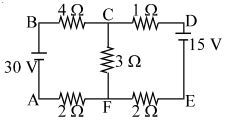
- 3View SolutionThe figure shows a network of five resistances and two batteries Which of the batteries is getting charged.
- 4A $200\,\Omega $ resistor has a certain color code. If one replaces the red color by green in the code, the new resistance will be .............. $\Omega$View Solution
- 5A $25\, W$, $ 220\, V$ bulb and a $100\, W$, $220\, V$ bulb are connected in parallel across a $440\, V$ lineView Solution
- 6With a potentiometer null point were obtained at $140\, cm$ and $180\, cm$ with cells of $emf$ $1.1 \,V$ and one unknown $X\, volts$. Unknown $emf$ is .............. $V$View Solution
- 7A potentiometer is used for the comparison of $e.m.f.$ of two cells ${E_1}$ and ${E_2}$. For cell ${E_1}$ the no deflection point is obtained at $20\,cm$ and for ${E_2}$ the no deflection point is obtained at $30\,cm$. The ratio of their $e.m.f.$'s will beView Solution
- 8View SolutionElectroplating does not help in
- 9A wire of length $L$ and $3$ identical cells of negligible internal resistances are connected in series. Due to current, the temperature of the wire is raised by $\Delta T$ in a time $t$. A number $N$ of similar cells is now connected in series with a wire of the same material and cross-section but of length $2\, L$. The temperature of the wire is raised by the same amount $\Delta T$ in the same time $t$. the value of $N$ isView Solution
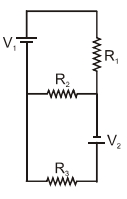
- 10Two ideal batteries of emf $V _1$ and $V _2$ and three resistances $R _1, R _2$ and $R _3$ are connected as shown in the figure.View Solution
The current in resistance $R _2$ would be zero if
$(A)$ $V_1=V_2$ and $R_1=R_2=R_3$
$(B)$ $V_1=V_2$ and $R_1=2 R_2=R_3$
$(C)$ $V_1=2 V_2$ and $2 R_1=2 R_2=R_3$
$(D)$ $2 V _1= V _2$ and $2 R _1= R _2= R _3$