Question
A1. Simple Factual Activities:
Make a list of the problems that we are facing and creating violence against children -

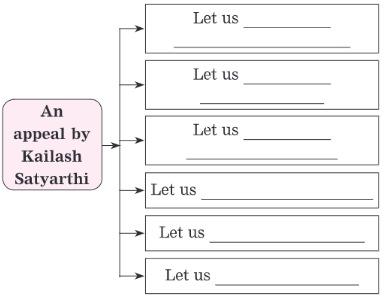
     I call upon all the governments, intergovernmental agencies, businesses, faith leaders, workers, teachers and NGOs, and each one of us, to put an end to all forms of violence against children. Slavery, trafficking, child marriages, child labour, sexual abuse, and illiteracy these things have no place in any civilised society.
     Friends, we can do this. Governments must make child - friendly policies, and invest in education and young people. Businesses must be more responsible, accountable and open to innovative partnerships.Intergovernmental agencies must work together to accelerate action. Global civil society must rise above the business-as-usual and fragmented agendas. Faith leaders and institutions, and all of us must stand with our children.
     We must be bold, we must be ambitious, and we must have the will. We must keep our promises. Over fifty years ago, on the first day of my school, I met a cobbler boy, my age sitting outside the gate of my school. I asked my teachers: “Why is he working outside? Why is he not with us in the school?” My teachers had no answer. One day, I
gathered the courage to ask the boys’ father. He said: “Sir, I have never thought about it. We are born to work.”
     His answer made me angry. It still makes me angry.

A2. Complex Factual Activities:
Complete the following sentences :
(1) Government should make _______________.
(2) _______________ and _______________ must stand with our children.
A3. Activities based on Vocabulary:
Find out the describing words used for the following noun and make your own sentences by using any combination:
(1) _______________ agencies
(2) _______________ partnership
A4. Activities based on Contextual Grammar:
Rewrite as indirect speech:
(1) I asked my teachers, "Why is he working outside? Why is he not with us in the school?"
(2) The boy's father said to the writer, "I have never thought about it. We are born to work."
A5. Personal Response:
(1) Why should the government invest in education and young people?
Answer

A1. Simple Factual Activities:
(1) slavery  (2) trafficking  (3) child marriage
(4) child labour  (5) sexual abuse  (6) illiteracy
A2. Complex Factual Activities:
(1) Government should make child-friendly policies and invest in education and young people.
(2) Faith leaders, institutions and all of us must stand with our children.
A3. Activities based on Vocabulary:
(1) intergovernmental agencies
(2) innovative partnership
Sentence: In a developing country like India, intergovernmental agencies play important role in the process of development.
A4. Activities based on Contextual Grammar:
(1) I asked my teacher why he was working outside and why he was not with them in the school.
(2) The boy's father told the writer that he had never thought about it. He further told him that they were born to work.
A5. Personal Response:
(1) Education is the systematic process of gaining knowledge and skills. It has positive impact on our life. It also promotes national interest. It is the backbone of developing countries. If the governinent invests in education and young people, they help the nation to develop as they are called real nation builders and future of the country so the government should invest in education and young people.

Need a full question paper?

Generate a complete, print-ready paper with questions like this in minutes — across 16+ boards, with answer keys.

Start Generating Free

Similar questions

A1. Simple Factual Activities:
State whether you Agree or Disagree with the following statements: 
(1) 'There is always an opening even in impossible things' - we learn it from small bits of grass. 
(2) Our difficult time never changes.
(3) The team work and perseverance of the ants were impressive.
(4) Clouds take new shapes with every passing moment.

     We saw small bits of grass peeping through the small cracks in a concrete pavement. It left us thinking : however impossible things may look, there is always an opening...
     We saw a tree bare of all leaves in the cold winter months. We thought its chapter was over. But three months passed, spring set in and the tree was back to its green majesty once again, full of leaves, flowers, birds and life. What if we too had the conviction that, however difficult things are right now, it will not remain so for ever. Remember, this too shall pass.
     We saw an army of ants lugging a fly which was at least ten times the ant’s size. The ants organized themselves around the fly, lifted it on frail feelers and carried it to quite a distance. Their teamwork and perseverance were impressive. What if we too are consistent, organized, focused...Spider webs are delicate, yet very strong. A rainbow colours the entire sky. Oysters take in a grain of sand they open up with a pearl. Innumerable stars shine across the infinite sky. Clouds take new shapes with every passing moment. The wind makes trees dance with unhindered passion. Water, without hint of ego, changes its form according to the dictates of the sun and the wind. When we see a caterpillar turn into a butterfly, a flower turn into a fruit, we experience the alchemy of nature... we touch it and become gold ourselves.

A2. Complex Factual Activities:
(1) What are the alchemies of nature mentioned in the extract? 
A3. Activities based on Vocabulary:
Frame meaningful sentences by using the given words:
(1) impressive
(2) passion
A4. Activities based on Contextual Grammar:
Identify the tenses:
(1) It will not remain so forever
(2) Ants were lugging a fly.
A5. Personal Response:
(1) Impossible itself says 'I M possible'. Do you agree? Justify your answer by citing some examples from the text and some that you have experienced or heard from someone.
A1. Simple Factual Activities:
State whether the following statements are True or False:
(1) Bishamber was a young bridegroom. 
(2) Ramlal had never dreamt that his fourth daughter Bholi would have such a grand wedding.
(3) When Bholi was brought near the sacred fire she was in a red silken bridal dress.
(4) Bholi felt herself lucky to get a well-to-do bridegroom like Bishamber.

    Thus the years passed.
    The village became a small town. The little primary school became high school. There were now a cinema under a tin shed and a cotton ginning mill. The mail train began to stop at their railway station.
     One night, after dinner, Ramlal said to his wife, “Then, shall I accept Bishamber’s proposal?”
    “Yes, certainly” his wife said. “Bholi will be lucky to get such a well to do bridegroom. A big shop, a house of his own and I hear several thousands in the bank. Moreover, he is not asking for any dowry”.
    “That’s right, but he is not so young, you know -almost the same age as I am- and he also limps. Moreover, the children from his first wife are quite grown up”.
    “So what does it matter ?” his wife replied. “Forty five or fifty-it is no great age for a man. We are lucky that he is from another village and does not know about her pockmarks and her lack of sense. If we don’t accept this proposal, she may remain
unmarried all her life.”
    “Yes, but I wonder what Bholi will say”.
    “What will that witless one say ? She is like a dumb cow.”
    “May be you are right”, muttered Ramlal. In the other corner of the courtyard, Bholi lay awake on her cot, and listened to her parents’ whispered conversation.
     Bishamber Nath was a well - to - do grocer. He came with a big party of friends and relations with him for the wedding. A brass band playing a popular tune from an Indian film headed the procession, with the bridegroom riding a decorated horse. Ramlal was
overjoyed to see such pomp and splendour. He had never dreamt that his fourth daughter would have such a grand wedding. Bholi’s elder sisters who had come for the occasion were envious of her luck.
     When the auspicious moment came the priest said, “Bring the bride”. Bholi, clad in a red silken bridal dress, was led to bride’s place near the sacred fire.
    “Garland the bride,” one of his friends prompted Bishamber Nath.

A2. Complex Factual Activities:
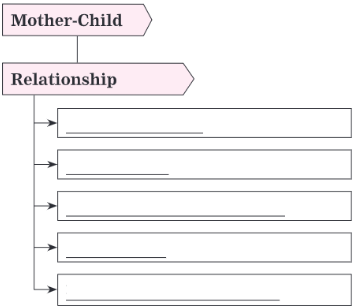
Complete the following web :
Image
A3. Activities based on Vocabulary:
Complete the following sentences using the words given in the brackets:
(envious, procession, overjoyed)
(1) Most of the youngsters like to dance in marriage _______________.
(2) He was _______________ to see his friend after a long time.
A4. Activities based on Contextual Grammar:
Change the following sentences in indirect speech:
(1) "What will that witless one say? She is like a dumb cow". "May be you are right," muttered Ramlal.
(2) "Yes, certainly," his wife said, "Bholi will be lucky to get such a well-to-do bridegroom."
A5. Personal Response:
(1) What is your opinion about Bholi's bridegroom? Should she get married to him?
A1. Simple Factual Activities:
Complete the following sentences using the information given in the passage:
(1) The langur baby was listless and _______________.
(2) The writer's parents and sisters had come out on the veranda and _______________.

    The changed circumstances and the sudden unexpected attack from unknown quarters forced the langur to drop the baby from the sloping roof over the veranda. The baby was listless and appeared to be dead. As its body started to slide down, the excitement of the pack of dogs grew manifold at the prospect of a good kill and meal. Keeping the dogs at bay with the stick, I managed to catch hold of the baby langur’s tail just as it tipped over the edge of the tiled roof. The baby appeared inert and lifeless. It was indeed a male baby.
   By this time, my parents and sisters had come out on to the veranda and were witnessing my rescue operation. Some of our neighbours had also gathered in the distance.
    I took the baby langur to our backyard and gently laid him on the floor inside the poultry coop. His body was full of deep bite marks and scratches. Blood was oozing from some of the wounds. The baby remained motionless. My father provided first aid to clean the wounds and stop the bleeding. I was relieved to find out that the baby was breathing, even though his breaths were shallow.
   Splashes of cold water made the baby stir and after a few shaky attempts, he sat up. He was in state of shock and started trembling like a leaf in the wind. His two little twinkling eyes welled up with tears and he started to sob with a muffled cry - just like a human child would after experiencing trauma. I offered him a peeled banana which he
accepted with his unsteady hand and began taking hesitant bites.

A2. Complex Factual Activities:
Complete the following web and describe the condition of wounded baby langur:
 Image
A3. Activities based on Vocabulary:
Match the words in column 'A' with their meanings in column 'B':

 Column 'A'Column 'B'
 (1) shaky (a) rose to the surface
 (2) welled up (b) made the sound quieter
 (3) prospect (c) unsteady
 (4) muffled (d) future benefit

A4. Activities based on Contextual Grammar:
(1) He was in a state of shock. (Past Perfect Tense.)
(2) I took the baby langur to our backyard. (Past Perfect Tense.)
A5. Personal Response:
(1) Complete the following :"
Image

A1. Simple Factual Activity:
Complete the sentences with the help of the information in the passage:
(1) For reducing weight, exercise, diet and stress- free thoughts should be _______________.
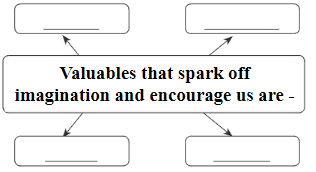
(2) Vision, wishes, intentions and dreams spark off imagination and encourage us _______________.

    Time-bound: Establish time parameters around each goal, as it will help increase focus and accountability. To reduce weight we know how to go about it. But without consistent time - bound action, it never becomes a reality. It may be exercise, diet and stress-free thoughts. All these have to be practised and implemented without hesitation, doubt or indifference, but within a deadline.
    Visions, wishes, intentions and dreams are all valuable. They spark off imagination and encourage us to define where we want to reach. In order to get there, however, we need to bring life images, down to earth and plan to execute our strategies. The quality and quantity of energy we put forth, directly impact the results. Life is something like a trumpet. If we don’t put anything in, we can’t get anything out.
     Success is a walk in the dark. Finding the right footing, precisely mastering the skills and getting to the next place, all depend on how we approach and
tackle the problem. The best way to get from where we are, to where we want to be is to find the footing of our next step. When we take the next step, it should support and hold us without a crack.

A2. Complex Factual Activity:

Complete the web: 
Image
A3. Activities based on Vocabulary:
Write antonyms for the following words :
(1) wrong ×
(2) decrease × 
(3) discourage × 
(4) light × 
A4. Activities based on Contextual Grammar:
(1) Establish time parameters around each goal. (Rewrite the sentence beginning with 'Let' and change the sentence into passive voice.)
(2) If we don't put anything in, we can't get anything out. (Rewrite the sentence using 'unless' in the beginning.)
A5. Personal Response:
(1) Write any four qualities of a successful person.
A1. Simple Factual Activities:
Name the following: 
(1) Original name of Madame Curie.
(2) Her place of birth.

     The history of men’s progress from the darkness of ignorance to the glorious light of knowledge and enlightenment is full of chapters that tell of extraordinary men and women. These men and women worked with great courage, commitment, dedication and singleness of purpose in their effort to attain what seemed to be unattainable. These men and women were driven in their effort to uncover the truth and mystery of the universe with an indomitable spirit which characterises the human spirit. And this is the spirit that drove Columbus and Vasco de Gama to sail to the unknown seas, Robert Peary to race to the Pole, Sir Ronald Ross to fight against malaria, Hillary and Tenzing to reach the top of Everest, and Armstrong and his team to go to the moon. 
     One great woman who dedicated her life to the cause of science and to the welfare of humanity is Madame Curie, the discoverer of radium. The mere statement that Madame Curie discovered the radium will never tell the true story of the extraordinary courage, determination and singleness of purpose that this noble woman showed in the face of extreme poverty, pain and suffering that comes along with such condition.
     Born Maria Sklodowska in Warsaw, Poland on November, 7 1867, Marie Curie’s childhood dream was to study science in Paris, but her father could not afford the expense for this. So Maria took a job as a governess and saved a little money. With that little money she finally went to Sorbonne, the University of Paris, to study science. Her father could send her only a small amount and her life in the university was a disheartening experience in poverty and hunger. She lived only on bread, butter and tea, and she often fainted for lack of food. In spite of all this she pursued her studies indomitably and she topped her class with Honours in Physics and Mathematics.
     It was at the university that she met a Frenchman, Pierre Curie, a brilliant but poor scientist. Then they together began to work in a shabby laboratory. Soon, their friendship turned into love and in less than a year, in July, 1895, they were married. The couple then took a flat in Paris with scarcely any furniture in it except their books, a lamp, a white wooden table and two chairs.
      After the birth of a daughter, Irene, the next year, Marie and Pierre set up a laboratory in a wooden shed near their flat, It had a leaky skylight and an earthen floor. Here Marie, after her daily household work, settled down to study.

A2. Complex Factual Activities:
Complete the following sentences: 
(1) Madame Curie dedicated her life to the cause _______________ and to the _______________.
(2) The qualities that great achievers possess are _______________ and _______________.
A3. Activities based on Vocabulary:
Find out the words from the passage which mean:
(1) unbeatable
(2) discouraging
(3) hardly
(4) illiteracy
A4. Activities based on Contextual Grammar:
(1) took a job as a governess and saved a little money. (Rewrite using 'by' + ing.)
(2) Marie Curie's childhood dream was to study science in Paris, but her father could not afford the expense for this. (Rewrite using "Though')
A5. Personal Response:
(1) Describe your favourite scientist.
A1. Simple Factual Activities:
Put ✔ or ✘ in front of the following sentences :
(1) Bholi was the beloved daughter of Ramlal.
(2) Bholi used to wear old dresses of her sisters.
(3) Bholi was happy to see so many girls of her age in the school.
(4) All the girls in the school were laughing at Bholi.

     The next day Ramlal caught Bholi by the hand and said. ‘‘Come with me. I will take you to school.’’ Bholi was frightened. She did not know what a school was like. She remembered how a few days ago their old cow. Lakshmi had been turned out of
the house and sold.
     ‘‘N-n-n-n No. no-no-no’’ she shouted in terror and pulled her hand away from her father’s grip.
     ‘‘What’s the matter with you, you fool?’’ shouted Ramlal, ‘‘I am only taking you to school.’’ Then he told his wife. ‘‘Let her wear some decent clothes today. Or else what will the teachers and the other schoolgirls think of us when they see her?’’
      New clothes had never been made for Bholi. The old dresses of her sisters were passed on to her. No one cared to mend or wash her clothes. But today she was lucky to receive a clean dress which had shrunk after many washing and no longer fitted
Champa. She was even bathed and oil was rubbed into her dry and matted hair. Only then did she begin to believe that she was being taken to a place better than her home!
      When they reached the school, the children were already in their classrooms. Ramlal handed over his daughter to the headmistress. Left alone, the poor girl looked about her with fear laden eyes. There were several rooms. And in each room girls like her squatted on mats, reading from books or writing on slates. The headmistress asked        Bholi to sit down in a corner in one of the classrooms. Bholi did not know what exactly a school was like and what happened there. But she was glad to find so many girls almost of her own age present there. She hoped that one of these girls might become her friend.
      The lady teacher who was in the class was saying something to the girls but Bholi could understand nothing. She looked at the pictures on the wall. The colours fascinated her. The horse was brown just like the horse on which the Tehsildar had come to visit their village : the goat was black like the goat of their neighbour: the parrot was green like the parrots she had seen in the mango orchard : and the cow was just like their Lakshmi. And suddenly Bholi noticed that the teacher was standing by her
side, smiling at her.
      “What’s your name. little one?’’
      ‘‘Bh-Bho-Bho.’’ She could stammer no further than that.
       Then she began to cry and tears flowed from her eyes in a helpless flood. She kept her head down as she sat in her corner, not daring to look up at the girls who, she knew were still laughing at her.

A2. Complex Factual Activities:
(1) How did Bholi's parents change her appearance? 
A3. Activities based on Vocabulary:
Find out synonyms for the following:
(1) attracted
(2) repair
A4. Activities based on Contextual Grammar:
(1) Rewrite as an exclamatory sentence:
The child was very fair and pretty.
(2) Correct the error in the following sentence. Focus on verbs and subject:
New clothes was never made for Bholi.
A5. Personal Response:
(1) "If girls go to school, who will marry them?"-Why, do you think, that Bholi's mother thought so?
A1. Simple Factual Activity:
Fill in the blanks and complete the sentences:
(1) The number of World Heritage Sites in 2009 were _______________.
(2) _______________ of the World Heritage Sites are considered mixed.

    TYPES OF WORLD HERITAGE SITES
    As of 2009, there are 890 World Heritage Sites that are located in 148 countries (map). 689 of these sites are cultural and include places like the Sydney Opera House in Australia and the Historic Center of Vienna in Austria. 176 are natural and feature such locations as the U.S.'s Yellowstone and Grand Canyon National Parks. 25 of the World Heritage Sites are considered mixed i.e. natural and cultural Peru's Machu Picchu is one of these. Italy has the highest number of World Heritage Sites with 44.
     India has 36 (28 cultural, 7 natural and 1 mixed) World Heritage Sites. The World Heritage Committee has divided the world’s countries into five geographic zones which include (1) Africa, (2) Arab States, (3) Asia Pacific (including Australia and Oceania), (4)
Europe and North America and (5) Latin America and the Caribbean.
     WORLD HERITAGE SITES IN DANGER
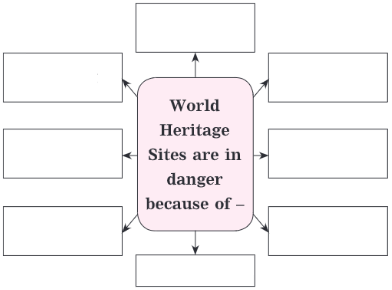
     Like many natural and historic cultural sites around the world, many World Heritage Sites are in danger of being destroyed or lost due to war, poaching, natural disasters like earthquakes, uncontrolled urbanization, heavy tourist traffic and environmental factors like air pollution and acid rain. World Heritage Sites that are in danger are inscribed on a separate List of World Heritage Sites in Danger which allows the World Heritage Committee to allocate resources from the World Heritage Fund to that site. In addition, different plans are put into place to protect and/or restore the site. If however, a site loses the characteristics which allowed for it to be originally included on the World Heritage List, the World Heritage Committee can choose to delete the site from the list. To learn more about World Heritage Sites, visit the World Heritage Centre’s website at whc.unesco.org.

A2. Complex Factual Activity:
Complete the following Web by giving reasons why World Heritage sites are in danger :
Image
A3. Activities based on Vocabulary:
Find out opposites from the passage for the following:
(1) artificial × _______________
(2) lowest × _______________
(3) exclude × _______________
(4) safe × _______________
A4. Activities based on Contextual Grammar:
Write the following sentences using 'not only... but also' and 'as well as' in two separate sentences:
(1) Opera House in Australia and the Historic Center of Vienna in Austria are cultural sites of the World Heritage.
A5. Personal Response:
(1) What is the role of the 'World Heritage Sites' in promoting tourism in any country?
A1. Simple Factual Activities:
State whether you Agree or Disagree with the following statements:
Image

Interviewer : Do you think interest in boxing in India will ever go beyond the Olympics ?
Mary Kom : Yes, I am sure that in a few years boxing will be very popular among everyone in India, all the year round.
Interviewer : How aware are Indian women of their nutritional requirements ? Diet and nutrition must’ve been a key factor in your conditioning for the Olympics. Do you think nutrition is a neglected area in Indian sports ?
Mary Kom : The awareness is growing now among the female athletes when it comes to nutritional requirements. Nutrition has definitely been a neglected area in Indian sports. I had to gain 3 kgs since I had to fight in the 51kg event instead of the usual 48kgs that I fight in. So I had to focus on what to eat. I gained weight by eating the right kind of healthy food rather than bad saturated fats.
Interviewer : How big a role did OGQ play in shaping the boxing scene in India for the better ?
Mary Kom : OGQ really played an important part in my success. They helped me out whenever I needed something. They took care of everything, which helped me focus on my boxing and kept me stress - free.
Interviewer : What’s your opinion on the future of Indian boxing ?
Mary Kom : The future is very bright and I am sure many more boxers will get medals for us.
Interviewer : Do you find it difficult to convince your children not to fight when they watch you go out and do it in style all the time ?
Mary Kom : Well, I have twins and yes, sometimes it becomes really difficult to keep them under control.
Interviewer : Will you train your kids to become boxers as well ?
Mary Kom : I haven’t really thought about it. As of now, just let their mother box !
Interviewer : You have broken several stereotypes about the women in India by showing that women can compete with men in any field. But how good are you at the ‘traditional’ feminine activities like cooking ?
Mary Kom : Well, I am good at cooking and other household work too.
Interviewer : Would you be interested in coaching Indian women in boxing one day ?
Mary Kom : Let’s see. In the future, may be yes.
Interviewer : What do you prefer being called -Super Mom or Super Boxer ?
Mary Kom : I love being a mom. That’s the best thing that has ever happened to me. 
Awards and recognitions
• Arjuna Award (Boxing) in 2003
• Padma Shree (Sports) in 2006
• Contender for Rajiv Gandhi Khel Ratna Award in 2007
• People of the Year - Limca Book of Records in 2007
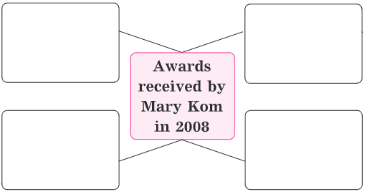
• CNN-IBN and Reliance Industries Real Heroes Award in 2008
• Pepsi MTV Youth, AIBA in 2008
• ‘Magnificent Mary’, AIBA in 2008
• Felicitation by Zomi Student’s Federation (ZSF) at New Lamka YPA Hall in 2008
• Rajiv Gandhi Khel Ratna award in 2009
• International Boxing Association’s Ambassador for Women’s Boxing in 2009
• Sportswoman of the year, Sahara Sports Award in 2010.

A2. Complex Factual Activities:
(1) How did Mary Kom increase her weight?
A3. Activities based on Vocabulary:
Write down the full forms of-
(1) OGQ - 
(2) CNN - 
A4. Activities based on Contextual Grammar:
Identify the tense:
(1) Sometimes it becomes really difficult to keep them under control.
(2) They took care of everything.
A5. Personal Response:
(1) What is Mary Kom more proud of being a boxer or a mother? 
A1. Simple Factual Activity:
(1) He was bestowed with numerous honorary doctorates and awards.
(2) Dr Hawking's 'A Brief History of Time' is one of the best selling books of our time.

    Though confined to a wheel chair with no control over his body save a finger and with
a computer to help him express his thoughts. Dr Hawking is an authority on profound subjects of science. Numerous honorary doctorates and awards have been bestowed
on him. He is a Fellow of The Royal Society and a Member of the US National Academy of Sciences.
     In spite of being considered Einstein’s equal in intelligence, Dr Hawking is a very humble man. A simple, down to earth man, he has authored many books dealing with his awesome ideas keeping a layman in mind. His writing is full of wit and humour. His style is so lucid that non-scientists can also understand him. His book, “A Brief History of Time” is one of the best selling books of our times.
     On being asked, how he feels about having the dreadful ALS, Dr Hawking, the quintessence of optimism and hope, says, “Not very different from the rest. I try and lead as normal a life as possible, and not think about my condition or regret the things it prevents me from doing, which are not many.”
      Dr Hawking firmly believes that in the next millenium, science will discover the core secrets of the universe, its origin, its history and maybe even predict its ultimate demise.
      Like Dr Hawking, there are many people who display exemplary courage in their lives. Let us salute all those brave people, who in spite of being disabled strive to do their best.

A2. Complex Factual Activity:
(1) Which of Dr Hawking's achievements are mentioned in this passage? 
A3. Activities based on Vocabulary:
Write the adjectives for the following nouns from the passage:
(1) ideas
(2) style
(3) courage
(4) secrets.
A4. Activities based on Contextual Grammar:
Do as directed:
(1) His writing is full of wit and humour.
(Rewrite the sentence using Past Perfect Tense.)
(2) He is a fellow of the Royal Society and a member of the US National Academy of Science.(Use not only but also.)
A5. Personal Response:
(1) How do you know that Dr Hawking is a perfect example of optimism and hope?  
A1. Simple Factual Activities:
State whether the following statements are Right or Wrong:
(1) We should have vision for today not tomorrow.
(2) If we close our eyes and feel the child inside us, we can listen to that child.
(3) Mahatına Gandhi, Nelson Mandela and Martin Luther King are calling on us.
(4) Satyarthi's vision of tomorrow is to see that cobbler's boy sitting with him in his classroom.

     As a child, I had a vision of tomorrow. A vision of that cobbler boy sitting with me in my classroom.
     Now, that tomorrow has become TODAY.
     I am TODAY, and you are TODAY. TODAY it is time for every child to have a right to life, right to freedom, right to health, right to education, right to safety, right to dignity, right to equality, and right to peace.
     TODAY, beyond the darkness, I see the smiling faces of our children in the blinking stars. TODAY, in every wave of every ocean, I see my children are playing and dancing. TODAY, in every plant, in every tree, and mountain, I see our children growing freely with dignity.
     Friends, I want you to see and feel this TODAY inside you.
     My dear sisters and brothers, as I said many interesting things are happening today. May I please request you to put your hand close to your heart - close your eyes and feel the child inside you?
     I am sure you can - Now, listen to that child.Listen please.
     Today, I see thousands of Mahatma Gandhis, Nelson Mandelas and Martin Luther Kings calling on us.
     Let us democratise knowledge. Let us universalise justice. Together, let us globalise compassion!
     I call upon you in this room, and all across the world. I call for a march from exploitation to education, I call for a march from poverty to shared prosperity, a march from slavery to liberty, and a march from violence to peace.
     Let us march from ignorance to awakening. Let us march from darkness to light. Let us march from mortality to divinity.
     Let us march!  

A2. Complex Factual Activities:
Complete the following web-chart :
Image
A3. Activities based on Vocabulary:
Write the infinitive forms of the following and use any two of them in your own sentences:
(1) dancing
(2) playing
(3) growing 
(4) happening 
A4. Activities based on Contextual Grammar:
Make nouns of the following:
(1) universal
(2) global
(3) knowledge
(4) exploitation
A5. Personal Response:
(1) What do you mean by 'Every child has a right to life'?