Question
A1. Simple Factual Activity:
Complete the following sentences using information in the passage:
(1) He flapped his wings once and _______________.
(2) He turned his beak sideways and cawed _______________.

    Then he completely forgot that he had not always been able to fly, and commended himself to dive and soar and curve, shrieking shrilly.
    He was near the sea now, flying straight over it, facing straight out over the ocean. He saw a vast green sea beneath him, with little ridges moving over it and he turned his beak sideways and cawed amusedly.
    His parents and his brothers and sister had landed on this green flooring ahead of him. They were beckoning to him, calling shrilly. He dropped his legs to stand on the green sea. His legs sank into it. He screamed with fright and attempted to rise again flapping his wings. But he was tired and weak with hunger and he could not rise, exhausted by the strange exercise. His feet sank into the green sea, and then his belly touched it and he sank no farther. He was floating on it, and around him his family was screaming, praising him and their beaks were offering him scraps of dog-fish. He had made his first flight.

A2. Complex Factual Activity:
(1) What did the young seagull forget? What did he do then? 
A3. Activities based on Vocabulary:
Read the following words and make meaningful sentences of your own by using them:*(1) beckon
(2) curveting
A4. Activities based on Contextual Grammar:
Do as directed:
(1) He was near the sea now. (Frame a Wh-question to get the underlined as an answer.)
(2) But he was tired and weak with hunger. (Use 'not only but also'.)
A5. Personal Response:
(1) How does your family help you to achieve your goal?
Answer

A1. Simple Factual Activity:
(1) He flapped his wings once and he soared upwards.
(2) He turned his beak sideways and cawed amusedly.
A2. Complex Factual Activity:
(1) The young seagull completely forgot that he had not always been able to fly. He commended himself for his diving and soaring and curveting shrieking shrilly.
A3. Activities based on Vocabulary:
(1) They were all beckoning him to join their team, but he did not respond.
(2) The eagle was curveting to land onto the ground to catch his prey.
A4. Activities based on Contextual Grammar:
(1) He could not rise, could he?
(2) But he was not only tired but also weak with hunger.
A5. Personal Response:
(1) My family is always there to help me in my work. Each one of them, especially my parents, help me in deciding my goal. If I neglect any day, they remind me of my goal all the while. They all are ready to guide me, in their own way, to achieve whatever I desire. They always encourage, admire and praise me even for my smallest achievement.

Need a full question paper?

Generate a complete, print-ready paper with questions like this in minutes — across 16+ boards, with answer keys.

Start Generating Free

Similar questions

A1. Simple Factual Activities:
Write whether the following sentences are True or False:
(1) Writer's journey from India to Norway is a connect between the two centre of global peace.
(2) The Nobel Committee did not invite the writer to deliver a lecture.
(3) Writer represented the sound of silence and cry of innocence.
(4) Writer humbly accepted the award on behalf of all activists.

     My dear children of the world ... Your Majesties, Your Royal Highnesses, Excellencies, distinguished members of the Norwegian Nobel Committee, dear brother Tom Harkin, brothers and sisters, and my dear daughter Malala.
      From this podium of peace and humanity, I am deeply honoured to recite a mantra from the ancient texts of wisdom, Vedas. This mantra carries a prayer, an aspiration and a resolve that has the potential to liberate humanity from all man-made crises.
      Let’s walk together. In the pursuit of global progress, not a single person should be left out or left behind in any corner of the world, from East to West, from South to North. Let’s speak together, let our minds come together! Learning from the experiences of our ancestors, let us together create knowledge for all that benefits all.
      I bow to my late parents, to my motherland India, and to the mother earth.
      With a warm heart I recall how thousands of times, I have been liberated, each time I have freed a child from slavery. In the first smile of freedom on their beautiful faces, I see the Gods smiling.
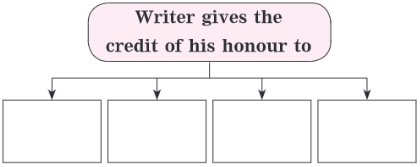
      I give the biggest credit of this honour to my movement’s Kaalu Kumar, Dhoom Das and Adarsh Kishore from India and Iqbal Masih from Pakistan who made the supreme sacrifice for protecting the freedom and dignity of children. I humbly accept this award on behalf of all such martyrs, my fellow activists across the world and my countrymen.
      My journey from the great land of Lord Buddha, Guru Nanak and Mahatma Gandhi; India to Norway is a connect between the two centres of global peace and brotherhood, ancient and modern.
      Friends, the Nobel Committee has generously invited me to present a “lecture.” Respectfully, I am unable to do that. Because, I am representing here - the sound of silence. The cry of innocence. And, the face of invisibility. I represent millions of those children who are left behind and that’s why I have kept an empty chair here as a reminder.

A2. Complex Factual Activities:
Complete the following :
Image
A3. Activities based on Vocabulary:
(1) Use the word 'credit' as a noun and a verb to make a meaningful sentence.
A4. Activities based on Contextual Grammar:
Do as directed:
(1) I humbly accept this award. (Choose the correct question tag.)
(a) do I?  (b) don't I? (c) did I? (d) didn't I?
(2) I am unable to do that.
(Make it negative without changing its meaning)
A5. Personal Response:
(1) What do you know about Kailash Satyarthi? 
A1. Simple Factual Activities:
State who/what:
(1) Colours the entire sky.
(2) Takes new shapes with every passing moment,
(3) Makes trees dance.
(4) Changes its forın according to the dictates of the sun and the wind.

     We saw small bits of grass peeping through the small cracks in a concrete pavement. It left us thinking : however impossible things may look, there is always an opening...
     We saw a tree bare of all leaves in the cold winter months. We thought its chapter was over. But three months passed, spring set in and the tree was back to its green majesty once again, full of leaves, flowers, birds and life. What if we too had the conviction that, however difficult things are right now, it will not remain so for ever. Remember, this too shall pass.
     We saw an army of ants lugging a fly which was at least ten times the ant’s size. The ants organized themselves around the fly, lifted it on frail feelers and carried it to quite a distance. Their teamwork and perseverance were impressive. What if we too are consistent, organized, focused...Spider webs are delicate, yet very strong. A rainbow colours the entire sky. Oysters take in a grain of sand they open up with a pearl. Innumerable stars shine across the infinite sky. Clouds take new shapes with every passing moment. The wind makes trees dance with unhindered passion. Water, without hint of ego, changes its form according to the dictates of the sun and the wind. When we see a caterpillar turn into a butterfly, a flower turn into a fruit, we experience the alchemy of nature... we touch it and become gold ourselves.

A2. Complex Factual Activities:
(1) What are the alchemies of nature mentioned in the extract?
A3. Activities based on Vocabulary:
Match the pairs of antonyms:

 WordsAntonyms
 (1) impossible (a) easy
 (2) difficult (b) strong
 (3) delicate (c) forget
 (4) remember (d) possible

A4. Activities based on Contextual Grammar:
Identify the tenses:
(1) We saw an army of ants
(2) We experience the alchemy of nature
A5. Personal Response:
(1) 'Nature is our best teacher'-Explain.

A1. Simple Factual Activities:
State whether you Agree or Disagree with the following statements:
(1) Mary Kom's coach was allowed to accompany her during her preparation for Olympics
(2) Mary practised with male boxers in Pune
(3) Mary is the first Indian female boxer to win an Olympics medal for India
(4) Dodgy judging was not at all the part of the reason for her loss in the semi-finals.

     In an exclusive interview with Sportskeeda correspondent Taruka Srivastava, Olympic Bronze medalist Mary Kom talked about her preparation for the Olympics and her elation at winning a medal.
Interviewer : First things first- you’re the first Indian female boxer to win an Olympics medal for India. Has the feeling completely sunk in ?
Mary Kom : I am really happy with my achievement and yes it is yet to sink in. I am just so exhilarated.
Interviewer : You were the only female representative from India in boxing. Did that put additional pressure on you?
Mary Kom : No, not at all. I was pretty confident about myself. I knew.
Interviewer : Your coach Charles Atkinson was not allowed to accompany you to the Olympics. How did that affect your preparations ?
Mary Kom : Well I did miss him there but thankfully, we had already done our homework and I was well prepared.
Interviewer : During your preparations for the Olympics, you sparred with the male boxers of the Indian contigent. Who was your favourite sparring partner ?
Mary Kom : (Laughs) Well, I trained hard in Pune and the male boxers were kind enough to practise with me whenever I required them. To name a favourite would be unfair.
Interviewer : You were quoted saying “Adams was very clever, a counter - puncher but, although she carried power, she wasn’t very tactical. I was scoring but the judges were not pressing the buttons.” Do you think dodgy judging was part of the reason for
your loss in the semi - finals?
Mary Kom : Yes, I think some of the decisions were unfortunate and did not work to my benefit.
Interviewer : India managed just 6 medals in the 2012 Olympics even though we are a nation of 1.3 billion people. Where do you think a change is required to help us win medals that are proportionate with our population ?
Mary Kom : I think more and more people should take up sports as a full - time career if we want more gold medals. More corporates should come in and sponsor players so that the players don’t have any financial pressure and can just focus on their games.

A2. Complex Factual Activities:
(1) What can help Indian sportsmen to win more Olympic medals? 
A3. Activities based on Vocabulary:
Find out opposite words for the following from the passage.
(1) hated ×
(2) fair ×
(3) Inclusive ×
(4) diffident ×
A4. Activities based on Contextual Grammar:
Underline the subordinate clause and state its kind:
(1) The male boxers were kind enough to practise with me, whenever I required them.
Kind: _______________
(2) I think more and more people should take up sports as a full-time career.
Kind: _______________
A5. Personal Response:
(1) Name some sportswomen you know:
A1. Simple Factual Activities:
State whether you agree or disagree with the following statements:

 Group 'A' Group 'B'
 (1) A small, skinny child labourer (a) to care for our children
 (2) A Sudanese child- soldier (b) children's frightened and exhausted eyes
 (3) Satyarthi had looked into  (c) was forced to kill his friends and family
 (4) The great religions teach us (d) The world forced me to take a gun or a tool

    I have come here only to share the voices and dreams of our children - because they are all our children - [gesture to everyone in the audience]. I have looked into their frightened and exhausted eyes. I have held their injured bodies and felt their broken spirits.
    Twenty years ago, in the foothills of the Himalayas, I met a small, skinny child labourer. He asked me: “Is the world so poor that it cannot give me a toy and a book, instead of forcing me to take a gun or a tool?”
    I met with a Sudanese child-soldier. He was kidnapped by an extremist militia. As his first training lesson, he was forced to kill his friends and family. He asked me: “What is my fault?”
    Friends, all the great religions teach us to care for our children. Jesus said: “Let the children come to me; do not hinder them, for the kingdom of God belongs to them.” The Holy Quran says: “Kill not your children because of poverty.”
    Friends! There is no greater violence than to deny the dreams of our children. Therefore ... I refuse to accept that all the temples and mosques and churches and prayer houses have no place for the dreams of our children.
    I refuse to accept that the world is so poor, when just one week of global military expenditure can bring all the children to classrooms. I refuse to accept that all the laws and constitutions, police and judges are unable to protect our children.
    I refuse to accept that the shackles of slavery can ever be stronger than the quest for freedom. I REFUSE TO ACCEPT here.
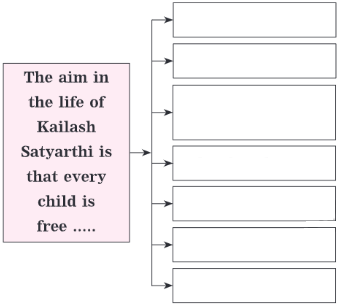
    My only aim in life is that every child is free to be a child,
- free to grow and develop,
- free to eat, sleep, and see daylight,
- free to laugh and cry,
- free to play and learn,
- free to go to school, and above all,
- free to dream.
    I have the privilege of working with many courageous people who have the same aim. We have never given up against any threat or attack and we never will.

A2. Complex Factual Activities:

Complete the following diagram/chart :
Image
A3. Activities based on Vocabulary:
Choose the correct option and write in front of the given word :
(1) extremist: _______________
(A) militant (B) robber (C) spy
(2) courageous: _______________
(A) cowards (B) brave (C) friendly
A4. Activities based on Contextual Grammar:

Rewrite the following into indirect speech:
(1) A skinny child labourer asked Satyarthi, "Is the world so poor that it cannot give me a toy and a book, instead of forcing me to take a gun or a tool?" 
A5. Personal Response:
What will you do in the following situations?
(1) If you find a child working on a brickwork site.
(2) If you come across a beggar child.

A1. Simple Factual Activities:
Who said to whom:
(1) "Come with me. I will take you to school."
(2) "What is your name, little one?"

     The next day Ramlal caught Bholi by the hand and said. ‘‘Come with me. I will take you to school.’’ Bholi was frightened. She did not know what a school was like. She remembered how a few days ago their old cow. Lakshmi had been turned out of
the house and sold.
     ‘‘N-n-n-n No. no-no-no’’ she shouted in terror and pulled her hand away from her father’s grip.
     ‘‘What’s the matter with you, you fool?’’ shouted Ramlal, ‘‘I am only taking you to school.’’ Then he told his wife. ‘‘Let her wear some decent clothes today. Or else what will the teachers and the other schoolgirls think of us when they see her?’’
      New clothes had never been made for Bholi. The old dresses of her sisters were passed on to her. No one cared to mend or wash her clothes. But today she was lucky to receive a clean dress which had shrunk after many washing and no longer fitted
Champa. She was even bathed and oil was rubbed into her dry and matted hair. Only then did she begin to believe that she was being taken to a place better than her home!
      When they reached the school, the children were already in their classrooms. Ramlal handed over his daughter to the headmistress. Left alone, the poor girl looked about her with fear laden eyes. There were several rooms. And in each room girls like her squatted on mats, reading from books or writing on slates. The headmistress asked        Bholi to sit down in a corner in one of the classrooms. Bholi did not know what exactly a school was like and what happened there. But she was glad to find so many girls almost of her own age present there. She hoped that one of these girls might become her friend.
      The lady teacher who was in the class was saying something to the girls but Bholi could understand nothing. She looked at the pictures on the wall. The colours fascinated her. The horse was brown just like the horse on which the Tehsildar had come to visit their village : the goat was black like the goat of their neighbour: the parrot was green like the parrots she had seen in the mango orchard : and the cow was just like their Lakshmi. And suddenly Bholi noticed that the teacher was standing by her
side, smiling at her.
      “What’s your name. little one?’’
      ‘‘Bh-Bho-Bho.’’ She could stammer no further than that.
       Then she began to cry and tears flowed from her eyes in a helpless flood. She kept her head down as she sat in her corner, not daring to look up at the girls who, she knew were still laughing at her.

A2. Complex Factual Activities:
(1) What shows that Bholi was unwilling to go to school? 
A3. Activities based on Vocabulary:
Complete the following sentences using words given in the brackets:
(disfigured, matted, fascinated)
(1) After the accident Juhi's face was _______________.
(2) It took a long time to straighten the _______________ bundle of wool.
A4. Activities based on Contextual Grammar:
(1) Change into indirect speech:
Ramlal's wife said to him, "I will tell you what to do."
(2) Rewrite as an exclamatory sentence:
The child was very fair and pretty.
A5. Personal Response:
(1) "If girls go to school, who will marry them?"-Why, do you think, that Bholi's mother thought so? 
A1. Simple Factual Activities:
State whether the following statements are True or False:
(1) Monsieur de Poulengey and Monsieur de Metz want to go with Joan.
(2) Chinon is one of the cities in England.
(3) Poulengey was sure that only miracle can save them.
(4) Joan's words have put fire into Robert.

Robert : (To the steward) Is this true about Monsieur de Poulengey ?
Steward : (Eagerly) Yes, sir, and about Monsieur de Metz too. They both want to go with her.
Robert : (Goes to the window, and shouts into the court-yard) Send Monseiur de Poulengey to me, will you ? (He turns to Joan) Get out and wait in the yard.
Joan : (Smiling brightly at him) Right, squire. (She goes out).
Robert : (To the steward) Go with her. Stay within call and keep your eye on her. I shall have her up here again. (The steward retreats hastily. Bertran de Poulengey, a French guard, enters, salutes and stands waiting.)
Robert : She says you, Jack and Dick have offered to go with her. What for ? Do you take her crazy idea of going to the Dauphin seriously ?
Poulengey : (Slowly) There is something about her. It may be worth trying.
Robert : Oh, come on Polly! You must be out of your mind !
Poulengey : (Unmoved) What is wrong with it ? The Dauphin is in Chinon, like a rat in a corner, except that he won’t fight. The English will take Orleans. He’ll not be able to stop them.
Robert : He beat the English the year before last at Montargis. I was with him. Poulengey : But this time, his men are cowed and now he can’t work miracles. And I tell you that nothing can save our side now but a miracle.
Robert : Miracles are all right, Polly. The only difficulty about them is that they don’t happen nowadays.
Poulengey : I used to think so. I’m not so sure now. There is something about her. I think the girl herself is a bit of a miracle. Anyhow, this is our lastchance. Let’s see what she can do.
Robert : (Wavering) You really think that ?
Poulengey : (turning) Is there anything else left for us to think? Let’s take a chance. Her words have put fire into me.
Robert : (Giving up) Whew! You’re as mad as she is.
Poulengey : (Obstinately) We want a few mad people now. See where the sane ones have landed us !
Robert : I feel like a fool. Still, if you feel sure... ?
Poulengey : I feel sure enough to take her to Chinon unless you stop me.
Robert : Do you think I ought to have another talk with her ?

A2. Complex Factual Activities:
Answer the following:
(1) Was the Dauphin fit to be a Prince and heir?
(2) What was the Squire's opinion about miracles? 
A3. Activities based on Vocabulary:
(1) Find out two adjectives and two adverbs from the passage:
A4. Activities based on Contextual Grammar:
Make it affirmative:
(1) I am not sure, now.
(2) He will not be able to stop them.
A5. Personal Response:
(1) What is your opinion about Joan? 
A1. Simple Factual Activities:
Write one sentence each, why the following years were landmarks in the lives of Pierre and Marie Curie: 
(1) 1906 -
(2) 1911-

    The Curies continued their work for four more years. Wearing an acid stained, dust covered mask, Marie toiled along stirring large pots of pitchblende ensuring that the fires beneath were active throughout the day and the night. Then in 1902, success finally came. On a September night the Curies, after a day’s tiresome work, went home. Then just as they were about to go to bed they went to the laboratory to have another look at the hundreds of small bowls into which they had poured filtered pitchblende. In the dark laboratory as they moved cautiously forward there were all around them rays of soft, bluish purple light coming from the small, glass covered bowls. Radium had been discovered ! Marie said to her husband, ‘Do you remember the day when you told me that you wanted radium to have a beautiful colour? Look …. look!’’
     Actually, what they had produced was just a tiny pinch of white powder that looked like salt. But it was to become one of the wonders of the world. With its rays people would be able to see through the hardest of substances except lead.
     The benefits of radium in the world of medicine are incalculable. It has been used with great effect in the treatment of cancer. The bacteria of such diseases as typhus, cholera and anthrax can also be killed by radium.
     In 1903 the Curies along with Henry Becquesel, were awarded the Nobel Prize for physics for the discovery of Radium and Polonium. They wished, they could have patented their discovery and become rich, but this noble woman refused to do so and gave it free to the world to be used properly.
     In 1906, Pierre was knocked down and killed by a horse-drawn wagon. Marie clung to his lifeless body and remained disconsolate.
      In 1911, Marie was awarded the Nobel prize for the second time and this was for Chemistry. Madame Curie remained comparatively poor and when asked why she did not make money by her discoveries, she replied, ‘‘I am working for science. Radium belongs to the people, not to me.’’
      In 1934, the health of Marie Curie failed and in the July of that year this great scientist, who had given her life for the cause of science and humanity, died. In every great man and woman there is a compulsive desire to discover the truth. Madame Curie, who pursued her life’s goal with great courage, endurance, dedication and strength of character, is a living example of this statement.
      There are also men and women who show extreme courage when they are face to face with great danger. But greater is the courage of men and women who display a strength of mind that is not defeated by extremely hostile and unfavourable conditions of life. Madame Curie certainly belongs to this latter group.

A2. Complex Factual Activities:
(1) What makes Marie Curie an exceptional scientist?  
A3. Activities based on Vocabulary:
Write down the describing words used for the following nouns :
(1) _______________ work
(2) _______________ pitchblende
(3) _______________ colour
(4) _______________ desire.
A4. Activities based on Contextual Grammar:
Change the voice:
(1) In 1906, Pierre was knocked down by a horse- drawn wagon.
(Begin the sentence with 'A horse-drawn wagon'.)'
(2) In 1911, Marie was awarded the Nobel Prize.
(Begin the sentence with 'They'.)
A5. Personal Response:
(1) Besides the uses of Radium and Polonium mentioned in the text, in what other way do you think, it is used in the field of medicine?
A1. Simple Factual Activities:
Read the passage and fill in the blanks:
(i) Meena was a chronic _______________.
(ii) _______________ changed Meena's life.
(iii) The begger lived with his _______________ daughter.
(iv) The beggars were playing on the road because _______________.

     ‘Yes, a beggar,’ she repeated, as if to reassure me. ‘He was old and used to stay in front of my house with his five-year old granddaughter. As you know, I was a chronic pessimist. I used to give my leftovers to this beggar every day. I never spoke to him. Nor did he speak to me. One monsoon day, I looked out of my bedroom window and started cursing the rain. I don’t know why I did that because I wasn’t even getting wet. That day I couldn’t give the beggar and his granddaughter their daily quota of leftovers. They went hungry, I am sure.
     ‘However, what I saw from my window surprised me. The beggar and the young girl were playing on the road because there was no traffic. They were laughing, clapping and screaming joyously, as if they were in paradise. Hunger and rain did not matter.They were totally drenched and totally happy. I envied their zest for life.
     ‘That scene forced me to look at my own life. I realized I had so many comforts, none of which they had. But they had the most important of all assets, one which I lacked. They knew how to be happy with life as it was. I felt ashamed of myself. I even started to make a list of what I had and what I did not have. I found I had more to be grateful for than most people could imagine. That day, I decided to change my attitude towards life, using the beggar as my role model.’
      After a long pause, I asked Meena how long it had taken her to change.
     ‘Once this realization dawned’, she said, ‘it took me almost two years to put the change into effect. Now nothing matters. I am always happy. I find happiness in every small thing, in every situation and in every person.’
     ‘Did you give any gurudakshina to your guru ?’ I asked.
     ‘No. Unfortunately, by the time I understood things, he was dead. But I sponsored his granddaughter to a boarding school as a mark of respect to him.’

A2. Complex Factual Activities:

(1) How did the beggar change Meena's attitude towards life? Write it down in 5 to 6 lines. 
A3. Activities based on Vocabulary:
Find synonyms for the following words from the passage:
(a) heaven
(b) happily
(c) rainy
(d) very surprised
A4. Activities based on Contextual Grammar:
Do as directed:
(1) They were laughing and screaming.
(Choose the correct option of 'Not only...... but also'.)
(a) They were not only but also laughing and screaming.
(b) They were not only laughing but also screaming.
(c) They were laughing not only but also screaming.
(d) They were not only laughing and but also screaming.
(2) He used to stay in front of my house.
(Rewrite the sentence by using 'would'.)
A5. Personal Response:
(1) Describe an experience, where somebody has changed your way of looking at life.
A1. Simple Factual Activity:
Fill in the blanks and complete the sentences:
(1) The number of World Heritage Sites in 2009 were _______________.
(2) _______________ of the World Heritage Sites are considered mixed.

    TYPES OF WORLD HERITAGE SITES
    As of 2009, there are 890 World Heritage Sites that are located in 148 countries (map). 689 of these sites are cultural and include places like the Sydney Opera House in Australia and the Historic Center of Vienna in Austria. 176 are natural and feature such locations as the U.S.'s Yellowstone and Grand Canyon National Parks. 25 of the World Heritage Sites are considered mixed i.e. natural and cultural Peru's Machu Picchu is one of these. Italy has the highest number of World Heritage Sites with 44.
     India has 36 (28 cultural, 7 natural and 1 mixed) World Heritage Sites. The World Heritage Committee has divided the world’s countries into five geographic zones which include (1) Africa, (2) Arab States, (3) Asia Pacific (including Australia and Oceania), (4)
Europe and North America and (5) Latin America and the Caribbean.
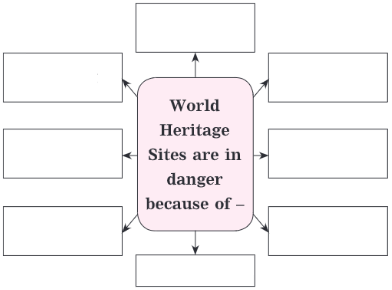
     WORLD HERITAGE SITES IN DANGER
     Like many natural and historic cultural sites around the world, many World Heritage Sites are in danger of being destroyed or lost due to war, poaching, natural disasters like earthquakes, uncontrolled urbanization, heavy tourist traffic and environmental factors like air pollution and acid rain. World Heritage Sites that are in danger are inscribed on a separate List of World Heritage Sites in Danger which allows the World Heritage Committee to allocate resources from the World Heritage Fund to that site. In addition, different plans are put into place to protect and/or restore the site. If however, a site loses the characteristics which allowed for it to be originally included on the World Heritage List, the World Heritage Committee can choose to delete the site from the list. To learn more about World Heritage Sites, visit the World Heritage Centre’s website at whc.unesco.org.

A2. Complex Factual Activity:
Complete the following Web by giving reasons why World Heritage sites are in danger :
Image
A3. Activities based on Vocabulary:
Find out opposites from the passage for the following:
(1) artificial × _______________
(2) lowest × _______________
(3) exclude × _______________
(4) safe × _______________
A4. Activities based on Contextual Grammar:
Write the following sentences using 'not only... but also' and 'as well as' in two separate sentences:
(1) Opera House in Australia and the Historic Center of Vienna in Austria are cultural sites of the World Heritage.
A5. Personal Response:
(1) What is the role of the 'World Heritage Sites' in promoting tourism in any country?
A1. Simple Factual Activities:
Complete the following sentences using the information given in the passage:
(1) The langur baby was listless and _______________.
(2) The writer's parents and sisters had come out on the veranda and _______________.

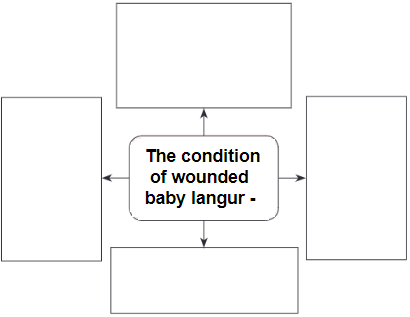
    The changed circumstances and the sudden unexpected attack from unknown quarters forced the langur to drop the baby from the sloping roof over the veranda. The baby was listless and appeared to be dead. As its body started to slide down, the excitement of the pack of dogs grew manifold at the prospect of a good kill and meal. Keeping the dogs at bay with the stick, I managed to catch hold of the baby langur’s tail just as it tipped over the edge of the tiled roof. The baby appeared inert and lifeless. It was indeed a male baby.
   By this time, my parents and sisters had come out on to the veranda and were witnessing my rescue operation. Some of our neighbours had also gathered in the distance.
    I took the baby langur to our backyard and gently laid him on the floor inside the poultry coop. His body was full of deep bite marks and scratches. Blood was oozing from some of the wounds. The baby remained motionless. My father provided first aid to clean the wounds and stop the bleeding. I was relieved to find out that the baby was breathing, even though his breaths were shallow.
   Splashes of cold water made the baby stir and after a few shaky attempts, he sat up. He was in state of shock and started trembling like a leaf in the wind. His two little twinkling eyes welled up with tears and he started to sob with a muffled cry - just like a human child would after experiencing trauma. I offered him a peeled banana which he
accepted with his unsteady hand and began taking hesitant bites.

A2. Complex Factual Activities:
Complete the following web and describe the condition of wounded baby langur:
 Image
A3. Activities based on Vocabulary:
Find from the passage present participles and past participles used as adjectives:
(1) Present Participles: __________ roof, __________ eyes.
(2) Past Participles: __________ attack, __________ quarter, __________ cry, __________ banana.
A4. Activities based on Contextual Grammar:
(1) They were witnessing my rescue operation. (Simple Past Tense.)
(2) He was in a state of shock. (Past Perfect Tense.)
A5. Personal Response:
(1) Have you ever saved a puppy/dog or any other animal from naughty children who were throwing stones at him? Write about your experience.