Question
A1. Simple Factual Activities:
State whether the following statements are Right or Wrong:
(1) People in Milan welcomed Prospero with great love and joy.
(2) Prospero nobly forgave his old enemies.
(3) Ferdinand and Miranda got married on the enchanted island.
(4) Ariel was as free as air at the end.

      The king and the other courtiers were ashamed. They begged Prospero’s forgiveness. “I have been duly punished for my sins.” Cried king Alonso, “For I have lost my son, and my kingdom is without an heir!”
      Prospero drew back a curtain from the entrance of his cave. Inside, they saw Ferdinand and Miranda, happily playing a game of chess.
      How happy Alonso was to see his lost son! How thrilled he was to hear that Ferdinand was to marry the Duke of Milan’s beautiful daughter!
      So it all ended happily! Prospero assured them that their ship was safely anchored and each and every sailor was safe on board.
      On the following day, they all set sail for Naples, where Ferdinand and Miranda were to be married. Waving them goodbye, Ariel promised them calm seas and favourable winds. Prospero had set him free to wander where he would, as free as the air!
      Thus, after many years of hardship, Prospero was back in Milan, where his people welcomed him with great love and joy. He decided to break his magic stick and give up the practice of magic. He was happy and pleased to be back in Milan - but he was happy above all, to forgive his old enemies who had wronged him cruelly. Even though they had been at his mercy, he did not take revenge on them, but very nobly, forgave them!

A2. Complex Factual Activity:
(1) Who said to whom and when :
"I have been duly punished for my sins."
(2) What surprise awaited king Alonso when Prospero drew back the curtain? 
A3. Activities based on Vocabulary:
Statements

(1) heir, cave, ship, old, wind
(2) take, wander, safe, punish, hear
(3) happy, thrilling, calm, revenge, favourable
(4) nobly, safely, happily, marry, duly
A4. Activities based on Contextual Grammar:
Make them assertive:
(1) How happy Alonso was to see his lost son!
(2) How thrilled Alonso was to hear that Ferdinand was to marry the duke of Milan's beautiful daughter!
A5. Personal Response:
What could be the reason for Prospero to give up the practice of magic?
Answer

A1. Simple Factual Activities:
(1) Right
(2) Right
(3) Wrong
(4) Right
A2. Complex Factual Activities:
(1) Alonso said to Prospero, when he realised that he had lost his son.
(2) When Prospero drew back the curtain from the entrance of his cave, King Alonso saw Ferdinand, his lost son happily playing a game of chess with Miranda. That was a pleasant surprise for the king Alonso.
A3. Activities based on Vocabulary:
(1) old
(2) safe
(3) revenge
(4) marry
A4. Activities based on Contextual Grammar: 
(1) Alonso was very happy to see his lost son.
(2) Alonso was very much thrilled to hear that Ferdinand was to marry the duke of Milan's beautiful daughter.
A5. Personal Response:

Ariel was the chief of imprisoned good spirits. Prospero promised him that he would set him free with his power of magic. He was serving Prospero and helping him faithfully in every need of an hour to set himself free.

Need a full question paper?

Generate a complete, print-ready paper with questions like this in minutes — across 16+ boards, with answer keys.

Start Generating Free

Similar questions

A1. Simple Factual Activities:
Who said to whom? Complete the table:

DialogueWho saidTo whom
 (1) "Here's something for you."  
 (2) "What do you want me to do with that?"  


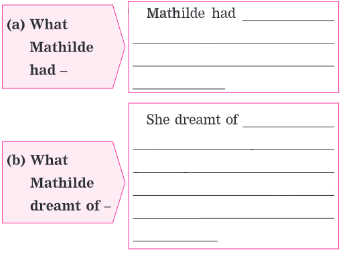
      Mathilde was a pretty and charming girl, born, as if by an error of fate, into a family of clerks. She had no means of becoming known, understood, loved or be wedded to an aristocrat; and so she let herself be married to a minor official at the Ministry of Education.
      She dressed plainly, because she had never been able to afford anything better. She suffered endlessly, feeling she was entitled to all the luxuries of life. She suffered because of her shabby, poorly furnished house. All these things, that another woman of her class would not even have noticed, tormented her and made her resentful. She dreamed of a grand, palatial mansion, with vast rooms and inviting smaller rooms, perfumed for afternoon chats with close friends.
      Yet, she had no rich dresses, no jewels, nothing; and these were the only things she loved. She wanted so much to charm, to be envied, to be sought after.
      She had a rich friend, a former schoolmate at the convent, whom she avoided visiting, because afterwards she would weep with regret, despair and misery.
      One evening her husband came home with an air of triumph, holding a large envelope in his hand. “Look,” he said, “here’s something for you.”
      She tore open the paper and drew out a card, on which was printed the words:
      “The Minister of Education and Mme. Georges Rampouneau request the pleasure of M. and Mme. Loisel’s company at the Ministry, on the evening of Monday, January 18th.”   
      Instead of being delighted, as her husband had hoped, she threw the invitation on the table resentfully, and muttered, “What do you want me to do with that ? And what do you expect me to wear if I go ?”

A2. Complex Factual Activities:
(1) Why did Mathilde weep with misery after visiting her schoolmate? 
A3. Activities based on Vocabulary:
(1) Write any four words from the passage that show the feeling of great pain:
(2) Write English terms that stand for the French terms Monsieur and Mme:
A4. Activities based on Contextual Grammar:
Do as directed:
(1) She had no rich dresses. (Make the sentence affirmative without changing the meaning.)
(2) These were the only things she loved. (Make the sentence negative without changing the meaning.)
A5. Personal Response:
Write what you think about the following thoughts and actions of Mathilde :
(1) Mathilde felt that her house was shabby and poorly furnished.
(2) Mathilde wanted other people to envy her.

A1. Simple Factual Activities:
Complete the following sentences using the information from the passage:
(1) The Greek leaders decided to follow the advice of ______________
(2) The Trojans thought that the long siege was ______________.

       At last Troy was taken, not by force but by a  trick. It was the cunning Odysseus who thought of a  plan to obtain the victory.
        “Let us build a great wooden horse”, he said, “big  enough to hold men inside it, and let some of our  best fighters hide in the horse. Then let us burn our  tents and pretend to sail away in our ships. But instead  of sailing away, we will return in the night. When  the Trojans are asleep, we will attack the city and  burn and kill.”
       The Greek leaders decided to follow the advice  of the wise Odysseus. So a great horse of wood was  made by a skilful engineer, and the greatest heroes,  Menelaus, Odysseus himself, and others entered it, the  last man to go in being the architect himself who  knew the secret of opening and shutting the entrance.  That evening the Greeks burned their tents and sailed  away in their ships, but they did not go very far.  Only one man was left behind to persuade the Trojans  to drag the horse into their city.
        Next day the Trojans woke up, expecting to go  out and fight as they had done for the past ten years.  What delight and surprise they felt at the sight they  saw on the seashore outside the walls ! It seemed that  the long siege was over at last. The tents had been  burnt. The shore was deserted. The Greek ships had  all gone.
       “It’s peace at last,” they cried, and opened wide  their gates and came out in large numbers on the  plain, glad to be free again to go where they pleased.  Then they saw on the sands the huge, wooden horse.  They gathered round it in astonishment, for it was  indeed a wonderful piece of work.

A2. Complex Factual Activities:
Put the following events in the order in which they took place. Number them accordingly:
(1) The Greeks burnt their tents and sailed away.
(2) The cunning Odysseus thought of a plan.
(3) The Greeks built a big wooden horse.
(4) The great heroes hid inside the horse.
A3. Activities based on Vocabulary:
Find the nouns for the following adjectives from the passage:
(1) skilful
(2) cunning
(3) wonderful
(4) wooden
A4. Activities based on Contextual Grammar:
Read the following constructions carefully and then use them to express your ideas:
(1) A horse big enough to hold men inside it.
(2) The Greeks were tired of the long war.
A5. Personal Response:
Why, do you think, did the Greeks burn their tents?
A1. Simple Factual Activities:
State whether you Agree or Disagree with the following statements:
Statements
(1) A little boy Franz is narrating the story.
(2) Mr. Hamel is the teacher in Franz's school.
(3) Franz had learnt all his participles well.
(4) All bad news had come from the bulletin board which was kept in front of Franz's school.

     I started for school very late that morning and was in great dread of a scolding, especially because M. Hamel had said that he would question us on participles, and I did not know the first word about them. For a moment I thought of running away and spending the day out of doors. It was so warm, so bright ! The birds were chirping at the edges of the woods; and in the open field back of the sawmill the Prussian soldiers were drilling.
     When I passed the town hall there was a crowd in front of the bulletin board. For the last two years all our bad news had come from there. I thought myself. “What can be the matter now ?”
     Then, as I hurried by as fast as I could go, the blacksmith, Watcher, who was there with his apprentice, reading the bulletin, called after me :
     “Don’t go so fast, boy; you’ll get to your school in plenty of time !”
     I thought he was making fun of me, and reached M. Hamel’s little garden all out of breath.
     Usually, when school began, there was a great bustle, which could be heard out in the street - the opening and closing of desks, lessons repeated in unison, very loud, and the teacher’s great ruler rapping on the table. But now it was all so still !
     Through the window I saw my classmates, already in their place, and M. Hamel walking up and down with his terrible iron ruler under his arm. I had to open the door and go in before everybody. You can imagine how I blushed and how frightened I was.
     But nothing happened. M. Hamel saw me and said very kindly :"
     “Go to your place quickly, little Franz. We were beginning without you.”

A2. Complex Factual Activities:
Write the meaning of the following words :
(1) Sawmill machinery - ___________
(2) Prussian - ___________
A3. Activities based on Vocabulary:
Write the meaning of the following words :
(1) Sawmill machinery - ___________
(2) Prussian - ___________
(3) Apprentice - ___________
(4) bustle - ___________
A4. Activities based on Contextual Grammar:
Frame a Wh-question to get underlined answer:
(1) The birds were chirping at the edges of the woods.
(2) The blacksmith was there with his apprentice.
A5. Personal Response:
What is the scene like when your own school begins? Describe it in short.
A1. Simple Factual Activities:
Complete the sentences using the information from the passage:
(1) At the end of ten years, they ______________.
(2) How little is needed for one to be ______________
(3) Mathilde played her part ______________.
(4) She came to know the ______________.

      From then on, Madame Loisel knew the horrible life of the very poor. But she played her part heroically. The dreadful debt must be paid. She would pay it. They dismissed their maid; they changed their lodgings; they rented a garret under the roof.
    She came to know the drudgery of housework, the odious labours of the kitchen. She washed the dishes, the dirty linen, she carried the garbage down to the street every morning, and carried up the water, stopping at each landing to catch her breath and dressed like a commoner. She had to bargain at markets, quarrel and face insults over every miserable sou.
      Each month they had to pay some loans, renew others, get more time.
      Her husband worked extra, every evening, doing accounts for a tradesman, and often, late into the night, he sat copying a manuscript at five sous a page.
      And this life lasted ten years. At the end of ten years they had paid off everything, even the interest.
      Madame Loisel looked old now. Often, she brooded over the past - What would have happened if she had not lost that necklace ? How strange life is, how fickle ! How little is needed for one to be ruined or saved !

A2. Complex Factual Activities:
(1) How did life of Mathilde change after the horrible incident? 
A3. Activities based on Vocabulary:
Write from the passage the phrases related to 'housework'.
A4. Activities based on Contextual Grammar:
Change the following sentences in passive voice:
(1) They dismissed their maid.
(2) They rented a garret under the roof.
A5. Personal Response:
Write what you think about the following actions of Mathilde:
(1) Mathilde worked very very hard to pay the debt.
A1. Simple Factual Activities:
Stay whether the following statements are True or False:
Statements
(1) Mathilde was married to a big officer at the Ministry of Education.
(2) Mathilde's former schoolmate was very rich.
(3) Mathilde had rich dresses, jewels and everything that she loved.
(4) Mathilde was happy with the invitation brought by her husband

      Mathilde was a pretty and charming girl, born, as if by an error of fate, into a family of clerks. She had no means of becoming known, understood, loved or be wedded to an aristocrat; and so she let herself be married to a minor official at the Ministry of Education.
      She dressed plainly, because she had never been able to afford anything better. She suffered endlessly, feeling she was entitled to all the luxuries of life. She suffered because of her shabby, poorly furnished house. All these things, that another woman of her class would not even have noticed, tormented her and made her resentful. She dreamed of a grand, palatial mansion, with vast rooms and inviting smaller rooms, perfumed for afternoon chats with close friends.
      Yet, she had no rich dresses, no jewels, nothing; and these were the only things she loved. She wanted so much to charm, to be envied, to be sought after.
      She had a rich friend, a former schoolmate at the convent, whom she avoided visiting, because afterwards she would weep with regret, despair and misery.
      One evening her husband came home with an air of triumph, holding a large envelope in his hand. “Look,” he said, “here’s something for you.”
      She tore open the paper and drew out a card, on which was printed the words:
      “The Minister of Education and Mme. Georges Rampouneau request the pleasure of M. and Mme. Loisel’s company at the Ministry, on the evening of Monday, January 18th.”   
      Instead of being delighted, as her husband had hoped, she threw the invitation on the table resentfully, and muttered, “What do you want me to do with that ? And what do you expect me to wear if I go ?”

A2. Complex Factual Activities:
Complete the following:
Image
A3. Activities based on Vocabulary:
Match the words in Column 'A' with their meaning in Column 'B':

Column 'A'

Column 'B'

(1) aristocrat

(a) destiny

(2) fate

(b) great success

(3) shabby

(c) nobleman

(4) triumph

(d) nearly worn out

A4. Activities based on Contextual Grammar:
Find and write the adjectives from the passage for the following nouns:
(1) house (2) girl (3) official (4) mansion.
A5. Personal Response:
Write what you think about the following thoughts and actions of Mathilde :
(1) Mathilde was beautiful, and so she wanted to marry an aristocrat.
(2) Mathilde was sad because she did not get any luxuries.

A1. Simple Factual Activities:
State whether the following statements are True or False :
(1) The Goldsmith blamed the King for the delay in his work.
(2) The King thought that the Goldsmith had a good reason to delay the Daughter's work.
(3) The Goldsmith was hanged.
(4) The noose did not fit the Goldsmith's neck.

Second Guard exits and returns with the goldsmith.
Goldsmith : (in a cranky tone) O Noble King ! I beg of you ! How can you give me such a harsh  sentence ? I was merely following your orders to  the letter. You commanded me to set aside all  my work and get the Queen’s ornaments ready  before Her Highness’s birthday. So there has been  a delay in making this lady’s bridal ornaments.  In the name of justice, Your Highness, pardon me.  Spare my life. I was just following Your Highness’s  orders.
King : Not another word. Your excuse does not hold  good. (To the guards) Take the goldsmith away  to the gallows and hang him at once.
Goldsmith : Have mercy, O, Generous King, I fall at  thy feet. Please, forgive me, just once, this time.  Let me live. I have....
King : (loudly) None of this anymore. Take him away  at once. Let him hang to death.
(Two guards drag the wailing goldsmith away.  Courtiers and others whisper to one another out  of shock. Soon the guards return with the goldsmith  and the hangman.)
King : (annoyed) What ? Why have you not carried out  my orders ? Hang the goldsmith at this moment  or else you will suffer the same punishment.
Hangman : (holding a noose in his hand) A thousand  apologies, O Great King, but this noose does not  fit the goldsmith’s neck. It is too loose.
King : Then try it around everyone’s neck here (Pointing  to the subjects) and see who it fits. Whosoever  has a neck of the size of the noose must be  hanged.
(Hangman tries the noose on many of the subjects  waiting for justice. They spurn and resist, but the  Hangman with the help of the guards overpowers  them. Finally, the noose fits the disciple.)
Hangman : Ah, Your Highness, It fits..... at last. 
Disciple : But... but.. King : Ah ! Justice at last ! Take him to the gallows without further delay.
(Hangman and guards force the protesting disciple out.)
King : Justice delayed is justice denied. Andher Nagari prides itself on prompt action. Our actions speak louder than words.

A2. Complex Factual Activities:
(1) List the characters that appear for the first time in this part of the play. Write one or two lines about each of them :
A3. Activities based on Vocabulary:
Find out a suitable word from the extract and complete the following sentences:
(1) If you disturb the class, your teacher will give you ______________.
(2) Most of the women are crazy for ______________.
(3) King Shibi was very ______________.
(4) It is our duty to follow our parent's ______________.
A4. Activities based on Contextual Grammar:
List the proverbs and sayings used in the passage:
A5. Personal Response:
Is the Goldsmith telling the truth? Give reasons for your answer. 
A1. Simple Factual Activities:
Complete the following sentences using the information from the passage:
(1) The most popular beverage in the world is ______________.
(2) ______________ is an evergreen plant that grows in tropical and sub-tropical climates.
(3) Tea plants require at least ______________ cm of rainfall a year.
(4) The teas we buy are usually classified according to the ______________

      Let us begin with a question : can you name the most widely consumed beverage in the world, after water?
      Perhaps many of you have guessed the answer : the most popular beverage in the world is tea - the fresh, aromatic brew with which people like to begin their day. It has a refreshing, astringent flavour. It is actually made by brewing, that is by infusing in boiling water, the leaves and shoots of a plant whose botanical name is the Camellia sinensis. The leaves are at first dried, cured and processed before they are packed and sold to us.
      Camellia sinensis is an evergreen plant that grows in tropical and sub-tropical climates. Tea plants require at least 100-125 cm of rainfall a year and prefer acidic soils. Many of the world’s best tea estates are located on hill slopes at elevations of up to 1500 metres : it is said that the tea plants grow slowly and acquire a richer flavour at this height.
      When the plants mature, only the top 1-2 inches of the plant are picked. These buds and leaves are called flushes. A new flush appears on the plant every seven to ten days during the peak growing season. Left to grow on its own, the tea plant may actually grow into a small tree. But in all tea gardens, the plants are pruned and kept at a height of about three feet (waist high) to enable easy plucking of the leaves. The teas we buy are usually classified according to their leaf size. Accordingly we have (1) Assam type of tea, characterised by the largest leaves; (2) China type, characterised by the smallest leaves; and (3) Cambod, characterised by leaves of intermediate size.
      We have three very distinct and different tea growing regions in India. Each of these regions is famous for the special type of tea it produces, which are unique in taste, aroma, strength and flavour. The three regions are : Darjeeling in North-Eastern India, Assam in far North-East India and Nilgiris in South India.

A2. Complex Factual Activities:
(1) Which geographical conditions (features) are required for growing tea plants? 
A3. Activities based on Vocabulary:

Column 'A'

Column 'B'

(1) aromatic

(a) any liquid for drinking

(2) brew

(b) the hot regions of the world

(3) beverage

(c) fragrant

(4) tropical

(d) to make tea etc. by boiling

A4. Activities based on Contextual Grammar:
Underline the adverbs from the following sentences: 
(1) Can you name the most widely consumed beverage in the world, after water?
(2) The tea plants grow slowly.
A5. Personal Response:
What are botanical names? How are they decided?

A1. Simple Factual Activities:
Complete the sentences using the information given in the passage:
(1) People started telling Davy that ______________________.
(2) He handed him a piece of Bavarian glass, which ______________________.

      Faraday became a celebrity scientist overnight. Nobody now cared about his social status or education; this young man had just created a revolution. One would think, as a teacher Davy was happy at his pupil’s achievement. But in reality he was jealous. People started telling Davy that of all his discoveries, the best was Faraday himself; this made him even more jealous. An angry Davy gave Faraday an impossible task to keep him out of his way. He handed him a piece of Bavarian glass, which was used in the lenses in telescopes and microscopes, and asked him to reverse engineer it. Bavarian glass was manufactured by a secret complicated process and Davy knew that with the equipment available in the lab Faraday would never be able to accomplish the task. This piece of glass became a significant thing in his life.
      Faraday had a never - give - up attitude and he respected Davy. So he accepted the assignment, despite  knowing that it would be very difficult. He toiled for four years, with no help from Davy, and, as expected, failed. Faraday never learned the secret, and this remained his first failure as a scientist. To remind himself of these difficult times, he kept a single glass brick on his shelf as a souvenir. This would inspire him during difficult times.

A2. Complex Factual Activity:
Give one example each to show that -
(1) Davy was not a good mentor.
A3. Activities based on Vocabulary:
Write words using each letter of the following words:
(1) about (2) angry 
A4. Activities based on Contextual Grammar:
Do as directed:
(1) It would be very difficult (Make it a negative sentence.)
(2) He accepted the assignment. (Change the voice.)
A5. Personal Response:
Write what is implied in the following sentence :
People started telling Davy that of all his discoveries, the best was Faraday himself.
(What does it suggest about Davy's work?
A1. Simple Factual Activities:
Who said to whom:
(1) "I was merely following your Highness's order."
(2) "Take him to the gallows without further delay."

Second Guard exits and returns with the goldsmith.
Goldsmith : (in a cranky tone) O Noble King ! I beg of you ! How can you give me such a harsh  sentence ? I was merely following your orders to  the letter. You commanded me to set aside all  my work and get the Queen’s ornaments ready  before Her Highness’s birthday. So there has been  a delay in making this lady’s bridal ornaments.  In the name of justice, Your Highness, pardon me.  Spare my life. I was just following Your Highness’s  orders.
King : Not another word. Your excuse does not hold  good. (To the guards) Take the goldsmith away  to the gallows and hang him at once.
Goldsmith : Have mercy, O, Generous King, I fall at  thy feet. Please, forgive me, just once, this time.  Let me live. I have....
King : (loudly) None of this anymore. Take him away  at once. Let him hang to death.
(Two guards drag the wailing goldsmith away.  Courtiers and others whisper to one another out  of shock. Soon the guards return with the goldsmith  and the hangman.)
King : (annoyed) What ? Why have you not carried out  my orders ? Hang the goldsmith at this moment  or else you will suffer the same punishment.
Hangman : (holding a noose in his hand) A thousand  apologies, O Great King, but this noose does not  fit the goldsmith’s neck. It is too loose.
King : Then try it around everyone’s neck here (Pointing  to the subjects) and see who it fits. Whosoever  has a neck of the size of the noose must be  hanged.
(Hangman tries the noose on many of the subjects  waiting for justice. They spurn and resist, but the  Hangman with the help of the guards overpowers  them. Finally, the noose fits the disciple.)
Hangman : Ah, Your Highness, It fits..... at last. 
Disciple : But... but.. King : Ah ! Justice at last ! Take him to the gallows without further delay.
(Hangman and guards force the protesting disciple out.)
King : Justice delayed is justice denied. Andher Nagari prides itself on prompt action. Our actions speak louder than words.

A2. Complex Factual Activities:
(1) What is the goldsmith's excuse?
A3. Activities based on Vocabulary:
Arrange the given words in the following columns as per their meanings:
Words: force, excuse, command, shout, pardon, order, apologise, forgive
A4. Activities based on Contextual Grammar:
Pick out the subject and object in the following sentences:
(1) The guards dragged the goldsmith.
(2) You commanded me
(3) The Hangman forced the disciple.
(4) The Hangman overpowers them.
A5. Personal Response:

Is the Goldsmith telling the truth? Give reasons for your answer.
A1. Simple Factual Activities:
Fill in the blanks with correct information from the passage. Choose the correct option from the brackets:
(1) Troy was a rich ______________ city in Asia Minor. (beautiful/trading)
(2) Troy was a strong city protected by its ______________. (Mount Ida/wall)
(3) Troy was well situated for ______________ and agriculture. (fertile fields/commerce and agriculture)
(4) Helen was the wife of a Greek king ______________.(Paris/Menelaus)

      The Iliad is the story of Ilium or Troy, a rich trading city in Asia Minor near the narrow sea that leads from the Aegean to the Black Sea. It was well situated, both for commerce and agriculture. In front of the city was the sea over which sailed the ships of Troy, carrying goods and grain. At the back rose the high peak of Mount Ida, from which flowed many rivers and streams. The valleys among the hills were well-watered and fertile, with corn growing in fertile fields and cattle feeding on the rich grass of the meadows while sheep fed on the slopes of the hills.
      Round their city the Trojans had built a strong wall so that no enemy should attack them from the sea. The wall was so broad that people could stand and sit and walk on it. The great gates stood open, and people could go to the seashore outside and come in as they pleased. But in time of war the gates would be closed; and then the city was like a strong fortress, quite safe from all attack, protected by the walls surrounding it, as well as by the hills behind.
      Thus, Troy was a strong city, strongly protected by its walls and strongly defended by its brave soldiers. But all the kings and heroes of Greece had declared war against the Trojans, because Paris, a prince of Troy, had persuaded Helen, wife of a Greek king Menelaus, to elope with him. He had brought her to Troy. The Greeks wanted to take revenge on Troy for the wrong done to Menelaus. They sailed to Troy and laid siege to the city. The Trojans, too, fought hard and the siege continued for ten long years.

A2. Complex Factual Activities:
(1) How were the Trojans protected?
A3. Activities based on Vocabulary:
Find antonyms of the following from the passage: 
(1) barren ×  ______________
(2) surrender ×  ______________
(3) cowardly × ______________
(4) defenceless × ______________
A4. Activities based on Contextual Grammar:
Underline the infinitives in the sentences
(1) Paris persuaded Helen to elope with him.
(2) The Greeks wanted to take revenge.
A5. Personal Response:
Do you know one of the wars in ancient India which was fought over a woman? Describe it in short.