Question
A1. Simple Factual Activity:
State whether you Agree or Disagree with the following statements:
(1) No event or parts of the story are mentioned in this book review.
(2) Mischievousness was the most striking quality of 10-year-old Swami.

     A little bit about the book...
     Anything I mention about the book can be mistakenly understood as 'spoilers', so I would rather give a glance into the book without mentioning any events or plots of the story.
     Swami is a mischievous little kid of about 10 years old and living in the era where India was under the British rule... Like most kids of that age, Swami is a kid who cannot stay at one place and absolutely hates school, even worse Mathematics. School is his absolute nightmare. Anyway the story unfolds around the happenings of this kid and how he constantly gets into trouble and gets a good beating from his father.
      Swami is a talkative little kid and thinks that’s his way of facing life, talking himself out of everything. But he does learn the truth the harsh way. As many teens back then, all he wants to do is play under the sun, kick something, climb a tree, break something and harass somebody (unlike kids today!!!). This, in fact, was (and in most parts of India, still is) the life of a typical boy growing up. Technology isn’t big in a kid's life. All they want is to play havoc!!!
       In what ways is Swami a typical boy in his growing years ?
       In this regard, Narayan gets deeply into the workings of Swami’s ten year old mind, explaining exquisitely how he thinks and what his perspective of the world is. The reader does feel like Swami and gets very attached with the character as the story progresses. That's the magic of Narayan.

A2. Complex Factual Activity:
Complete the following sentences that tell you about author Narayan's magic:
(1) Narayan gets deeply into the working of  _______________.
(2) Explains in pleasing manner how _______________. 
A3. Activities based on Vocabulary:
Find the following from the passage:
(i) Noun forms of : happen, true
(ii) Verb forms of : hatred, thought
A4. Activities based on Contextual Grammar:
Find the error and rewrite the corrected sentences:
(1) Swami thinks that's his way of living life.
(2) Swami is an mischievous little kid.
A5. Personal Response:
(1) Yes, I definitely think so. It is the natural instinct of most of the kids to play, to make fun, to play mischiefs and enjoy the life like Swami. They try to avoid going to school under some pretext and dislike to learn some particular subjects. They often get beaten for their naughtiness, mistakes and their mischievous deeds. They do anything that comes to their mind, unintentionally.
Answer

A1. Simple Factual Activity:
(1) Agree
(2) Agree
A2. Complex Factual Activity:
(1) Narayan gets deeply into the working of Swami's ten year old mind.
(2) Explains in pleasing manner how Swami thinks.
A3. Activities based on Vocabulary:
(i) happen - happening, true - truth
(ii) hatred - hate, thought - think
A4. Activities based on Contextual Grammar:
(1) Swami thinks that's his way of living life.
(2) Swami is a mischievous little kid.
A5. Personal Response:
(1) Yes, I definitely think so. It is the natural instinct of most of the kids to play, to make fun, to play mischiefs and enjoy the life like Swami. They try to avoid going to school under some pretext and dislike to learn some particular subjects. They often get beaten for their naughtiness, mistakes and their mischievous deeds. They do anything that comes to their mind, unintentionally.
Need a full question paper?

Generate a complete, print-ready paper with questions like this in minutes — across 16+ boards, with answer keys.

Start Generating Free

Similar questions

A1. Simple Factual Activity:
Name the following:
(1) The country where Mount Huangshan is situated in
(2) The famous dam in Egypt on River Nile

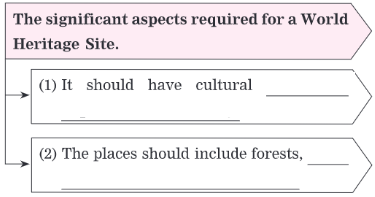
     A World Heritage Site is a site determined by the United Nations Educational, Scientific and Cultural Organization (UNESCO) to have significant cultural or natural importance to humanity. As such the sites are protected and maintained by the
International World Heritage Programme which is administered by the UNESCO World Heritage Committee. Because World Heritage Sites are places that are significant culturally and naturally, they vary in type and include forests, lakes, monuments, buildings and cities.
    World Heritage Sites can also be a combination of both cultural and natural areas. For example, Mount Huangshan in China is a site with significance to human culture because it played a role in historical Chinese art and literature. The mountain is also
significant because of its physical landscape characteristics.
     Although the idea of protecting cultural and natural heritage sites around the world began in the early twentieth century, momentum for its actual creation was not until the 1950s. In 1954, Egypt started plans to build the Aswan High Dam to collect and control water from the Nile River. The initial plan for the dam’s construction would have flooded the valley containing the Abu Simbel Temples and scores of ancient Egyptian artefacts. To protect the temples and artifacts, UNESCO launched an international campaign in 1959 that called for the dismantling and movement of the temples to higher ground. The project cost an estimated US $80 million, $40 million of which came from 50 different countries. Because of the project’s success, UNESCO and the
International Council on Monuments and Sites initiated a draft convention to create an international organization responsible for protecting cultural heritage
 
A2. Complex Factual Activity:
Complete the web:
Image
A3. Activities based on Vocabulary:
Look at the words and their meanings.Underline the correct alternatives:
(i) determine: (a) think over (b) decide (c) ask for (d) look over
(ii) monument: (a) statue (b) pillar (c) memorial building (d) fort
A4. Activities based on Contextual Grammar:
This does not mean that the book is filled with heavy Grammar.Rewrite the following sentences using 'not only ... but also' and 'as well as in two separate sentences:
(1) World Heritage Sites can be a combination of both cultural and natural areas.
A5. Personal Response:
(1) What are our duties towards preservation of any historical site?
A1. Simple Factual Activity:
Name the following:
(1) The place where the conference based on Human Environment was held _______________.
(2) State parties are elected by the _______________.

     Shortly thereafter in 1965, a White House Conference in the United States called for a “World Heritage Trust” to protect historic and cultural sites but to also protect the world’s significant natural and scenic sites. Finally, in 1968, the International Union for Conservation of Nature developed similar goals and presented them at the United Nations conference on Human Environment in Stockholm, Sweden in 1972. Following the presentation of these goals, the Convention concerning the Protection of World Cultural and Natural Heritage was adopted by UNESCO’s General Conference on November 16,1972.
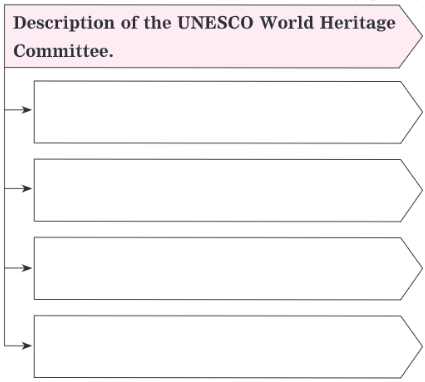
     THE WORLD HERITAGE COMMITTEE Today, the World Heritage Committee is the main group responsible for establishing which sites will be listed as a UNESCO World Heritage Site. The Committee meets once a year and consists of representatives from 21 State Parties that are elected for six year terms by the World Heritage Center’s General Assembly. The State Parties are then responsible for identifying and nominating new sites within their territory to be considered for inclusion on the World Heritage list.
 
A2. Complex Factual Activity:
Complete the web :
Image
A3. Activities based on Vocabulary:
Write from the passage nouns for the following:
(1) present (2) protect (3) conserve (4) include
A4. Activities based on Contextual Grammar:
Rewrite the sentences using 'not only....but also' and 'as well as' in two separate sentences:
(1) The State Parties are responsible for identifying and nominating new sites.
A5. Personal Response:
(1) Why do you like to visit tourist spots ?
A1. Simple Factual Activities:
Complete the sentences:
(1) A tiny bird was rushing towards _________.
(2) A heavy fire had broken out in the _________.
(3) The speaker is appealing to globalise _________.
(4) The tiny bird was going to _________.

     We can do it ...
     You may ask that - what can one person do? I would recall a story of my childhood: A heavy fire had broken out in the forest. All the animals were running away, including lion, the king of the forest. Suddenly, then he saw a tiny bird rushing towards the fire. He asked the bird, “What are you doing?” To the lion’s surprise, the bird replied “I am going to extinguish the fire.” The lion laughed and said, “How can you do it keeping just one drop of water, in your beak?” The bird was adamant, and she said, “I am doing my bit.”
     Eighteen years ago, millions of individuals marched across the globe. And demanded a new international law for the abolition of worst form of child labour, and it has happened, we did it, millions of individuals did it.
     Friends! We live in an age of rapid globalisation. We are connected through high-speed Internet. We exchange our goods and services in one single global market. Thousands of flights every day connect us from one corner to another corner of the globe. But there is one serious disconnect and there is a lack of compassion. Let us inculcate and transform these individuals’ compassion into a global compassion.
Let us globalise compassion.
     Mahatma Gandhi said, “If we are to teach real peace in this world... we shall have to begin with the children.” I humbly add, let us unite the world through the compassion for our children.
     I ask - Whose children are they who stitch footballs, yet never played with one?
     Whose children are they who harvest cocoa, yet have never tasted chocolate?
     Whose children are they who are dying of Ebola?
     Whose children are they who are kidnapped and held hostage?
     They are all our children.
     I remember an eight-year-old girl we rescued from intergenerational forced labour from stone quarries. When she was sitting in my car right after her rescue, she asked me: “Why did you not come earlier?”
     Her angry question still shakes me – and has the power to shake the whole world. Her question is for all of us. What are we doing? What are we waiting for? How many girls will we allow to go without rescue?
     Children are questioning our inaction and watching our actions. We need collective actions with a sense of urgency.
     Every single minute matters, every single child matters, every single childhood matters.
     Therefore, I challenge the passivity and pessimism surrounding our children. I challenge this culture of silence and this culture of passivity, this culture of neutrality.

A2. Complex Factual Activities:

Complete the following web:
Image

A3. Activities based on Vocabulary:
(1) Use the word 'stitch' as a Noun and a Verb in separate meaningful sentences.
A4. Activities based on Contextual Grammar:
Add a question tag:
(1) We are connected through high-speed internet.
(2) We exchange our goods and services in one single global market.
A5. Personal Response:
(1) What lesson does the story of the lion and the tiny bird teach us? 
A1. Simple Factual Activities:
Fill in the blanks:
(1) Ramlal had ________ sons and ________ daughters.
(2) All the children except Bholi were ________ and ________.

    Her name was Sulekha but since her childhood everyone had been calling her Bholi the simpleton.
    She was the fourth daughter of Numberdar Ramlal. When she was ten months old, she had fallen off the cot on her head and perhaps it had damaged some part of her brain. That was why she remained a backward child and came to be known
as Bholi, the simpleton.
     At birth the child was very fair and pretty. But when she was two years old, she had an attack of small pox. Only the eyes were saved. But the entire body was permanently disfigured by deep black pockmarks. Little Sulekha could not speak till she was five and when at last she learnt to speak, she stammered. The other children often made fun of
her and mimicked her. As a result, she talked very little.
     Ramlal had seven children, three sons and four daughters and the youngest of them was Bholi. It was a prosperous farmer’s household and there was plenty to eat and drink. All the children except Bholi were healthy and strong. The sons had been sent to
the city to study in schools and later in colleges. Of the daughters Radha, the eldest had already been married. The second daughter Mangla’s marriage had also been settled Ramlal would think of third Champa. They were good looking, healthy girls. And
it was not difficult to find bridegrooms for them.
     But Ramlal was worried about Bholi. She had neither good looks nor intelligence.
     Bholi was seven years old when Mangla was married. The same year a primary school for girls was opened in their village. The Tehsildar sahib came to perform its opening ceremony. He said to Ramlal, ‘‘As a revenue official you are the representative of the government in the village and so you must set an example to the villagers. You
must send your daughter to school.’’
      That night when Ramlal consulted his wife. She cried, ‘‘Are you crazy? If girls go to school, who will marry them?’’
      But Ramlal had not the courage to disobey the Tehsildar. At last his wife said, ‘‘I will tell you what to do. Send Bholi to school. As it is there is little chance of her getting married, with her ugly face and lack of sense. Let the teachers at school worry about her.’’

A2. Complex Factual Activities:
Give reasons:
(1) Little Sulekha used to talk very little because - _______________
A3. Activities based on Vocabulary:
Use the following phrases in the following sentences by making certain changes:
(to shout in terror, to pass on, to hand over)
(1) My sister _______________ a letter of apology to her class teacher.
(2) My father had the day off because he didn't want _______________ his flu to everyone in the office."
A4. Activities based on Contextual Grammar:
Do as directed:
(1) The child was very fair and pretty.
(Choose correct alternative to make it exclamatory.)
(a) What a fair and pretty the child was!
(b) How a fair and pretty the child was!
(c) How fair and pretty the child was!
(2) There was plenty to eat and drink.
(Pick out the infinitive.) 
A5. Personal Response:
(1) How do you feel on the first day of your school? 
A1. Simple Factual Activity:
Say whether the following statements are True or False:
(1) When the young seagull. pretended to be falling asleep, his parents took notice of him.
(2) Flying across the young seagull, the mother dropped into his beak a piece of fish.
(3) The young seagull was fed a piece of fish by his mother.
(4) The young seagull's father was preening the feathers on his white back.

     The sun was now ascending the sky, blazing on his ledge that faced the south. He felt the heat because he had not eaten since the previous nightfall.
     He stepped slowly out to the brink of the ledge, and standing on one leg with the other leg hidden under his wing, he closed one eye, then the other, and pretended to be falling asleep. Still they took no notice of him. He saw his two brothers and his sister
lying on the plateau dozing with their heads sunk into their necks. His father was preening the feathers on his white back. Only his mother was looking at him. She was standing on a little high hump on the plateau, her white breast thrust forward. Now and
again, she tore at a piece of fish that lay at her feet and then scrapped each side of her beak on the rock. The sight of the food maddened him. How he loved to tear food that way, scrapping his beak now and again to whet it.
     “Ga, ga, ga”, he cried begging her to bring him some food. “Gaw-col-ah”, she screamed back derisively. But he kept calling plaintively, and after a minute or so he uttered a joyful scream. His mother had picked up a piece of the fish and was flying across to him with it. He leaned out eagerly, tapping the rock with his feet, trying to get nearer to her as she flew across. But when she was just opposite to him, she halted, her wings motionless, the piece of fish in her beak almost within reach of his beak. He waited a moment in surprise, wondering why she did not come nearer, and then, maddened by hunger, he dived at the fish. With a loud scream he fell outwards
and downwards into space. Then a monstrous terror seized him and his heart stood still. He could hear nothing. But it only lasted a minute. The next moment he felt his wings spread outwards. The wind rushed against his breast feathers, then under his stomach, and against his wings. He could feel the tips of his wings cutting through the air. He was not falling headlong now. He was soaring gradually downwards and outwards. He was no longer afraid. He just felt a bit dizzy.

A2. Complex Factual Activity:

(1) What were the young seagull's parents doing? 
A3. Activities based on Vocabulary:
Match the words in Column 'A' with their meanings in Column 'B':

'A''B'
(1) ascending  (a) grabbed
(2) maddened (b) flying upward into the air
(3) soaring (c) made one very angry
(4) seized (d) rising up

A4. Activities based on Contextual Grammar:
Read the following sentences carefully, underline the verbs and find out the tenses in the sentences: 
(1) The sun was ascending now.
(2) Still they took no notice of him.
A5. Personal Response:
Complete the following statements:
(1) The seagull is afraid to fly because _______________ .
(2) Young birds are afraid to make their first flight because_______________.

A1. Simple Factual Activities:
Choose the correct alternatives:
(1) What kind of text is it?
(A) story (B) speech (C) interview (D) essay
(2) Which State does Mary Kom belong to?
(A) Maharashtra (B) Tamil Nadu (C) Kerala (D) Manipur

   There had to be one successful story if Indians were to survive in sports and we have that story now. Enough has been said about this great warrior who conquered the world. This warrior is none other than Mary Mangte Kom-the Komqueror and the Komrade. She is famed as a five times World Boxing Champion and the only boxer to win a medal in every one of the six world championships. In the 2012 Olympics, she became the first Indian woman boxer to qualify and win a bronze medal in the 51
kg flyweight category of Boxing.
     Kom was born in Kangthei village, Moirang Lamkhai in Churachandpur district of rural Manipur in eastern India. She came from a poor family. Her parents, Mangte Tonpa Kom and Mangte Akham Kom were tenant farmers who worked in jhum fields.
Kom grew up in humble surroundings, helping her parents with farm related chores, going to school and learning athletics initially and later boxing simultaneously. Her father was a keen wrestler in his younger age.
     She had an eager interest in athletics since childhood and the success of Dingko Singh a fellow Manipuri returned from the 1998 Bangkok Asian games with a gold medal, Kom recollects, had inspired many youngsters in Manipur to try boxing
and she too thought of giving it a try.
     Mary Kom’s career started in 2000 after her victory in the Manipur State women’s boxing championship and the regional championship in West Bengal. In 2001, she started competing at international level. She was only 18 years old when she made her international debut at the first AIBA Women’s World Boxing Championship in United States, winning a silver medal in the 48 kg weight category. Her greatness is reinforced by the way she apoligized to the whole nation for not being able to win the Gold. She is a legend for sure and an idol for all the sportswomen to look up to.

A2. Complex Factual Activities:
(1) What has added to Mary Kom's greatness as a boxing champion? 
A3. Activities based on Vocabulary:
Use the following words in your own sentences:
(1) debut :
(2) legend :
A4. Activities based on Contextual Grammar:
Choose the tail tags given in the brackets and complete the following sentences:
(isn't she?, hadn't he?, wasn't he?)
(1) Her father was a keen wrestler in his younger age, _______________
(2) Dingko Singh had inspired many youngsters in Manipur, _______________
A5. Personal Response:
(1) Write any two names of indoor games and two names of outdoor games.
A1. Simple Factual Activity:
Complete the sentences using the information from the passage:
(1) According to Mrs Bhushan,  _______________.
(2) Mr Bhushan said to his wife, "You go from one shop to another, like  _______________.

      And Sitaram, glad that he had been of service to both a customer and his friend, hoisted his bag on his shoulders and went his way.
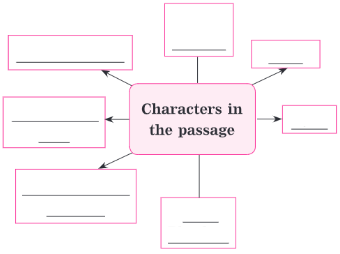
      Mrs. Srivastava had to do some shopping. She gave instructions to the ayah about looking after the baby, and told the cook not to be late with the midday meal. Then she set out for the Pipalnagar market place, to make her customary tour of the cloth shops.
      A large shady tamarind tree grew at one end of the bazaar, and it was here that Mrs. Srivastava found her friend Mrs. Bhushan sheltering from the heat. Mrs. Bhushan was fanning herself with a large handkerchief. She complained of the summer, which she affirmed, was definitely the hottest in the history of Pipalnagar. She then showed Mrs. Srivastava a sample of the cloth she was going to buy, and for five minutes they discussed its shade, texture and design. Having exhausted this topic, Mrs. Srivastava
said, ‘Do you know, my dear, that Seth Govind Ram’s bank can’t even pay its employees? Only this morning I heard a complaint from their sweeper, who hasn’t received his wages for over a month!’
     ‘Shocking!’ remarked Mrs. Bhushan. ‘If they can’t pay the sweeper they must be in a bad way. None of the others could be getting paid either.’
     She left Mrs. Srivastava at the tamarind tree and went in search of her husband, who was sitting in front of Kamal Kishore’s photography shop, talking with the owner.
    ‘So there you are!’ cried Mrs. Bhushan. ‘I’ve been looking for you for almost an hour. Where did you disappear ?’
    ‘Nowhere,’ replied Mr. Bhushan. ‘Had you remained stationary in one shop, I might have found you. But you go from one shop to another, like a bee in a flower garden.’
    ‘Don’t start grumbling. The heat is trying enough.I don’t know what’s happening to Pipalnagar. Even the bank’s about to go bankrupt.’   

A2. Complex Factual Activity:
Complete the following web:
Image
A3. Activities based on Vocabulary:
Complete the followinig sentences by using the correct form of the phrases from the bracket:
[to complain of, at the end of, to set out for]
(1) There is an old Shiva's temple at the end of the village.
(2) The travellers set out early in the morning for the tour.
A4. Activities based on Contextual Grammar:
(1) That summer was the hottest in the history of Pipalnagar.
(Change the sentence into Positive Degree.)
(2) I heard a complaint.
(Begin the sentence with 'A complaint.....')
A5. Personal Response:
(1) Do you think, Mr Bhushan was right to compare his wife with a bee in a flower garden? Give your reason.
A1. Simple Factual Activities:
Answer in one-two words:
(1) Coach
(2) Interviewer
(3) Place of Training
(4) Total medals won in 2012 Olympics by India

     In an exclusive interview with Sportskeeda correspondent Taruka Srivastava, Olympic Bronze medalist Mary Kom talked about her preparation for the Olympics and her elation at winning a medal.
Interviewer : First things first- you’re the first Indian female boxer to win an Olympics medal for India. Has the feeling completely sunk in ?
Mary Kom : I am really happy with my achievement and yes it is yet to sink in. I am just so exhilarated.
Interviewer : You were the only female representative from India in boxing. Did that put additional pressure on you?
Mary Kom : No, not at all. I was pretty confident about myself. I knew.
Interviewer : Your coach Charles Atkinson was not allowed to accompany you to the Olympics. How did that affect your preparations ?
Mary Kom : Well I did miss him there but thankfully, we had already done our homework and I was well prepared.
Interviewer : During your preparations for the Olympics, you sparred with the male boxers of the Indian contigent. Who was your favourite sparring partner ?
Mary Kom : (Laughs) Well, I trained hard in Pune and the male boxers were kind enough to practise with me whenever I required them. To name a favourite would be unfair.
Interviewer : You were quoted saying “Adams was very clever, a counter - puncher but, although she carried power, she wasn’t very tactical. I was scoring but the judges were not pressing the buttons.” Do you think dodgy judging was part of the reason for
your loss in the semi - finals?
Mary Kom : Yes, I think some of the decisions were unfortunate and did not work to my benefit.
Interviewer : India managed just 6 medals in the 2012 Olympics even though we are a nation of 1.3 billion people. Where do you think a change is required to help us win medals that are proportionate with our population ?
Mary Kom : I think more and more people should take up sports as a full - time career if we want more gold medals. More corporates should come in and sponsor players so that the players don’t have any financial pressure and can just focus on their games.

A2. Complex Factual Activities:
(1) What failed to pressurize Mary Kom during the Olympics? 
A3. Activities based on Vocabulary:
Make sentences of your own using the following words:
(1) elation:
(2) sponsor:
A4. Activities based on Contextual Grammar:
Do as directed:
(1) Charles Atkinson was not allowed to accompany Mary to the Olympics.
(Make it affirmative.)
(2) Some of the decisions did not work to my benefit. (Make it Affirmative.)
A5. Personal Response:
(1) Do you think financial support is very necessary for the sportsmen? Why? 
A1. Simple Factual Activities:
State whether the following statements are True or False:
(1) On the rocky beach the writer found rocks curved and sculpted by the water
(2) When we listen to the Nature, it leaves us in complete awe.
(3) We should not live our life to its fullest.
(4) The water was shaped by the rocks.

To see a world in a grain of sand
     And a heaven in a wild flower,
Hold infinity in the palm of your hand
      And eternity in an hour
    We instinctively turn to outdoor activities and nature as a way of relaxing and enhancing our wellbeing. Nature soothes and nurtures. Nature fulfils and motivates. Nature whispers and commands.
    Are you listening?
    When I do, it leaves me in complete awe.
    We have a hibiscus plant in our garden. Every fortnight a flower blooms on it big, bright and tender. Through the day it smiles with the sun and dances with the wind, but as evening approaches, it starts wilting. The morning after, it withers completely and by evening it falls and becomes one with the earth again. The flower comes to life only for a day, yet it does so in full splendour. What if we too lived our life, however short, to its fullest?
    We went to a rocky beach and saw the spread of the majestic ocean and the rocks alongside, carved, sculpted and shaped by the water. Water is so gentle, rock so hard, yet, as the water flows over it every day, for years, the rock gives in. It takes the shape that the water commands. Our problems are so colossal and we are so small, yet if we persist.... 

A2. Complex Factual Activities:
Complete the following sentences:
(1) _______________ smiles with the sun and dances with the wind.
(2) 'However short our life is _______________ is the lesson we learn from the hibiscus plant..
(3) The rock on the beach was _______________.
(4) The poet William Blake tells us to hold _______________ eternity in an hour.
A3. Activities based on Vocabulary:
Find synonyms/one word from the text for the following words/phrases.
(1) a strong feeling of fear or respect
(2) to direct authoritatively
(3) large and impressively beautiful
A4. Activities based on Contextual Grammar:
Use 'not only..... but also'.
(1) Outdoor activities enhance and relax our well- being.
(2) Nature whispers and commands.
A5. Personal Response:
(1) The rock is hard, but is it dominating? Give reason for your answer.
A1. Simple Factual Activity:
State whether the following statements are Rumours or Facts:
(1) The manager told the customers to go home and come back next day.
(2) Nathu was disgusted to see the broken glass and  stonescluttering the steps.

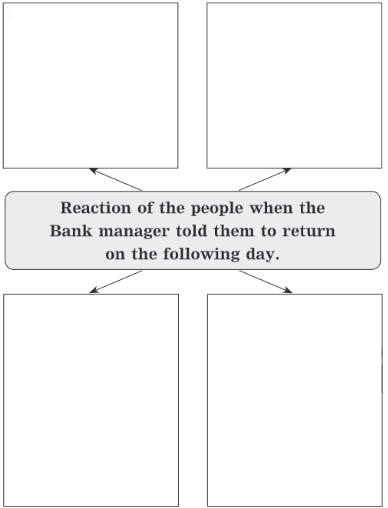
     People were turned back from the counters and told to return the following day. They did not like the sound of that. And so they gathered outside, on the steps of the bank shouting ‘Give us our money or we’ll break in!’ and ‘Fetch the Seth, we know he’s hiding in a safe deposit locker!’ Mischief makers who didn’t have a paisa in the bank, joined the crowd and aggravated their mood. The manager stood at the door and tried to placate them. He declared that the bank had plenty of money but no immediate means of collecting it; he urged them to go home and come back the next day.
    ‘We want it now!’ chanted some of the crowd.‘Now, now, now!’
     And a brick hurtled through the air and crashed through the plate glass window of the Pipalnagar Bank.
    Nathu arrived next morning to sweep the steps of the bank. He saw the refuse and the broken glass and the stones cluttering the steps. Raising his hands in a gesture of horror and disgust he cried: ‘Hooligans! Sons of donkeys! As though it isn’t bad enough to be paid late, it seems my work has also to be increased!’ He smote the steps with his broom scattering the refuse.
    Good morning, Nathu,’ said the washerman’sboy, getting down from his bicycle. ‘Are you ready to take up a new job from the first of next month? You’ll have to I suppose, now that the bank is going out of business.’
    ‘How’s that?’ said Nathu. ‘Haven’t you heard? Well you’d better wait here until half the population of Pipalnagar arrives to claim their money.’ And he waved cheerfully he did not have a bank account and sped away on his cycle.
     Nathu went back to sweeping the steps, muttering to himself. When he had finished his work, he sat down on the highest step, to await the arrival of the manager. He was determined to get his pay. ‘Who would have thought the bank would collapse!’ he said to himself, and looked thoughtfully into the distance. ‘I wonder how it could have happened …

A2. Complex Factual Activity:
Complete the web:
Image
A3. Activities based on Vocabulary:
Write one word for the following:
(1) a person who deliberately causes trouble to people.
(2) a person who washes clothes for other people.
A4. Activities based on Contextual Grammar:
Do as directed :
(1) Nathu raised his hands in a gesture of horror. He cried.
(Join the sentences beginning with the word 'Raising'.)
(2) He was determined to get his pay.
(Change the sentence into exclamatory sentence.)
A5. Personal Response:
(1) How are rumours spread? Are the rumours harmful? Why?/Why not?