MCQ
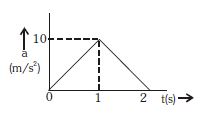
Acceleration-time graph is given. If initial velocity is $5\,\,m/s,$  then velocity after $2$ $seconds$ is.......$m/s$
  • A
    $10$
  • $15$
  • C
    $20$
  • D
    $0$

Answer

Correct option: B.
$15$
b
$\Delta v\,\,=\,\,$ area under $(a-t)$  graph

$\Rightarrow \,\,v\,-\,5\,\,=\,\,\frac {1}{2}\,\,\times \,\,10\,\,\times \,\,2\,\,\Rightarrow \,\,v\,=\,15\,\,m/s$

Need a full question paper?

Generate a complete, print-ready paper with questions like this in minutes — across 16+ boards, with answer keys.

Start Generating Free

Similar questions

The terminal velocity of a copper ball of radius $2.0 \;mm$ falling through a tank of oll at $20\,^{\circ} C$ is $6.5 \;cm s ^{-1} .$ Compute the viscosity of the oil at $20\,^{\circ} C .$ Density of oil is $1.5 \times 10^{3} \;kg m ^{-3},$ density of copper is $8.9 \times 10^{3} \;kg m ^{-3}$
A container with rigid walls is covered with perfectly insulating material. The container is divided into two parts by a partition. One part contains a gas while the other is fully evacuated (vacuum). The partition is suddenly removed. The gas rushes to fill the entire volume and comes to equilibrium after a little time. If the gas is not ideal, then
The relation between phase difference  $ (\Delta \phi) $ and path difference $ (\Delta x) $ is
The value of surface tension of a liquid at critical temperature is
Newton's law of cooling is a special case of
On heating a uniform metallic cylinder length increases by $3 \%$. The area of cross-section of its base will increase by ........... $\%$
A jar contains a gas and few drops of water at $T K.$ The pressure in the jar is $830 \,mm$ of mercury. The temperature of jar is reduced by $1\%.$ The saturated vapour pressure of water at the two temperatures are $30 \,mm$ and $ 25\, mm$ of mercury. Then the new pressure in the jar will be ..... $mm$ of $Hg$
In which case, work done will be zero:
Radius of an air bubble at the bottom of the lake is $r$  and it becomes $ 2r $ when the air bubbles rises to the top surface of the lake. If $P $ $cm$  of water be the atmospheric pressure, then the depth of the lake is
A point mass $M$ moving with a certain velocity collides with a stationary point mass $M / 2$. The collision is elastic and in one-dimension. Let the ratio of the final velocities of $M$ and $M / 2$ be $x$. The value of $x$ is