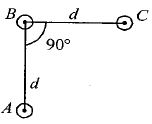
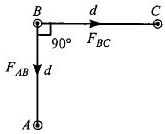
An arrangement of three parallel straight wires placed perpendicular to plane of paper carrying same current $'I'$ along the same direction as shown in figure. Magnitude of force per unit length on the middle wire $'B'$ is given by
NEET 2017, Medium


Download our appand get started for free
Experience the future of education. Simply download our apps or reach out to us for more information. Let's shape the future of learning together!No signup needed.*
Similar Questions
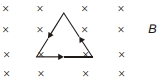
- 1A wire is bent in the form of an equilateral triangle of side $100 \,cm$ and carries a current of $2 \,A$. It is placed in a magnetic field of induction $2.0 \,T$ directed perpendicular into the plane of paper. The direction and magnitude of magnetic force acting on each side of the triangle will beView Solution
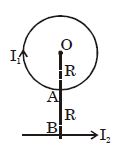
- 2In the diagram, $I_1$ , $I_2$ are the strength of the currents in the loop and infinite long straight conductor respectively. $OA = AB = R$ . The net magnetic field at the centre $O$ is zero. Then the ratio of the currents in the loop and the straight conductor isView Solution
- 3A $36 \,\Omega$ galvanometer is shunted by resistance of $4\,\Omega$. The percentage of the total current, which passes through the galvanometer isView Solution
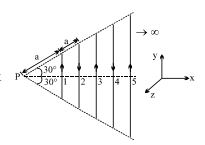
- 4Infinite number of straight wires each carrying current $I$ are equally placed as shown in the figure. Adjacent wires have current in opposite direction. Net magnetic field at point $P$ isView Solution
- 5View SolutionAn electron and a proton have equal kinetic energies. They enter in a magnetic field perpendicularly, Then
- 6View SolutionThe tangent galvanometer, when connected in series with a standard resistance can be used as
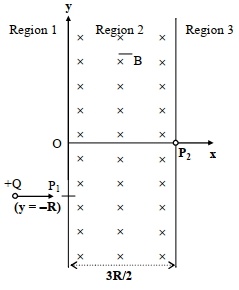
- 7A uniform magnetic field $B$ exists in the region between $x=0$ and $x=\frac{3 R}{2}$ (region $2$ in the figure) pointing normally into the plane of the paper. A particle with charge $+Q$ and momentum $p$ directed along $x$-axis enters region $2$ from region $1$ at point $P_1(y=-R)$. Which of the following option(s) is/are correct?View Solution
$[A$ For $B>\frac{2}{3} \frac{p}{QR}$, the particle will re-enter region $1$
$[B]$ For $B=\frac{8}{13} \frac{\mathrm{p}}{QR}$, the particle will enter region $3$ through the point $P_2$ on $\mathrm{x}$-axis
$[C]$ When the particle re-enters region 1 through the longest possible path in region $2$ , the magnitude of the change in its linear momentum between point $P_1$ and the farthest point from $y$-axis is $p / \sqrt{2}$
$[D]$ For a fixed $B$, particles of same charge $Q$ and same velocity $v$, the distance between the point $P_1$ and the point of re-entry into region $1$ is inversely proportional to the mass of the particle
- 8A circular loop is kept in that vertical plane which contains the north-south direction. It carries a current that is towards south at the topmost point. Let $A$ be a point on axis of the circle to the east of it and $B$ a point on this axis to the west of it. The magnetic field due to the loop :-View Solution
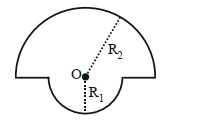
- 9The magnetic field at the centre of a wire loop formed by two semicircular wires of radii $R_1=2 \pi\ \mathrm{m}$ and $R_2=4 \pi\ \mathrm{m}$ carrying current $I=4 \mathrm{~A}$ as per figure given below is $\alpha \times 10^{-7} \mathrm{~T}$. The value of $\alpha$ is___________ (Centre $\mathrm{O}$ is common for all segments)View Solution
- 10An electron having charge $1.6 \times {10^{ - 19}}\,C$ and mass $9 \times {10^{ - 31}}\,kg$ is moving with $4 \times {10^6}\,m{s^{ - 1}}$ speed in a magnetic field $2 \times {10^{ - 1}}\,tesla$ in a circular orbit. The force acting on electron and the radius of the circular orbit will beView Solution