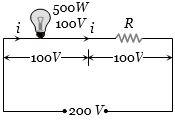
An electric bulb rated for $500\, watts$ at $100\, volts$ is used in a circuit having a $200-volt$ supply. The resistance $R$ that must be put in series with the bulb, so that the bulb draws $500\, W$ is .................. $\Omega$
Medium


Download our appand get started for free
Experience the future of education. Simply download our apps or reach out to us for more information. Let's shape the future of learning together!No signup needed.*
Similar Questions
- 1A potentiometer circuit has been set up for finding the internal resistance of a given cell. The main battery, used across the potentiometer wire, has an emf of $2.0\,V$ and a negligible internal resistance. The potentiometer wire itself is $4\,m$ long. When the resistance $R,$ connected across the given cell, has values of $(i)$ infinity $(ii)$ $9.5\,\Omega$ the balancing lengths on the potentiometer wire are found to be $3\,m$ and $2.85\,m,$ respectively. The value of internal resistance of the cell is ............... $\Omega$View Solution
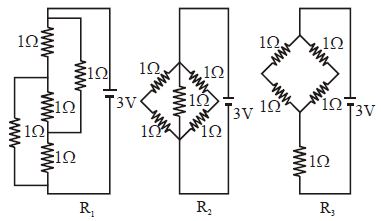
- 2Figure shows three resistor configurations $R_1,R_2$ and $R_3$ connected to $3\,V$ battery. If the power dissipated by the configuration $R_1, R_2$ and $R_3$ is $P_1, P_2$ and $P_3$ , respectively thenView Solution
- 3For a cylinder of radius $R$ current density $J =J_0 \frac{r}{R} $, where $J_0$ is a constant and $r$ is distance from axis. Calculate total currentView Solution
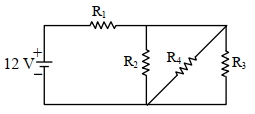
- 4In the given figure $R_1=10 \Omega, R_2=8 \Omega, R_3=4 \Omega$ and $R_4=8 \Omega$. Battery is ideal with emf $12 \mathrm{~V}$. Equivalent resistant of the circuit and current supplied by battery are respectively.View Solution
- 5A copper wire has a square cross-section, $2.0\, mm$ on a side. It carries a current of $8\, A$ and the density of free electrons is $8 \times {10^{28}}\,{m^{ - 3}}$. The drift speed of electrons is equal toView Solution
- 6A hollow cylindrical conductor has length of $3.14\,m$, while its inner and outer diameters are $4\,mm$ and $8\,mm$ respectively. The resistance of the conductor is $n \times 10^{-3}\,\Omega$.If the resistivity of the material is $2.4 \times 10^{-8}\,\Omega\,m$. The value of $n$ is $..........$View Solution
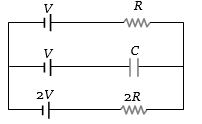
- 7View SolutionIn the given circuit, with steady current, the potential drop across the capacitor must be
- 8A thermocouple of negligible resistance produces an $e.m.f.$ of $40\,\mu V{/^o}C$ in the linear range of temperature. A galvanometer of resistance $10\; ohm$ whose sensitivity is $1\;\mu A/div$, is employed with the thermocouple. The smallest value of temperature difference that can be detected by the system will beView Solution
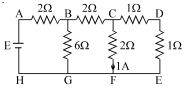
- 9The figure shows a network of resistors and $a$ battery. If $1\,A$ current flowsthrough the branch $CF$, then answer the following questions The current throughView Solution
- 10Ratio of thermal energy released in two resistor $R$ and $3 R$ connected in parallel in an electric circuit is :View Solution