In bio savart law direction of magnetic field is shown by $d\vec B = \frac{{{\mu _0}}}{{4\pi }}\frac{{I\overrightarrow {dl} \times \vec r}}{{{r^3}}}$
Easy


Download our appand get started for free
Experience the future of education. Simply download our apps or reach out to us for more information. Let's shape the future of learning together!No signup needed.*
Similar Questions
- 1One of the two identical conducing wires of length $L$ is bent in the form of a circular loop and the other one into a circular coil of $N$ identical turns. If the same current is passed in both, the ratio of the magnetic field at the central of the loop $(B_L)$ to that at the centre of the coil $(B_C),$; $.\,\frac {B_L}{B_C}$ will beView Solution
- 2A particle of mass $m$ and charge $q$ enters a magnetic field $B$ perpendicularly with a velocity $v$, The radius of the circular path described by it will beView Solution
- 3View SolutionThe magnetic moment of a circular coil carrying current is
- 4The magnetic force acting on a charged particle of charge $-2\, \mu C$ in a magnetic field of $2\, T$ acting in $y$ direction, when the particle velocity is $(2i + 3 j) \times 10^6\,\, m/s$ isView Solution
- 5A wire length $2\,m$ carrying a current of $1\,A$ is bent to form a circle. The magnetic moment of the coil isView Solution
- 6A solenoid is $1.0$ $ metre$ long and it has $4250$ $turns$. If a current of $5.0$ $ampere$ is flowing through it, what is the magnetic field at its centre $[{\mu _0} = 4\pi \times {10^{ - 7}}\,weber/amp - m]$View Solution
- 7A wire of magnetic moment $M$ is moulded according to figure, then magnetic moment becomesView Solution
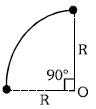
- 8The magnetic field at the origin due to a current element $i\,\overrightarrow {dl} $ placed at position $\vec r$ isView Solution
$(i)\,\,\left( {\frac{{{\mu _0}i}}{{4\pi }}} \right)\left( {\frac{{d\vec l\, \times \,\vec r}}{{{r^3}}}} \right)$
$(ii)\,\, - \left( {\frac{{{\mu _0}i}}{{4\pi }}} \right)\left( {\frac{{d\vec l\, \times \,\vec r}}{{{r^3}}}} \right)$
$(iii)\,\left( {\frac{{{\mu _0}i}}{{4\pi }}} \right)\left( {\frac{{\,\vec r \times d\vec l}}{{{r^3}}}} \right)$
$(iv)\, - \left( {\frac{{{\mu _0}i}}{{4\pi }}} \right)\left( {\frac{{\,\vec r \times d\vec l}}{{{r^3}}}} \right)$
- 9A galvanometer coil of resistance $50 \,\Omega$, show full deflection of $100\,\mu A$. The shunt resistance to be added to the galvanometer, to work as an ammeter of range $10\, mA$ isView Solution
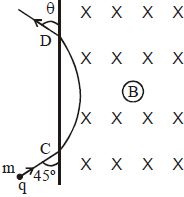
- 10A particle of mass $m = 1.67 \times 10^{-27}\, kg$ and charge $q = 1.6 \times 10^{-19} \, C$ enters a region of uniform magnetic field of strength $1$ $tesla$ along the direction shown in the figure. the radius of the circular portion of the path is :-View Solution