An electron enters in high potential region ${V_2}$ from lower potential region ${V_1}$ then its velocity
Easy


Download our appand get started for free
Experience the future of education. Simply download our apps or reach out to us for more information. Let's shape the future of learning together!No signup needed.*
Similar Questions
- 1A condenser of $2\,\mu F$ capacitance is charged steadily from $0$ to $5\,C$. Which of the following graph represents correctly the variation of potential difference $(V)$ across it's plates with respect to the charge $(Q)$ on the condenser?View Solution
- 2View SolutionWhen one electron is taken towards the other electron, then the electric potential energy of the system
- 3A metal ball of radius $R$ is placed concentrically inside a hollow metal sphere of inner radius $2R $ and outer radius $3R$. The ball is given a charge $+2Q$ and the hollow sphere a total charge $- Q$. The electrostatic potential energy of this system is :View Solution

- 4$0.2\,F$ capacitor is charged to $600\,V$ by a battery. On removing the battery, it is connected with another parallel plate condenser of $1\,F$. The potential decreases to.........$volts$View Solution
- 5A $30\,\mu F$ capacitor is charged by a constant current of $30\, mA$. If the capacitor is initially uncharged, how long does it take for the potential difference to reach $400\, V$.....$s$View Solution
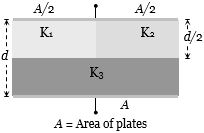
- 6A parallel plate capacitor of area $A$, plate separation $d$ and capacitance $C$ is filled with three different dielectric materials having dielectric constants ${k_1},{k_2}$ and ${k_3}$ as shown. If a single dielectric material is to be used to have the same capacitance $C$ in this capacitor, then its dielectric constant $k$ is given byView Solution
- 7View SolutionA capacitor is kept connected to the battery and a dielectric slab is inserted between the plates. During this process
- 8A $10\,\mu F$ capacitor and a $20\,\mu F$ capacitor are connected in series across a $200\;V$ supply line. The charged capacitors are then disconnected from the line and reconnected with their positive plates together and negative plates together and no external voltage is applied. What is the potential difference across each capacitorView Solution
- 9Two charged particles of masses $m$ and $2m$ have charges $+2q$ and $+q$ respectively. They are kept in uniform electric field and allowed to move for some time. The ratio of their kinetic energies will beView Solution
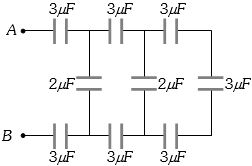
- 10The resultant capacitance between $A$ and $B$ in the following figure is equal to.....$\mu F$View Solution