An electron moving towards the east enters a magnetic field directed towards the north. The force on the electron will be directed
Easy
Download our app for free and get started
(b) Apply Fleming's left hand rule.

Download our appand get started for free
Experience the future of education. Simply download our apps or reach out to us for more information. Let's shape the future of learning together!No signup needed.*
Similar Questions
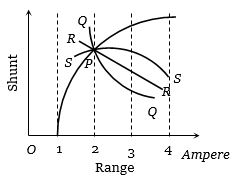
- 1The ammeter has range $1\, ampere$ without shunt. the range can be varied by using different shunt resistances. The graph between shunt resistance and range will have the natureView Solution
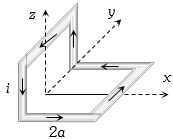
- 2A non-planar loop of conducting wire carrying a current $I$ is placed as shown in the figure. Each of the straight sections of the loop is of length $2a$. The magnetic field due to this loop at the point $P$ $(a,0,a)$ points in the directionView Solution
- 3Consider three quantities $x = E/B,$ $y =\sqrt {1/{\mu _0}{\varepsilon _0}} $ and $z = l$ . Here, $l$ is the length of a wire, $C$ is a $CR$ capacitance and $R$ is a resistance. All other symbols have standard meanings.View Solution
- 4A galvanometer has $36\,\Omega $ resistance. If a $4\,\Omega $ shunt is added to this, the fraction of current that passes through the shunt isView Solution
- 5A long solenoid has $100\,turns/m$ and carries current $i.$ An electron moves with in the solenoid in a circle of radius $2·30\,cm$ perpendicular to the solenoid axis. The speed of the electron is $0·046\,c$ ($c =$ speed of light). Find the current $i$ in the solenoid (approximate).....$A$View Solution
- 6A square loop of side $l$ is kept in a uniform magnetic field $B$ such that its plane makes an angle $\alpha$ with $\vec{B}$. The loop carries a current $i$. The torque experienced by the loop in this position isView Solution
- 7A car of mass $1000\,kg$ negotiates a banked curve of radius $90\,m$ on a fictionless road. If the banking angle is $45^o$, the speed of the car is ......... $ms^{-1}$View Solution
- 8View SolutionElectrons moving with different speeds enter a uniform magnetic field in a direction perpendicular to the field. They will move along circular paths.
- 9An $\alpha -$ particle of $1\,MeV$ energy moves on circular path in uniform magnetic field. Then kinetic energy of proton in same magnetic field for circular path of double radius is......$MeV$View Solution
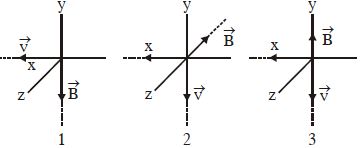
- 10The figure shows three situations when an electron moves with velocity $\vec v$ travels through a uniform magnetic field $\vec B$. In each case, what is the direction of magnetic force on the electronView Solution