Question
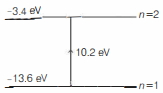
An electron with kinetic energy $E$ collides with a hydrogen atom in the ground state. The collision will be elastic

Answer

$(b)$ First excitation energy of a hydrogen atom in ground state is $10.2 \,eV$.

So, if energy of colliding electron is more than $10.2 \,eV$, then hydrogen atom absorbs $10.2 \,eV$ from kinetic energy of electron and collision will be inclastic.

If energy of electron is less than $10.2 \,eV$, then hydrogen atom does not absorbs energy and total energy before and after collision remains same and collision will be elastic.
Need a full question paper?

Generate a complete, print-ready paper with questions like this in minutes — across 16+ boards, with answer keys.
Start Generating Free

Similar questions

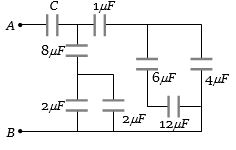
In the following circuit, the resultant capacitance between $A$ and $B$ is $1\,\mu F$. Then value of $C$ is
An ideal gas undergoes an adiabatic process obeying the relation $PV^{4/3} =$ constant. If its initial temperature is $300\,\, K$ and then its pressure is increased upto four times its initial value, then the final temperature is (in Kelvin):
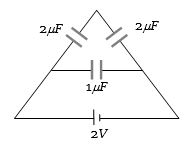
The charge on any one of the $2\,\mu \,F$ capacitors and $1\,\mu \,F$ capacitor will be given respectively (in $\mu \,C$) as
A body of mass $60 g$ experiences a gravitational force of $3.0 N$, when placed at a particular point. The magnitude of the gravitational field intensity at that point is ..... $N/ kg$
A radioactive sample disintegrates via two independent decay processes having half lives $T _{1 / 2}^{(1)}$ and $T _{1 / 2}^{(2)}$ respectively. The effective half- life $T _{1 / 2}$ of the nuclei is
When a conservative force does positive work on a body, then the
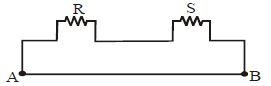
In a meter bridge, the null point is found at a distance of $25\, cm$ from $A$. If now a resistance of $10\,\Omega $ is connected in parallel with $S$, the null point occurs at mid point of $AB$. The value of $R$ is ................. $\Omega$
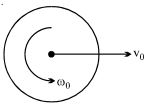
$A$ uniform sphere of radius $R$ is placed on $a$ rough horizontal surface and given a linear velocity $v_0$ angular velocity $\omega_0$ as shown. The sphere comes to rest after moving some distance to the right. It follows that:
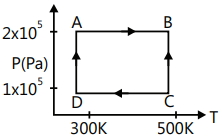
Two moles of helium gas are taken over the cycle $ABCDA$, as shown in the $P-T$ diagram. Assuming the gas to be ideal the work done on the gas in taking it from $A $ to $B$ is ...... $R$
The temperature, at which the root mean square velocity of hydrogen molecules equals their escape velocity from the earth is closest to : [Boltzmans Constant $k_B = 1.38\times10^{-23}\, J / K$ Avogadro number $N_A = 6.02\times10^{26}\, / kg$ Radius of Earth $: 6.4\times10^6\, m$ Gravitation acceleration on Earth $= 10\, ms^{-2}$]