$Assertion :$ In isothermal process whole of the heat supplied to the body is converted into internal energy.
$Reason :$ According to the first law of thermodynamics : $\Delta Q = \Delta U + p\Delta V$
$Reason :$ According to the first law of thermodynamics : $\Delta Q = \Delta U + p\Delta V$
AIIMS 1997, Easy


Download our appand get started for free
Experience the future of education. Simply download our apps or reach out to us for more information. Let's shape the future of learning together!No signup needed.*
Similar Questions
- 1The efficiency of carnot engine is $50\%$ and temperature of sink is $500\,K$ . If temperature of source is kept constant and its efficiency raised to $60\%$ , then the required temperature of the sink will be .... $K$View Solution
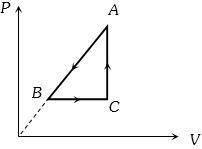
- 2$P-V$ diagram of a cyclic process $ABCA$ is as shown in figure. Choose the correct statementView Solution
- 3If $\Delta U$ and $\Delta W$ represent the increase in internal energy and work done by the system respectively in a thermodynamical process, which of the following is true?View Solution
- 4View SolutionFor adiabatic process, wrong statement is
- 5View SolutionAn ideal diatomic gas is heated at constant pressure. The ratio of the work done to the heat supplied is
- 6View SolutionThe internal energy of an ideal gas increases during an isothermal process when the gas is
- 7View SolutionA gas is compressed isothermally to half its initial volume. The same gas is compressed separately through an adiabatic process until its volume is again reduced to half. Then
- 8View SolutionThe efficiency of a Carnot engine depends upon
- 9View SolutionTwo gases have the same initial pressure, volume and temperatue. They expand to the same final volume, one adiabatically and the other isothermally
- 10A solid body of constant heat capacity $1\ J/^o C$ is being heated by keeping it in contact with reservoirs in two ways :View Solution
$(i)$ Sequentially keeping in contact with $2$ reservoirs such that each reservoir supplies same amount of heat.
$(ii)$ Sequentially keeping in contact with $8$ reservoirs such that each reservoir supplies same amount of heat.
In both the cases body is brought from initial temperature $100^o C$ to final temperature $200^o C$. Entropy change of the body in the two cases respectively is :