MCQ
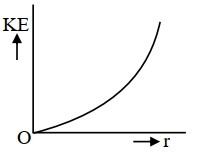
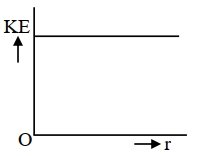
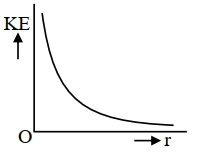
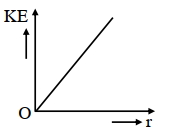
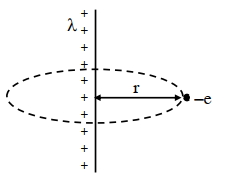
An infinitely long positively charged straight thread has a linear charge density $\lambda \mathrm{Cm}^{-1}$. An electron revolves along a circular path having axis along the length of the wire. The graph that correctly represents the variation of the kinetic energy of electron as a function of radius of circular path from the wire is :
  • A


  • C

  • D

Answer

Correct option: B.

b
Electric field $\mathrm{E}$ at a distance $\mathrm{r}$ due to infinite long wire is $E=\frac{2 \mathrm{k} \lambda}{\mathrm{r}}$

Force of electron $\Rightarrow \mathrm{F}=\mathrm{eE}$

$F=e\left(\frac{2 k \lambda}{r}\right)$

$F=\frac{2 k \lambda e}{r}$

This force will provide required centripetal force

$\mathrm{F} =\frac{\mathrm{mv}^2}{\mathrm{r}}=\frac{2 \mathrm{k} \lambda \mathrm{e}}{\mathrm{r}}$

$\mathrm{v}  =\sqrt{\frac{2 \mathrm{k} \lambda \mathrm{e}}{\mathrm{m}}}$

$\mathrm{KE}  =\frac{1}{2} \mathrm{mv}^2=\frac{1}{2} \mathrm{~m}\left(\frac{2 \mathrm{k} \lambda \mathrm{e}}{\mathrm{m}}\right)$

$=\mathrm{k} \lambda \mathrm{e}$

This is constant so option $(2)$ is correct.

Need a full question paper?

Generate a complete, print-ready paper with questions like this in minutes — across 16+ boards, with answer keys.

Start Generating Free

Similar questions

Two identical thin rings, each of radius $R $ meter are coaxially placed at distance $R$ meter apart. If $Q_1$ and $Q_2$ coulomb are respectively the charges uniformly spread on the two rings, the work done in moving a charge $q$ from the centre of one ring to that of the other is
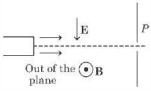
A collimated beam of charged and uncharged particles is directed towards a hole marked $P$ on a screen as shown below. If the electric and magnetic fields as indicated below are turned $ON$
The value of the gas constant $(R)$ calculated from the perfect gas equation is $8.32\, joules/gm \,mole\, K,$ whereas its value calculated from the knowledge of ${C_P}$ and ${C_V}$ of the gas is $1.98\, cal/gm\, mole\, K.$ From this data, the value of $J$ is  ......... $J/cal$
To explain his theory, Bohr used
The $Q$-value of a nuclear reaction and kinetic energy of the projectile particle, $K _{ p }$ are related as
Two coils have a mutual inductance $0.005\,H$ . The current changes in the first coil The current changes in the first coil according to the equation $I = I_0 sin\,\omega t$ , where $I_0 = 10\,A$ and $\omega  = 100\pi \,rad/s$ . The maximum value of $emf$ in the second coil will be
A string fixed at both ends is in resonance in its $2^{nd}$ harmonic with a tuning fork of frequency $f_1$. Now its one end becomes free. If the frequency of the tuning fork is increased slowly from $f_1$ then again a resonance is obtained when the frequency is $f_2$. If in this case the string vibrates in $n^{th}$ harmonic then
Ten charges are placed on the circumference of a circle of radius $R$ with constant angular separation between successive charges. Alternate charges $1,3,5,7,9$ have charge $(+q)$ each, while $2,4,6,8,10$ have charge $(-q)$ each. The potential $V$ and the electric field $E$ at the centre of the circle are respectively

(Take $V =0$ at infinity $)$

Which one of the following statements is true
A body cools from ${60^o}C$ to ${50^o}C$ in $10$ minutes. If the room temperature is ${25^o}C$ and assuming Newton's law of cooling to hold good, the temperature of the body at the end of the next $10$ minutes will be ......... $^oC$