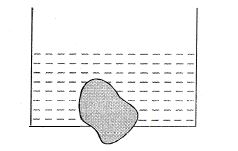
An object is fitted in a hole at base of a container as shown in figure, the force due to liquid on object is (Assume no leakage of water, volume of object inside container is $V$ and density of liquid is $\rho $ )
Medium
Download our app for free and get started
Force due to liquid will depend on the shape of the object

Download our appand get started for free
Experience the future of education. Simply download our apps or reach out to us for more information. Let's shape the future of learning together!No signup needed.*
Similar Questions
- 1A vessel contains oil (density =$ 0.8 \;gm/cm^3$) over mercury (density = $13.6\; gm/cm^3$). A homogeneous sphere floats with half of its volume immersed in mercury and the other half in oil. The density of the material of the sphere in $ gm/cm^3$ isView Solution
- 2Asphere of radius $R$ and made of material of relative density $\sigma$ has a concentric cavity of radius $r$. It just floats when placed in a tank full of water. The value of the ratio $R/r$ will beView Solution
- 3The volume of an air bubble becomes three times as it rises from the bottom of a lake to its surface. Assuming atmospheric pressure to be $75 cm$ of $Hg $ and the density of water to be $1/10$ of the density of mercury, the depth of the lake is ....... $m$View Solution
- 4A boat having a length of $3\,metre$ and breadth $2\,metre$ is floating on a lake. The boat sinks by one cm when a man gets on it. Mass of the man is ....... $kg$View Solution
- 5A cylindrical vessel of height $500 \mathrm{~mm}$ has an orifice (small hole) at its bottom. The orifice is initially closed and water is filled in it up to height $\mathrm{H}$. Now the top is completely sealed with a cap and the orifice at the bottom is opened. Some water comes out from the orifice and the water level in the vessel becomes steady with height of water column being $200 \mathrm{~mm}$. Find the fall in height (in ${m m}$ ) of water level due to opening of the orifice.View Solution
|Take atmospheric pressure $=1.0 \times 10^5 \mathrm{~N} / \mathrm{m}^2$, density of water $=1000 \mathrm{~kg} / \mathrm{m}^3$ and $g=10 \mathrm{~m} / \mathrm{s}^2$. Neglect any effect of surface tension.]
- 6View SolutionBernoulli's principle does not explain
- 7An aeroplane of mass $3 \times 10^4\,kg$ and total wing area of $120\,m^2$ is in a level flight at some height. The difference in pressure between the upper and lower surfaces of its wings in kilopascals is........... $kPa$ $(g=10\,m/s^2)$View Solution
- 8Two identical cylindrical vessels with their bases at same level, each contains a liquid of density $d$ . The height of the liquid in one vessel is $ h_1$ and that in the other vessel is $h_2$ . The area of either base is $A$ . The work done by gravity in equalizing the levels when the two vessels are connected isView Solution
- 9The rate of steady volume flow of water through a capillary tube of length $ 'l' $ and radius $ 'r' $ under a pressure difference of $P$ is $V$. This tube is connected with another tube of the same length but half the radius in series. Then the rate of steady volume flow through them is (The pressure difference across the combination is $ P$)View Solution
- 10Water flows in a horizontal tube as shown in figure. The pressure of water changes by $600\, N/ m^2$ between $A$ and $B$ where the area of crosssection are $30\, cm^2$ and $15\, cm^2$ respectively. Find the rate of flow of water through the tube.View Solution