Question
$Assertion :$ Reversible systems are difficult to find in real world.
$Reason :$ Most processes are dissipative in nature.

Answer

In any process some energy is found to be converted into heat (dissipative in nature) due to which process becomes irreversible.

Need a full question paper?

Generate a complete, print-ready paper with questions like this in minutes — across 16+ boards, with answer keys.
Start Generating Free

Similar questions

A car is moving with velocity $V$. If stop after applying break at a distance of $20\; m$. If velocity of car is doubled, then how much distance it will cover (travel) after applying break
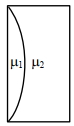
Curved surfaces of a plano-convex lens of refractive index $\mu_{1}$ and a plano-concave lens of refractive index $\mu_{2}$ have equal radius of curvature as shown in figure. Find the ratio of radius of curvature to the focal length of the combined lenses.
Heat radiations propagate with the speed of
$A$ man spinning in free space changes the shape of his body, $eg.$ by spreading his arms or curling up. By doing this, he can change his
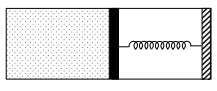
An ideal monoatomic gas is confined in a horizontal cylinder by a spring loaded piston (as shown in the figure). Initially the gas is at temperature $T _1$, pressure $P_1$ and volume $V_1$ and the spring is in its relaxed state. The gas is then heated very slowly to temperature $T_2$, pressure $P _2$ and volume $V _2$. During this process the piston moves out by a distance $x$. Ignoring the friction between the piston and the cylinder, the correct statement$(s)$ is(are)

$(A)$ If $V_2=2 V_1$ and $T_2=3 T_1$, then the energy stored in the spring is $\frac{1}{4} P_1 V_1$

$(B)$ If $V_2=2 V_1$ and $T_2=3 T_1$, then the change in internal energy is $3 P_1 V_1$

$(C)$ If $V_2=3 V_1$ and $T_2=4 T_1$, then the work done by the gas is $\frac{7}{3} P_1 V_1$

$(D)$ If $V_2=3 V_1$ and $T_2=4 T_1$, then the heat supplied to the gas is $\frac{17}{6} P_1 V_1$
In an inelastic collision, what is conserved
A particle of mass $0.01 \;kg$ travels with velocity given by $4 \hat{ i }+16 \hat{ k } \;ms ^{-1}$. After sometime, its velocity becomes $8 \hat{ i }+20 \hat{ j }\;ms ^{-1}$. The work done on particle during this interval of time is ...... $J$
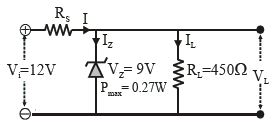
A $9\,V$ stabilised voltage supply is required to run a car stereo system from the car's $12\,V$ battery. A zener diode with $V_z = 9\,V$ and $P_{max} = 0.27\, W$ is to be used as the voltage regulator. The load resistance is $450\,\Omega $. The value of series resistor is....$\Omega $
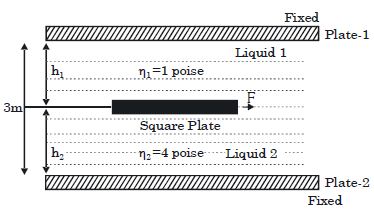
A thin square plate of side $2\ m$ is moving at the interface of two very viscous liquids of viscosities ${\eta _1} = 1$ poise and ${\eta _2} = 4$ poise respectively as shown in the figure. Assume a linear velocity distribution in each fluid. The liquids are contained between two fixed plates. $h_1 + h_2 = 3\ m$ . A force $F$ is required to move the square plate with uniform velocity $10\ m/s$ horizontally then the value of minimum applied force will be ........ $N$
A person can not see the objects clearly placed at a distance more than $40\, cm$. He is advised to use a lens of power