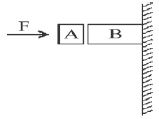
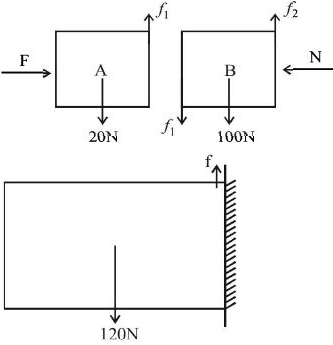
Given in the figure are two blocks $A$ and $B$ of weight $20\ N$ and $100\ N,$ respectively. These are being pressed against a wall by a force $F$ as shown. If the coefficient of friction between the blocks is $0.1$ and between block $B$ and the wall is $0.15$, the frictional force applied by the wall on block $B$ is ........... $N$
JEE MAIN 2015, Medium


Download our appand get started for free
Experience the future of education. Simply download our apps or reach out to us for more information. Let's shape the future of learning together!No signup needed.*
Similar Questions
- 1$A$ block of mass $M$ is placed on $a$ horizontal surface and it is tied with an inextensible string to $a$ block of mass, as shown in figure. A block of mass $m_0$ is also placed on $M$ If friction force exists between the block $M$ and the block $m_0$ and not between the block $M$ and the horizontal surface, then the minimum value of $\mu$ for which the block m remains stationary isView Solution

- 2View SolutionIf the normal force is doubled, the coefficient of friction is
- 3View SolutionMaximum force of friction is called
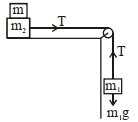
- 4Two masses $m_1 = 5\ kg$ and $m_2 = 10\ kg$, connected by an inextensible string over a frictionless pulley, are moving as shown in the figure. The coefficient of friction of horizontal surface is $0.15$. The minimum weight $m$ that should be put on top of $m_2$ to stop the motion is $...... kg$View Solution
- 5A $2 \,kg$ mass starts from rest on an inclined smooth surface with inclination $30^°$ and length $2\, m$. ...... $m$ will it travel before coming to rest on a frictional surface with frictional coefficient of $0.25$View Solution
- 6A heavy uniform chain lies on a horizontal table-top. If the coefficient of friction between the chain and table surface is $0.25$, then the maximum fraction of length of the chain, that can hang over one edge of the table is ...... $\%$View Solution
- 7A disc with a flat small bottom beaker placed on it at a distance $R$ from its center is revolving about an axis passing through the center and perpendicular to its plane with an angular velocity $\omega$. The coefficient of static friction between the bottom of the beaker and the surface of the disc is $\mu$. The beaker will revolve with the disc ifView Solution
- 8A child weighing $25 \,kg$ slides down a rope hanging from a branch of a tall tree. If the force of friction acting against him is $200 \,N$, the acceleration of child is ........... $m / s^2$ $\left(g=10 \,m / s ^2\right)$View Solution
- 9A pen of mass $m$ is lying on a piece of paper of mass $M$ placed on a rough table. If the coefficients of friction between the pen and paper and the paper and the table are $\mu_1$ and $\mu_2$, respectively. Then, the minimum horizontal force with which the paper has to be pulled for the pen to start slipping is given byView Solution
- 10At time $t=0$, a disk of radius $1 m$ starts to roll without slipping on a horizontal plane with an angular acceleration of $\alpha=\frac{2}{3} rad s ^{-2}$. A small stone is stuck to the disk. At $t=0$, it is at the contact point of the disk and the plane. Later, at time $t=\sqrt{\pi} s$, the stone detaches itself and flies off tangentially from the disk. The maximum height (in $m$ ) reached by the stone measured from the plane is $\frac{1}{2}+\frac{x}{10}$. The value of $x$ is. . . . . . .[Take $g=10 m s ^{-2}$.]View Solution