Question
Explain redox reactions on the basis of electron transfer. Give suitable examples.
Answer


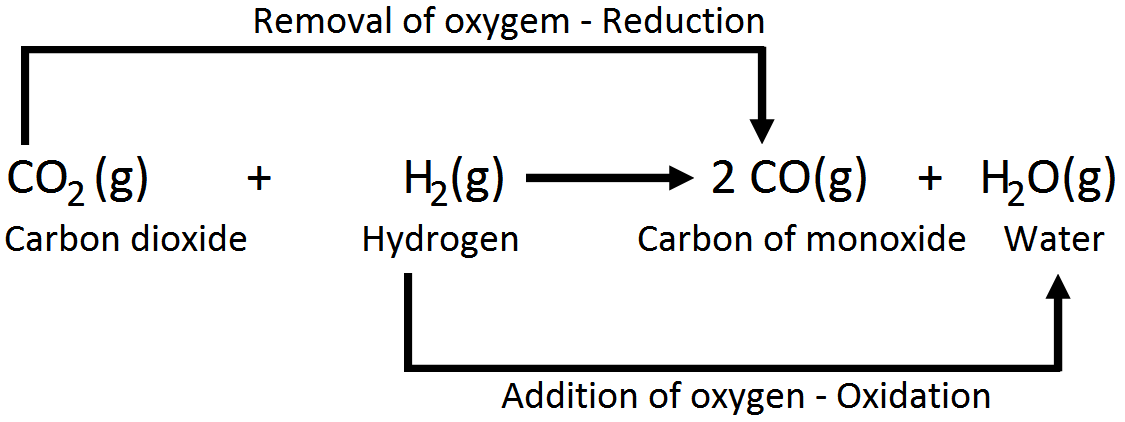
Redox reactions are the reactions in which the oxidation and reduction process are carried out simultaneously i.e. one reactant is getting reduced while the other gets oxidized. Such reactions are called oxidation reduction reactions or redox reactions .
Oxidation- Oxidation is defined as a process that involves a gain of oxygen or a loss of hydrogen and loss of electrons.
Reduction- It is defined as a process that involves gain of hydrogen and electrons and loss of oxygen.

Need a full question paper?

Generate a complete, print-ready paper with questions like this in minutes — across 16+ boards, with answer keys.
Start Generating Free

Similar questions

1. Will $CCl _4$ give a white precipitate of AgCl on heating it with $AgNO _3$ ?
2. Identify the functional groups present in the following compounds.
Image
Explain why the following compounds behave as Lewis acids?
  1. $BCl_3$.
  2. $AlCl_3$.
Calculate the mass percent of different elements present in sodium sulphate $\left(\mathrm{Na}_2 \mathrm{SO}_4\right)$.
Explain isomerism and nomenclature of alkynes.
  1. Write outer electronic configuration of Cr atom. Why are half filled orbitals more stable?
  2. An electron has a velocity of $50 \mathrm{~ms}^{-1}$, accurate upto $99.99 \%$. Calculate the uncertainty in locating its position. (Mass of electron $=9.1 \times 10^{-31} \mathrm{~kg}, \mathrm{~h}=6.6 \times 10^{-34} \mathrm{~J}$ s)
  3. Write the atomic number of the element in which filling of 3d sub-shell in the atom just starts.
The energy of $\sigma 2 \mathrm{p}_{\mathrm{z}}$ molecular orbital is greater than $2 \mathrm{p}_{\mathrm{x}}$ and $2 \mathrm{p}_{\mathrm{y}}$ molecular orbitals in nitrogen molecule. Write the complete sequence of energy levels in the increasing order of energy in the molecule. Compare the relative stability and the magnetic behaviour of the following species:
$\mathrm{N}_2, \mathrm{~N}^{+}{ }_2, \mathrm{~N}_2^{-}, \mathrm{N}^{2+}{ }_2$
The pH of milk, black coffee, tomato juice, lemon juice and egg white are 6.8, 5.0, 4.2, 2.2 and 7.8 respectively. Calculate corresponding hydrogen ion concentration in each.
Match Column I with Column II.
 
Column I
 
Column II
(i)
Dumas method.
(a)
$\mathrm{AgNO}_3$
(ii)
Kjeldahl’s method.
(b)
Silica gel.
(iii)
Carius method.
(c)
Nitrogen gas.
(iv)
Chromatography
(d)
Free radicals.
(v)
Homolysis
(e)
Ammonium sulphate.
What do you meant by oxidation number or oxidation state? Give the rules to calculate the oxidation number.
What are the major causes of water pollution? Explain.