Question
$BCl _3$ is trigonal planar while $AlCl _3$ is tetrahedral in dimeric state. Explain.
OR
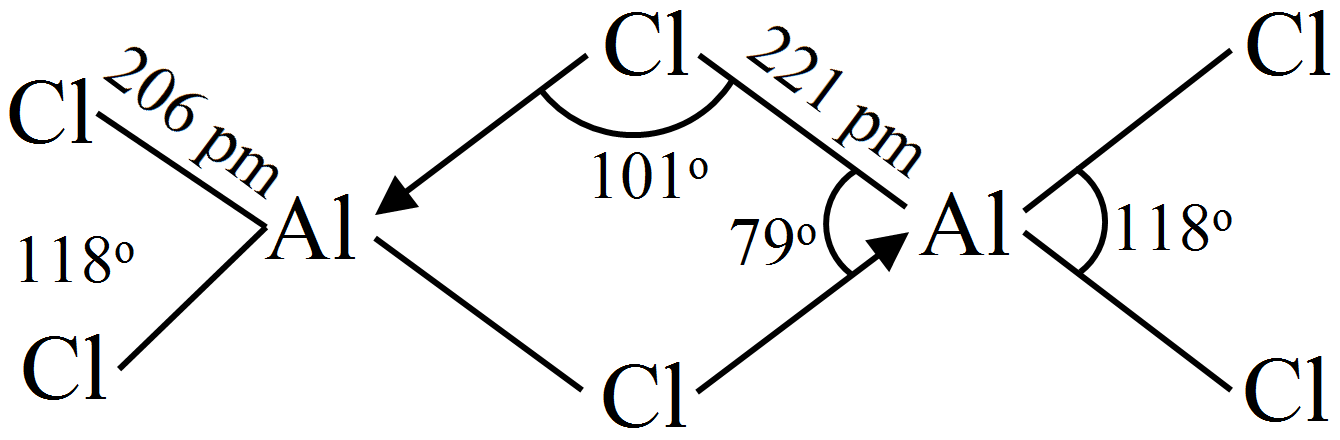
$BCl _3$ exists as monomer whereas $AlCl _3$ is dimerised through halogen bridging. Give reason. Explain the structure of the dimer of $AlCl _3$ also.
Answer

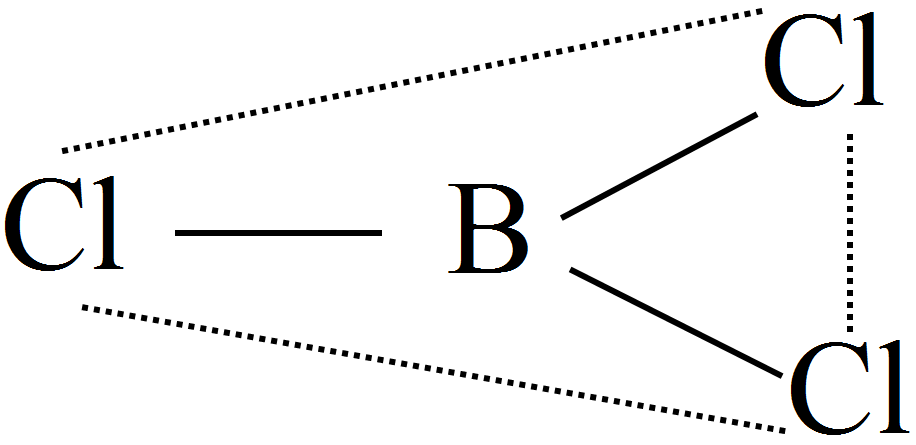
Both $BCl _3$ and $AlCl _3$ are electron deficient molecules having six electrons in the valence shell of their respective central atoms. To complete their octets, the central atom in each case can accept a pair of electrons from the chlorine atom of another molecule forming dimeric structures. However, because of small size of B , it cannot accommodate four big sized Cl atoms around it. Therefore, $BCl _3$ prefers to exist as a monomeric planar molecule in which B atom is $sp ^2$-hybridised.

On the other hand, Al because of its bigger size can easily accommodate four Cl atoms around it. As a result, $AlCl_3$ exists as a dimer. In this dimer, since the covalency of Al has increased to 4.
Therefore, Al is $sp^3$​​​​​​​-hybridised and the four Cl atoms are held tetrahedrally around it.

Need a full question paper?

Generate a complete, print-ready paper with questions like this in minutes — across 16+ boards, with answer keys.

Start Generating Free

Similar questions

Why are lithium salts commonly hydrated and those of the other alkali ions usually anhydrous?
How would you explain the fact that the first ionization enthalpy of sodium is lower than that of magnesium but its second ionization enthalpy is higher than that of magnesium?
The compression factor (compressibility factor) for one mole of a van der Waals gas at 0°C and 100 atm pressure is found to be 0.5. Assuming that the volume of a gas molecule is negligible, calculate the van der Waals' constant a.
Explain the following:
$Pb^{4+}$ acts as an oxidising agent but $Sn^{2+}$ acts as a reducing agent.
What do you understand by bond pairs and lone pairs of electrons? Illustrate by giving one exmaple of each type.
Complete the following reactions:()
  1. $\text{HCHO} +\text{H}_2\text{O}_2\xrightarrow{\ \ \ \ \ \ \ }$
  2.  
  1. $\text{KNO}_2+\text{H}_2\text{O}_2\xrightarrow{\ \ \ \ \ \ \ \ }$
Predict the formulas of the stable binary compounds that would be formed by the combination of the following pairs of elements.
  1. Lithium and oxygen.
  2. Magnesium and nitrogen.
  3. Aluminium and iodine.
  4. Silicon and oxygen.
  5. Phosphorus and fluorine.
  6. Element 71 and fluorine.
Account for the following:
  1. What is the state of hybridisation of stared carbon atoms in,
$\text{CH}_3-\text{}*\text{CH}=\text{CH}_2?$
  1. Write the molecular orbital electronic configuration of $\text{O}^-_2.$ Calculate its bond order and predict its magnetic behaviour.
How will you convert benzene into:
p-nitrobromobenzene.
The degree of ionization of a 0.1 M bromoacetic acid solution is 0.132 . Calculate the pH of the solution and the $\mathrm{pK}_{\mathrm{a}}$ of bromoacetic acid.