Question
Calculate the equilibrium constant for the following equilibrium system at 1120K. $\text{C}(\text{s})+\text{CO}_2(\text{g})+2\text{Cl}_2\stackrel{\text{K}_\text{p}}{\rightleftharpoons}2\text{COCl}_2(\text{g})$ Given the following equations and equilibrium constants: $\text{CO}(\text{s})+\text{Cl}_2(\text{g})\rightleftharpoons\text{COCl}_2(\text{g})$ $\text{Kp}_1 = 6.0 \times 10-3 \dots(1)$ $\text{CO}(\text{s})+\text{Cl}_2(\text{g})\rightleftharpoons\text{CO}_2(\text{g})$$\text{Kp}_2 = 1.3 \times 1014 \dots(2)$
Answer

$\text{Multiply Eq. (1) by 2}$
$2\text{CO}(\text{g})+2\text{Cl}_2(\text{g})\rightleftharpoons2\text{COCl}_2(\text{g})$
$\text{K}'_{\text{p}1}=\left(6.0 \times 10^{-3}\right)^2=36 \times 10^{-6}$
$\text{K}'_{\text{p}1}=\frac{[\text{COCl}_2]^2}{[\text{CO}]^2[\text{Cl}_2]^2}=36\times10^{-6}\dots(3)$
$\text{K}'_{\text{p}2}=\frac{[\text{CO}]^2}{[\text{CO}_2]}=36\times10^{14}\dots(4)$
$\text{Multiply K'p}_1 \text{ and } \text{K'p}_2$
$\text{K}'_{\text{p}}=\frac{[\text{COCl}_2]^2}{[\text{CO}_2][\text{Cl}_2]^2}$
$=46.8\times10^8=4.68\times10^9$

Need a full question paper?

Generate a complete, print-ready paper with questions like this in minutes — across 16+ boards, with answer keys.

Start Generating Free

Similar questions

How the IUPAC nomenclature of derivatives of Benzene is done? Explain with example.
How can we calculate the equivalent weight of oxidants and reductants?
Consider the cell reaction of an electrochemical cell:
$\text{Ni}\text{(s)}+2\text{Ag}^+\text{(aq)}\xrightarrow{\ \\ \ \ \ \ }\text{Ni}^{2+}\text{(aq)}+2\text{Ag}\text{(s)}$
Answer the following questions:
  1. Write anode and cathode half reactions.
  2. Mention the direction of flow of electrons.
  3. How is the electroneutrality maintained in solution of two half cells?
  4. Write the formula for calculating standard e.m.f of this cell.
  5. How does e.m.f. change when concentration of $Ag^+$ is decreased?
Among the second period elements the actual ionization enthalpies are in the order $Li < B < Be < C < O < N < F < Ne$. Explain why,
  1. Be has higher $\Delta_{\text{t}}\text{H}$ than B
  2. O has lower $\Delta_{\text{t}}\text{H}$ than N and F?
Consider the reaction of water with $F_2$ and suggest, in terms of oxidation and reduction, which species are oxidised/ reduced.
The concentration of sulphide ion in $0.1$ M HCl solution saturated with hydrogen sulphide is $1.0 \times 10^{-19} \mathrm{M}$. If $10$ mL of this is added to $5$ mL of $0.04$ M solution of the following: $\mathrm{FeSO}_4, \mathrm{MnCl}_2, \mathrm{ZnCl}_2$ and $\mathrm{CdCl}_2$. in which of these solutions precipitation will take place?
  1. $\text{MnO}_4^{2-}$ undergoes disproportionation reaction in acidic medium but does not, give reason.
  2. Give one example each of the following redox reaction:
  1. Combination reaction.
  2. Decomposition reaction.
  3. Metal displacement reaction.
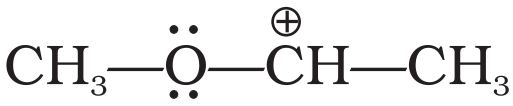
Match the ions given in Column I with their nature given in Column II.
 
Column I
 
Column II
(i)
(a)
Stable due to resonance.
(ii)
$\text{F}_3-\text{C}^\oplus$
(b)
Destabilised due to inductive effect.
(iii)
$\ \ \ \ \ \ \ \ \ \ \ \ \text{CH}_3\\\ \ \ \ \ \ \ \ \ \ \ \ \ |\\\text{CH}_3-\text{C}^\ominus\\\ \ \ \ \ \ \ \ \ \ \ \ \ \ |\\\ \ \ \ \ \ \ \ \ \ \ \ \ \text{CH}_3$
(c)
Stabilised by hyperconjugation.
(iv)
$\ \ \ \ \ \ \ \ \ \ \ \ \ _\oplus\\\text{CH}_3-\text{CH}-\text{CH}_3$
(d)
A secondary carbocation.
The ionization constant of benzoic acid is $6.46 \times 10^{–5}$ and $K_{sp}$ for silver benzoate is $2.5 \times 10^{–13}$. How many times is silver benzoate more soluble in a buffer of pH 3.19 compared to its solubility in pure water?
Account for the following:
i. Ozone layer is necessary for life.
ii. The temperature of thermosphere is $1500^{\circ} \mathrm{C}$ but a person would not feel warm in it.
iii. Increased $\mathrm{SO}_2$ concentration causes chlorosis.
iv. $\mathrm{CO}_2$ keeps the earth warm.
v. The pH of normal rain water is 5.6 .