MCQ
Can two isothermal curves cut each other
  • Never
  • B
    Yes
  • C
    They will cut when temperature is $0°C$
  • D
    Yes, when the pressure is critical pressure

Answer

Correct option: A.
Never
a
(a) If isothermal curves cut each other then at equilibrium two temperature will be there which is impossible.

Need a full question paper?

Generate a complete, print-ready paper with questions like this in minutes — across 16+ boards, with answer keys.
Start Generating Free

Similar questions

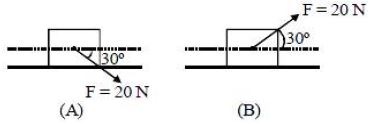
A block of mass $5\, kg$ is $(i)$ pushed in case $(A)$ and $(ii)$ pulled in case $(B)$, by a force $F = 20\, N$, making an angle of $30^o$ with the horizontal, as shown in the figures. The coefficient of friction between the block and floor is $\mu = 0.2$. The difference between the accelerations of the block, in case $(B)$ and case $(A)$ will be ........ $ms^{-2}$ .$(g = 10\, ms^{-2})$
In nuclear fission, the fission reactions proceeds with a projectile. Which of the following suits the best
A boy throws balls into air at regular interval of $2$ second. The next ball is thrown when the velocity of first ball is zero. How high do the ball rise above his hand is ...... $m$ [Take $g=9.8 \,m / s ^2$ ]
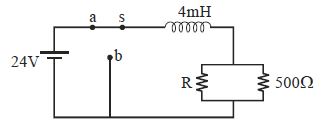
In given circuit, switch is in position $a$ , for what value of $R$ will the circuit have a time constant of $10\,\mu s$.......$K\Omega $
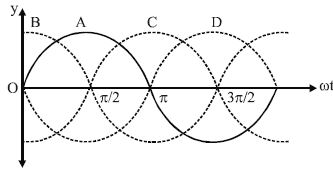
Figure given below shows four progressive waves $A, B, C$ and $D$ with their phases expressed with respect to the wave $A$ . It can be calculated from the figure that
An object is placed at a distance of $f/2$ from a convex lens. The image will be
In an elastic collision of two billiard balls which of the following quantities is not conserved during the short time of collision
The increasing order of the reactivity of the following with $LiAlH_4$ is
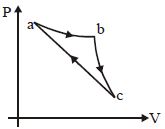
In the $P-V$ diagram shown, the gas does $5\, J$ of work in isothermal process $ab$ and $4\,J$ in adiabatic process $bc$.   .... $J$ will be the change in internal energy of the gas in straight path $c$ to $a$ ?
The ratio of de-Broglie wavelengths of molecules of hydrogen and helium which are at temperature $27^oC$ and $127^oC$ respectively is