MCQ
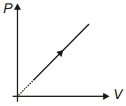
During the thermodynamic process shown in figure for an ideal gas
  • A
    $\Delta T=0$
  • B
    $\Delta Q=0$
  • C
    $W < 0$
  • $\Delta U > 0$

Answer

Correct option: D.
$\Delta U > 0$
d
(d)

For a straight $P-V$ graph line $P \propto V$

If pressure increases, volume increases then $T$ also increases $[P V \propto T]$

So $\Delta T \neq 0$

Volume increasing so work is positive, $W > 0$

and temperature also increasing so $\Delta Q > 0$

$\because \Delta Q=\Delta U+\Delta W$

So $\Delta U > 0$
Need a full question paper?

Generate a complete, print-ready paper with questions like this in minutes — across 16+ boards, with answer keys.
Start Generating Free

Similar questions

Water enters through end $A$  with speed ${v_1}$ and leaves through end $B$ with speed ${v_2}$ of a cylindrical tube $AB$. The tube is always completely filled with water. In case $I$  tube is horizontal and in case $ II$  it is vertical with end $ A $ upwards and in case $ III $ it is vertical with end $B$ upwards. We have ${v_1} = {v_2}$ for
A ring and a disc are initially at rest, side by side, at the top of an inclined plane which makes an angle $60^{\circ}$ with the horizontal. They start to roll without slipping at the same instant of time along the shortest path. If the time difference between their reaching the ground is $(2-\sqrt{3}) / \sqrt{10} \mathrm{~s}$, then the height of the top of the inclined plane, in metres, is. . . . . . Take $g=10 \mathrm{~m} \mathrm{~s}^{-2}$.
The distance of a particle moving on a circle of radius $12 \,m$ measured from a fixed point on the circle and measured along the circle is given by $s=2 t^3$ (in meters). The ratio of its tangential to centripetal acceleration at $t=2 \,s$ is .........
The maximum current that can be measured by a galvanometer of resistance $40 \,\Omega$ is $10\, mA$. It is converted into a voltmeter that can read upto $50\, V$. The resistance to be connected in series with the galvanometer is ... (in $ohm$)
A particle executes simple harmonic motion with an amplitude of $4 \mathrm{~cm}$. At the mean position, velocity of the particle is $10 \mathrm{~cm} / \mathrm{s}$. The distance of the particle from the mean position when its speed becomes $5 \mathrm{~cm} / \mathrm{s}$ is $\sqrt{\alpha} \mathrm{cm}$, where $\alpha=$____________.
Figure shows a polytropic process for an ideal gas. The work done by the gas will be in process $AB$ is
A parallel plate capacitor has capacitance $C$ . If charges of the plates are $Q$ and $-3Q$ , find the potential difference between the plates
$A$ block of mass $m$ moving with a velocity $v_0$ on a smooth horizontal surface strikes and compresses a spring of stiffness $k$ till mass comes to rest as shown in the figure. This phenomenon is observed by two observers:

$A$: standing on the horizontal surface

$B$: standing on the block To an observer

$A$, the work done by the normal reaction $N$ between the block and the spring on the block is

Assertion : Photoelectric saturation current increases with the increase in frequency of incident light.
Reason : Energy of incident photons increases with increase in frequency and as a result photoelectric current increases.
A plane electromagnetic wave travels in a medium of relative permeability $1.61$ and relative permittivity $6.44$. If magnitude of magnetic intensity is $4.5 \times 10^{-2} \;Am ^{-1}$ at a point, what will be the approximate magnitude of electric field intensity at that point$?$

(Given : permeability of free space $\mu_{0}=4 \pi \times 10^{-7}\;NA ^{-2}$, speed of light in vacuum $c =3 \times 10^{8} \;ms ^{-1}$ )