MCQ
Change in temperature of the medium changes:
- AFrequency of sound waves.
- BAmplitude of sound waves.
- CWavelength of sound waves.
- DLoudness of sound waves.
Explanation:
Speed of sound wave in amedium $\text{v}=\sqrt{\frac{\gamma\ \text{RT}}{\text{M}}}.$ here $\gamma,\text{R}$ and M are constent.
Hence, $\text{v}\propto\sqrt{\text{T}}$ (where T is tempreature of the medium)
It mence when temprature changes, speed also changes.
As, $\text{v}=\text{f}\lambda,$ where f is frequency and $\lambda$ is wavelength.
As frequency (f) remains fixed, $\text{v}\propto\lambda$ or $\lambda$ hence wavelength $(\lambda)$changes.
Hence verifies the option (c).
Generate a complete, print-ready paper with questions like this in minutes — across 16+ boards, with answer keys.
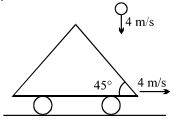
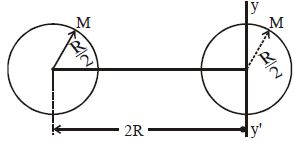
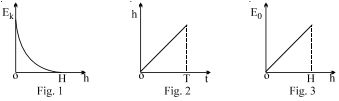
$[1]$ The graph of kinetic energy $E_k$ of the ball against height $h$ is shown in figure $1$
$[2]$ The graph of height $h$ against time $t$ is shown in figure $2$
$[3]$ The graph of gravitational energy $E_g$ of the ball against height $h$ is shown in figure $3$
Which of $A, B, C, D, E$ shows the correct answers?