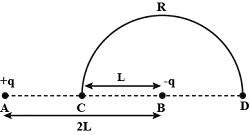
Charges $+q$ and $-q$ are placed at points $A$ and $B$ respectively which are a distance $2\,L$ apart, $C$ is the midpoint between $A$ and $B.$ The work done in moving a charge $+Q$ along the semicircle $CRD$ is
AIPMT 2007, Diffcult
Download our app for free and get started
From figure, $A C=L, B C=L, B D=B C=L$
$A D=A B+B D=2 L+L=3 L$
Potential at $C$ is given by
$V_{C}=\frac{1}{4 \pi \varepsilon_{0}}\left[\frac{q}{A C}+\frac{(-q)}{B C}\right]=\frac{1}{4 \pi \varepsilon_{0}}\left[\frac{q}{L}-\frac{q}{L}\right]=0$
Potential at $D$ is given by
$V_{D} =\frac{1}{4 \pi \varepsilon_{0}}\left[\frac{q}{A D}+\frac{(-q)}{B D}\right]=\frac{1}{4 \pi \varepsilon_{0}}\left[\frac{q}{3 L}-\frac{q}{L}\right]$
$=\frac{1}{4 \pi \varepsilon_{0}} \frac{q}{L}\left[\frac{1}{3}-1\right]=\frac{-q}{6 \pi \varepsilon_{0}}$
Work done in moving charge $+Q$ along the semicircle $CRD$ is given by
$W=\left[V_{D}-V_{C}\right](+Q)=\left[\frac{-q}{6 \pi \varepsilon_{0}}-0\right](Q)=\frac{-q Q}{6 \pi \varepsilon_{0} L}$
Comments : Potential at $C$ is zero because the charges are equal and opposite and the distances are the same. Potential at $D$ due to $-q$ is greater than that at $A$ $(+q),$ because $D$ is closer to $B .$ Therefore it is negative.

Download our appand get started for free
Experience the future of education. Simply download our apps or reach out to us for more information. Let's shape the future of learning together!No signup needed.*
Similar Questions
- 1Two charged spherical conductors of radius $R_{1}$ and $\mathrm{R}_{2}$ are connected by a wire. Then the ratio of surface charge densities of the spheres $\left(\sigma_{1} / \sigma_{2}\right)$ is :View Solution
- 2A capacitor of capacity ${C_1}$ is charged upto $V$ volt and then connected to an uncharged capacitor of capacity ${C_2}$. Then final potential difference across each will beView Solution
- 3Two positively charged particles $X$ and $Y$ are initially far away from each other and at rest. $X$ begins to move towards $Y$ with some initial velocity. The total momentum and energy of the system are $p$ and $E$.View Solution
- 4A $4\, \,\mu F$ condenser is charged to $400\, V$ and then its plates are joined through a resistance. The heat produced in the resistance is.......$J$View Solution
- 5From a supply of identical capacitors rated $8\ \mu F$, $250\ V$, the minimum number of capacitors required to form a composite $16$ $\mu F$, $1000$ $V$ is :View Solution
- 6There is an electric field $E$ in $X$-direction. If the work done on moving a charge $0.2\,C$ through a distance of $2\,m$ along a line making an angle $60^\circ $ with the $X$-axis is $4.0\;J$, what is the value of $E$........ $N/C$View Solution
- 7A cylindrical capacitor has two co-axial cylinders of length $20 \,cm$ and radii $2 r$ and $r$. Inner cylinder is given a charge $10 \,\mu C$ and outer cylinder a charge of $-10 \,\mu C$. The potential difference between the two cylinders will beView Solution
- 8A $10\, micro-farad$ capacitor is charged to $500\, V$ and then its plates are joined together through a resistance of $10\, ohm$. The heat produced in the resistance is........$J$View Solution
- 9A capacitor having capacitance $C$ is charged to a voltage $V$. It is then removed and connected in parallel with another identical capacitor which is uncharged. The new charge on each capacitor is nowView Solution
- 10View SolutionThe capacity of the conductor does not depend upon