ચોક્કસ ઉત્સેચક-ઉત્પ્રેરિત પ્રક્રિયામાં પદાર્થનું અર્ધ આયુષ્ય સમય $138\, s$ છે , પદાર્થની સાંદ્રતા માટે જરૂરી સમય $1.28\, mg \,L^{-1}$ થી $0.04\, mg\, L^{-1}$ ....... $\sec$ શું થશે
AIPMT 2011, Medium
Download our app for free and get started
c
Enzyme -catalysed reactions follow first order kinectics.
Enzyme -catalysed reactions follow first order kinectics.
therefore, Fall of concentration from \(1.28 \;\mathrm{mg}\, \mathrm{L}^{-1}\) to \(0.04\; \mathrm{mg} \,\mathrm{L}^{-1}\) involves five half-lives.
\(1.28 \stackrel{t_{1 / 2}}{\rightarrow} 0.64 \stackrel{t_{1 / 2}}{\rightarrow} 0.320 .16 \stackrel{t_{1 / 2}}{\rightarrow} 0.08 \stackrel{t_{1 / 2}}{\rightarrow} 0.04\)
therefore, Time required \(=5 \times t_{1 / 2}\)
\(=5 \times 138\; \mathrm{s}\)
\(=690\; \mathrm{s}\)

Download our appand get started for free
Experience the future of education. Simply download our apps or reach out to us for more information. Let's shape the future of learning together!No signup needed.*
Similar Questions
- 1એક ઉષ્માક્ષેપક પ્રક્રિયા $X \rightarrow Y ,30 ,kJ\, mol ^{-1}$ સક્રિયકરણ શક્તિ ધરાવે છે. પ્રક્રિયા દરમ્યાન જે (શક્તિ) ઊર્જાનો ફેરફાર $\Delta E -20\, kJ$ હોય તો, પ્રતિવર્તી પ્રક્રિયા માટે સક્રિયકરણ શક્તિ $kJ$ માં ........... છે. (પૂર્ણાક જવાબ)View Solution
- 2$A \rightarrow 2 B + C$ પ્રક્રિયા માટે જ્યારે પ્રક્રિયક $A$ ની સાંદ્રતા અનુક્રમે $0.5$ અને $1.0\, mol \,L ^{-1}$ હોય ત્યારે તેમના અર્ધઆયુુષ્યો અનુક્રમે $100\, s$ અને $50\, s$ થાય છે. પ્રક્રિયાનો ક્રમ $....$ છે.View Solution
- 3પ્રથમ ક્રમ પ્રક્રિયાનો અદ્ય આયુ સમય $69.3$ સેકન્ડ છે તો જ્યારે પ્રક્રિયકની સાંદ્રતા $0.10 $ મોલ લીટર $^{-1} $ હોય તો પ્રક્રિયક અચળાંક દર કેટલો થશે?View Solution
- 4ચોક્કસ ઉત્સેચક-ઉત્પ્રેરિત પ્રક્રિયામાં પદાર્થનું અર્ધ આયુષ્ય સમય $138\, s$ છે , પદાર્થની સાંદ્રતા માટે જરૂરી સમય $1.28\, mg \,L^{-1}$ થી $0.04\, mg\, L^{-1}$ ....... $\sec$ શું થશેView Solution
- 5ઓર્ડર ${n}$ની પ્રક્રિયા માટે, વેગ અચળાંકનો એકમ શું છે?View Solution
- 6$N_2O_5\rightarrow 2NO_2 + \frac{1}{2} O_2 $ આપેલ પ્રક્રિયા માટેView Solution
$-\frac{d[{{N}_{2}}{{O}_{5}}]}{dt}={{K}_{1}}[{{N}_{2}}{{O}_{5}}]$ ,
$\frac{d[N{{O}_{2}}]}{dt}={{k}_{2}}[{{N}_{2}}{{O}_{5}}]$ ,
$\frac{d[{{O}_{2}}]}{dt}={{K}_{3}}[{{N}_{2}}{{O}_{5}}]$
તો $K_1$, $K_2$ અને $K_3 $ વચ્ચેનો સંબંધ શું થાય?
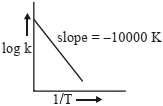
- 7પ્રક્રિયા, $a A +b B \rightarrow c C +d D$ માટે, આલેખ $\log \,k$ વિરૂધ્ધ $\frac{1}{ T }$ ને નીચે આપેલ છેView Solution
કયા તાપમાને $(K$ માં) પ્રક્રિયાનો વેગ અચળાંક $10^{-4} s ^{-1}$ થશે તે શોધો ?(નજીકના પૂર્ણાંકમાં રાઉન્ડ ઑફ)
[આપેલ : $500\, K$ પર, પ્રક્રિયાનો વેગ અચળાંક $10^{-5} s^{-1}$ છે.]
- 8જ્યારે તાપમાનનો ફેરફાર $293 K$ થી $313 K$ થાય તો ચોક્કસ પ્રક્રિયાનો દર ચતુષ્ક થાય છે. તો પ્રક્રિયાની સક્રિયકરણ ઊર્જા ......... $kJ\, mol^{-1}$ શોધો. $(R = 8.314 JK^{-1} mol^{-1}$)View Solution
- 9પ્રથમ ક્રમની પ્રક્રિયામાં પ્રક્રિયકની સાંદ્રતા $20$ મિનિટમાં $1.0\,M$ થી $0.25 \,M$ સુધી ઘટે છે. તો પ્રક્રિયાનો દર અચળાંક શું થશે?View Solution
- 10પ્રક્રિયાને ધ્યાનમાં લેતા, ${N_2}(g)\,\, + \,\,3{H_2}(g)\,\, \to \,2N{H_3}(g)\,\, $ તો $ \,\,\,\frac{{d[N{H_3}]}}{{dt}}\,\, $અને$ \, - \frac{{d[{H_2}]}}{{dt}}$વચ્ચેનો સમાનતાનો સંબંધ કયો છે?View Solution