Question
Compare and explain three distinguishing features observed in Young’s double slit interference pattern with those seen for a coherently illuminated single slit producing diffraction pattern.

Answer

Interference Diffraction
  1. Equally spaced fringes.
  2. All maxima have equal brightness.
  3. Formed by superposition of wavefronts from two coherent sources.
  4. There is a maxima at the angle $\lambda$/a.
  5. Quite a large number of fringes are easily observable.
  1. Fringes are not equally spaced.
  2. Intensity of maxima keeps on decreasing.
  3. Formed through superposition of wavelets from a single wavefront.
  4. First minima occurs at an angle $\lambda$/a.
  5. It becomes difficult to distinguish maxima and minima after a few fringes.

Need a full question paper?

Generate a complete, print-ready paper with questions like this in minutes — across 16+ boards, with answer keys.
Start Generating Free

Similar questions

State Biot – Savart law. Deduce the expression for the magnetic field at a point on the axis of a current carrying circular loop of radius ‘R’, distant ‘x’ from the centre. Hence write the magnetic field at the centre of a loop.
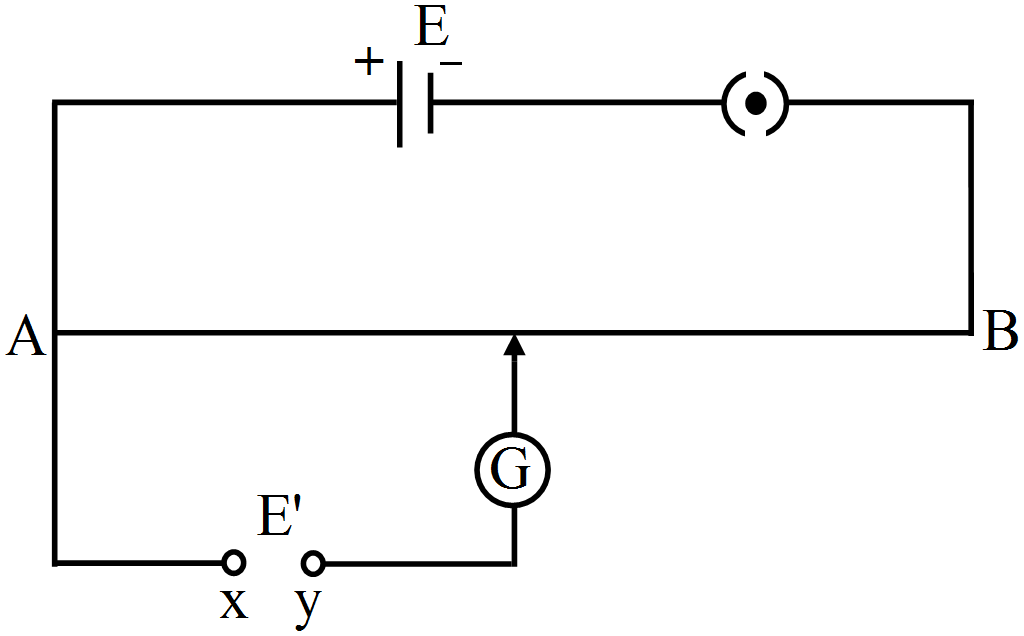
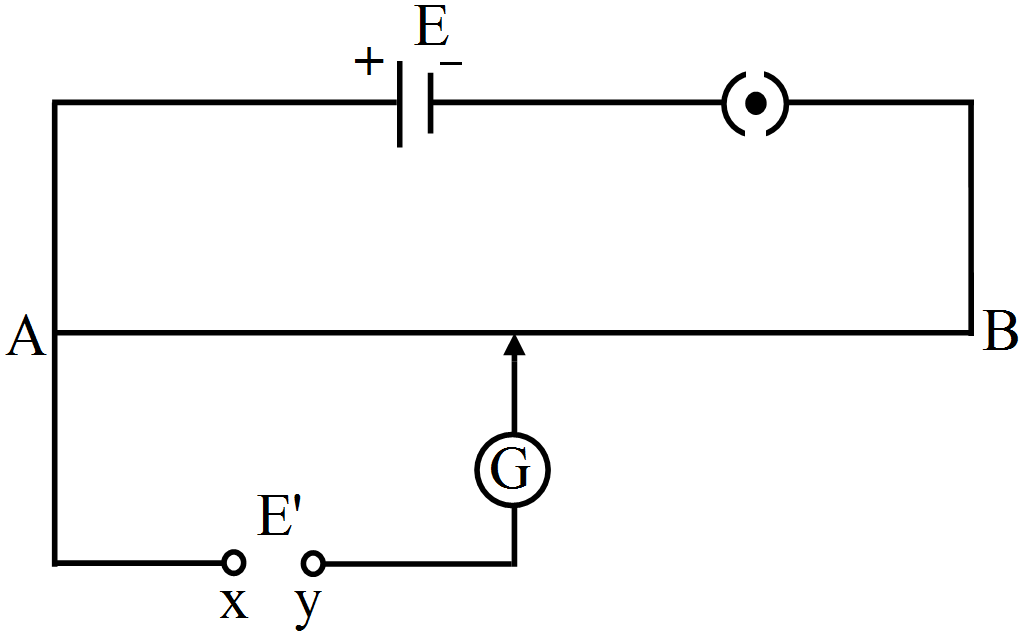
For the potentiometer circuit shown in the given figure, points X and Y represent the two terminals of an unknown emf E'. A student observed that when the jockey is moved from the end A to the end B of the potentiometer wire, the deflection in the galvanometer remains in the same direction.
What may be the two possible faults in the circuit that could result in this observation? If the galvanometer deflection at the end B is (i) more, (ii) less than at the end A, which of the two faults, listed above, would be there in the circuit? Give reason in support of your answer in each case.
  1. Describe briefly the functions of the three segments of $\text{n-p-n}$ transistor.
  2. Draw the circuit arrangement for studying the output characteristics of $\text{n-p-n}$ transistor in $CE$ configuration. Explain how the output characteristics is obtained.
A long, straight wire carries a current. Is Ampere's law valid for a loop that does not enclose the wire? That encloses the wire but is not circular?
A heating element using nichrome connected to a 230 V supply draws an initial current of 3.2 A which settles after a few seconds to a steady value of 2.8 A. What is the steady temperature of the heating element if the room temperature is 27${ }^{\circ} C$ ? Temperature coefficient of resistance of nichrome averaged over the temperature range involved is $1.70 \times 10^{-4}{ }^{\circ} C ^{-1}$.
For a system made of two very long coaxial solenoids, explain mutual inductance. Prove $M _{12}= M _{21}= M$ $($Reciprocity Theorem$).$
Draw a labelled ray diagram of a refracting telescope. Define its magnifying power and write the expression for it.
Write two important limitations of a refracting telescope over a reflecting type telescope.
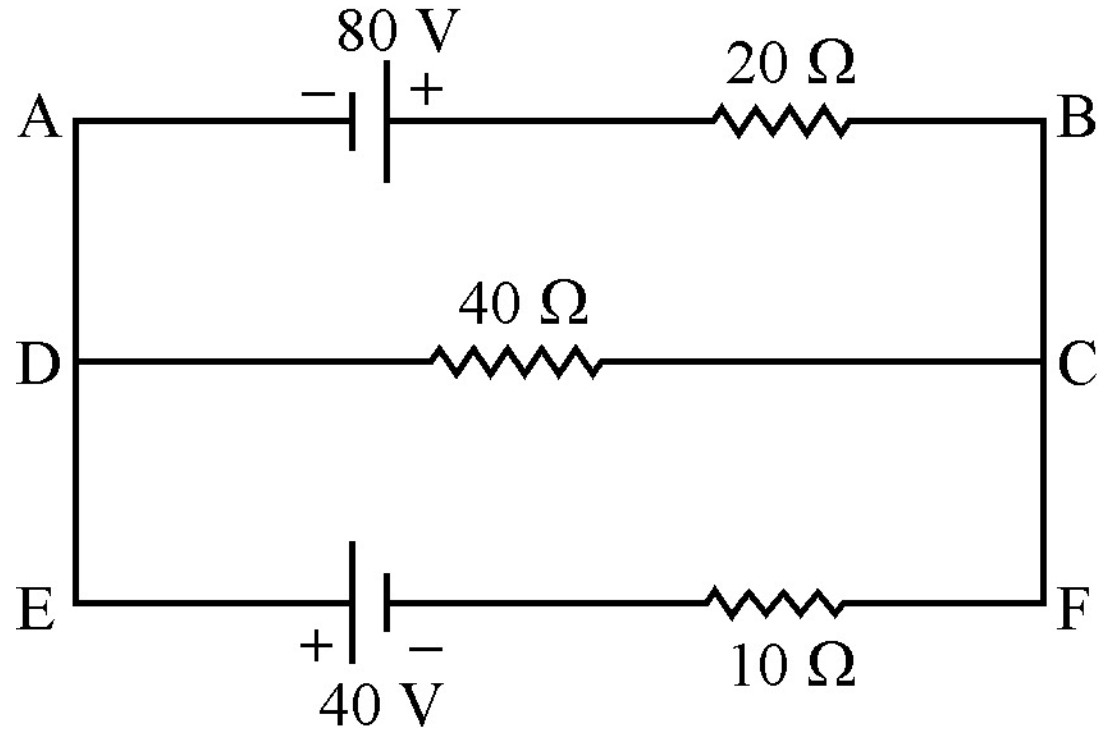
Using Kirchhoff’s rules, calculate the current through the $40\Omega$ and $20\Omega$ resistors in the following circuit:
A block of mass $5.0\ kg$ is suspended from the end of a vertical spring which is stretched by $10\ cm$ under the load of the block. The block is given a sharp impulse from below so that it acquires an upward speed of $2.0m/s.$ How high will it rise? Take $g = 10m/s^2.$
An experimenter's diary reads as follows: "A charged particle is projected in a magnetic field of $(7.0\vec{\text{i}}-3.0\vec{\text{j}})\times10^{-3}\text{T}.$ The acceleration of the particle is found to be $(\vec{\text{i}}+7.0\vec{\text{j}})\times10\text{m/s}^{2\text{n}}.$ The number to the left of $\vec{\text{i}}$ in the last expression was not readable. What can this number be?