Given,
${R_1} = 1\,\Omega $ $C_1 \,= 2\,\mu F$
${R_2} = 2\,\Omega $ $C_2 \,= 4\,\mu F$
The time constants ( in $\mu\, s$) for the circuits $I, II, III$ are respectively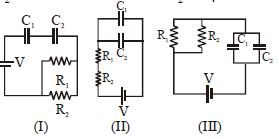
Diffcult


Download our appand get started for free
Experience the future of education. Simply download our apps or reach out to us for more information. Let's shape the future of learning together!No signup needed.*
Similar Questions
- 1Two parallel plates have equal and opposite charge. When the space between them is evacuated, the electric field between the plates is $2 \times {10^5}\,V/m$. When the space is filled with dielectric, the electric field becomes $1 \times {10^5}\,V/m$. The dielectric constant of the dielectric materialView Solution
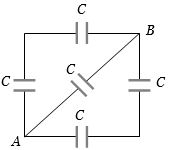
- 2In the figure shown, the effective capacitance between the points $A$ and $B$, if each has capacitance $C$, isView Solution
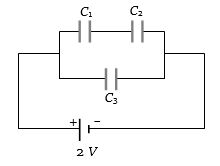
- 3Two capacitors ${C_1} = 2\,\mu \,F$ and ${C_2}\, = \,6\,\mu \,F$ in series, are connected in parallel to a third capacitor ${C_3} = \,4\,\mu \,F$. This arrangement is then connected to a battery of $e.m.f.$ $=$ $2V$, as shown in the figure. How much energy is lost by the battery in charging the capacitorsView Solution
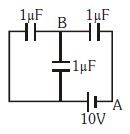
- 4If potential of $A$ is $10\,V$, then potential of $B$ isView Solution
- 5A parallel plate air capacitor of capacitance $C$ is connected to a cell of emf $V$ and then disconnected from it. A dielectric slab of dielectric constant $K,$ which can just fill the air gap of the capacitor, is now inserted in it. Which of the following is incorrect $?$View Solution
- 6The potential at a point $x$ (measured in $μ\ m$) due to some charges situated on the $ x$-axis is given by $V(x)$ =$\frac{{20}}{{{x^2} - 4}}$ $volt$ The electric field $E$ at $x = 4\ μ m$ is given byView Solution
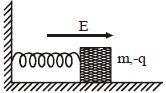
- 7A block of mass $m$ containing a net negative charge $-q$ is placed on a frictionless horizontal table and is connected to a wall through an unstretched spring of spring constant $k$ as shown. If horizontal electric field $E$ parallel to the spring is switched on, then the maximum compression of the spring is :-View Solution
- 8View SolutionAssertion: Electron move away from a region of higher potential to a region of lower potential.
Reason: An electron has a negative charge.
- 9A capacitor has capacitance $5 \mu F$ when it's parallel plates are separated by air medium of thickness $d$. A slab of material of dielectric constant $1.5$ having area equal to that of plates but thickness $\frac{ d }{2}$ is inserted between the plates. Capacitance of the capacitor in the presence of slab will be $..........\mu F$View Solution
- 10Electric potential in a region is varying according to the relation $V=\frac{3 x^2}{2}-\frac{y^2}{4}$, where $x$ and $y$ are in metre and $V$ is in volt. Electric field intensity (in $N/C$) at a point $(1 \,m , 2 \,m$ ) is ......View Solution