Conduction electrons are almost uniformly distributed within a conducting plate. When placed in an electrostatic field $\overrightarrow E $, the electric field within the plate
Easy


Download our appand get started for free
Experience the future of education. Simply download our apps or reach out to us for more information. Let's shape the future of learning together!No signup needed.*
Similar Questions
- 1A particle of mass $‘m’$ and charge $‘q’$ is accelerated through a potential difference of $V$ volt, its energy will beView Solution
- 2Two condensers of capacities $2C$ and $C$ are joined in parallel and charged upto potential $V$. The battery is removed and the condenser of capacity $C$ is filled completely with a medium of dielectric constant $K$. The $p.d.$ across the capacitors will now beView Solution
- 3A particle $A$ has charge $+q$ and particle $B$ has charge $+ 4q$ with each of them having the same mass $m$. When allowed to fall from rest through same electrical potential difference, the ratio of their speed $V_A : V_B$ will be :-View Solution
- 4A conducting sphere $A$ of radius $a$, with charge $Q$, is placed concentrically inside a conducting shell $B$ of radius $b$. $B$ is earthed. $C$ is the common centre of the $A$ and $B$.View Solution

- 5A parallel plate capacitor has plate area $40\,cm ^2$ and plates separation $2\,mm$. The space between the plates is filled with a dielectric medium of a thickness $1\,mm$ and dielectric constant $5$ . The capacitance of the system is :View Solution
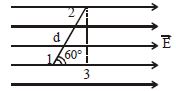
- 6Two plates are $2\,cm$ apart, a potential difference of $10\;volt$ is applied between them, the electric field between the plates is.........$N/C$View Solution
- 7View SolutionValue of potential at a point due to a point charge is
- 8A parallel plate capacitor Air filled with a dielectric whose dielectric constant varies with applied voltage as $K = V$. An identical capacitor $B$ of capacitance $C_0$ with air as dielectric is connected to voltage source $V_0 = 30\,V$ and then connected to the first capacitor after disconnecting the voltage source. The charge and voltage on capacitor.View Solution
- 9$100$ capacitors each having a capacity of $10\,\mu F$ are connected in parallel and are charged by a potential difference of $100\,kV$. The energy stored in the capacitors and the cost of charging them, if electrical energy costs $108\;paise\;per\;kWh$, will beView Solution
- 10The electric field $\vec E$ between two points is constant in both magnitude and direction. Consider a path of length d at an angle $\theta = 60^o$ with respect to field lines shown in figure. The potential difference between points $1$ and $2$ isView Solution