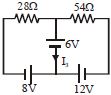
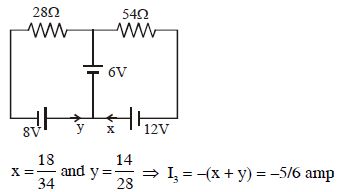
Consider the circuit shown in the figure. The current $I_3$ is equal to
Medium


Download our appand get started for free
Experience the future of education. Simply download our apps or reach out to us for more information. Let's shape the future of learning together!No signup needed.*
Similar Questions
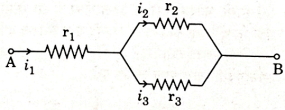
- 1Three resistors having resistances $\mathrm{r}_{1}, \mathrm{r}_{2}$ and $\mathrm{r}_{3}$ are connected as shown in the given circuit. The ratio $\frac{i_{3}}{i_{1}}$ of currents in terms of resistances used in the circuit is :View Solution
- 2The Kirchhooff's first law $\left(\sum i=0\right)$ and second law ( $\left.\sum i R=\sum E\right)$, where the symbols have their usual meanings, are respectively based onView Solution
- 3View SolutionAssertion : Long distance power transmission is done at high voltage.
Reason : At high voltage supply power losses are less.
- 4If resistance of voltmeter is $10000 \,\Omega$ and resistance of ammeter is $2 \,\Omega$ then find $R$ when voltmeter reads $12\,V$ and ammeter reads $0.1\, A$ ............... $\Omega$View Solution
- 5The maximum power drawn out of the cell from a source is given by (where $r$ is internal resistance)View Solution
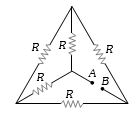
- 6Each of the resistance in the network shown in fig. is equal to $R$. The resistance between the terminals $A$ and $B$ isView Solution
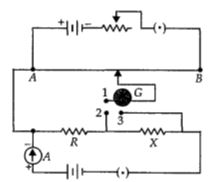
- 7A potentiometer circuit is set up as shown. The potential gradient, across the potentiometer wire, is $k$ $volt/cm$ and the ammeter, present in the circuit, reads $1.0\,\, A$ when two way key is switched off. The balance points, when the key between the terminals $(i)$ $1$ and $2$ $(ii)$ $1$ and $3,$ is plugged in, are found to be at lengths $l_1$ and $l_2$ respectively. The magnitudes, of the resistors $R$ and $X,$ in $ohms$, are then, equal, respectively, toView Solution
- 8View SolutionThe specific resistance of all metals is most affected by
- 9View SolutionKirchhoff's second law is based on the law of conservation of
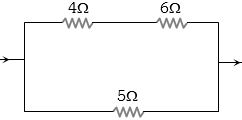
- 10In the circuit shown in figure, the heat produced in $5\, ohm $ resistance is $10\, cal / sec$ . The heat produced in $4$ resistance is ................ $cal /sec$View Solution