MCQ
Consider the quantities, pressure, power, energy, impulse, gravitational potential, electrical charge, temperature, area. Out of these, the only vector quantities are
  • A
    Impulse, pressure and area.
  • B
    Impulse and area.
  • C
    Area and gravitational potential.
  • D
    Impulse and pressure.

Answer

  1. Impulse and area.

Explanation:

We know that impulse J = F. $\Delta\text{t}=\Delta\text{p},$ where F is force, At is time duration and Ap is change in momentum. As $\Delta\text{p}$ is a vector quantity, hence impulse is also a vector quantity. Sometimes area can also be treated as vector direction of area vector is perpendicular to its plane.

Need a full question paper?

Generate a complete, print-ready paper with questions like this in minutes — across 16+ boards, with answer keys.

Start Generating Free

Similar questions

In an experiment four quantities $a, b, c$ and $d$ are measured with percentage error $1\%, 2\%, 3\%$ and $4\%$ respectively. Quantity $w$ is calculated as follows $w\, = \,\frac{{{a^4}{b^3}}}{{{c^2}\sqrt D }}$  error in the measurement of $w$ is .......... $\%$
How much work does a pulling force of $40 \,N$ do on the $20\, kg$ box in pulling it $8 \,m $ across the floor at a constant speed. The pulling force is directed at $60^o $ above the horizontal.....$J$
In order to double the frequency of the fundamental note emitted by a stretched string, the length is reduced to $\frac{3}{4}$$^{th}$ of the original length and the tension is changed. The factor by which the tension is to be changed, is
Following sets of three forces act on a body. Whose resultant cannot be zero
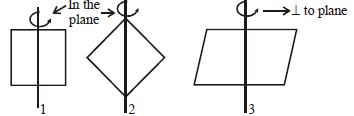
Three identical square plates rotate about the axes shown in the figure in such a way that their kinetic energies are equal. Each of the rotation axes passes through the centre of the square. Then the ratio of angular speeds $\omega _1 : \omega _2 : \omega _3$ is
An earthquake generates both transverse $(S)$ and longitudinal $(P)$ sound waves in the earth. The speed of $S$ waves is about $4.5 \,km/s$ and that of $P$ waves is about $8.0 \,km/s.$ A seismograph records $P$ and $S$ waves from an earthquake. The first $P$ wave arrives $4.0\, min$ before the first $S$ wave. The epicenter of the earthquake is located at a distance about .... $km$
If the displacement of an object is directly proportional to the square of time, then the speed of the object is :
A cubical box of side $a$ sitting on a rough table-top is pushed horizontally with a gradually increasing force until the box moves. If the force is applied at a height from the table top which is greater than a critical height $H$, the box topples first. If it is applied at a height less than $H$, the box starts sliding first. Then, the coefficient of friction between the box and the table top is
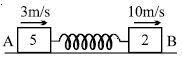
Two blocks $A(5kg)$ and  $B(2kg)$ attached to the ends of a spring constant $1120N/m$ are placed on a smooth horizontal plane with the spring undeformed. Simultaneously velocities of $3m/s$ and $10m/s$ along the line of the spring in the same direction are imparted to $A$ and $B$ then