Question
Consider the situation of the previous problem. Define displacement resistance $\text{R}_\text{d}=\frac{\text{V}}{\text{i}_\text{d}}$ of the space between the plates, where $V$ is the potential difference between the plates and $i_d$ is the displacement current. Show that $R_d$ varies with time as $\text{R}_\text{d}=\text{R}\big(\text{e}^{\text{t}/\tau}-1\big)$
Answer

$\text{E}=\frac{\text{Q}}{\epsilon_0\text{A}} ($Electric field$)$
$\phi=\text{E.A.}=\frac{\text{Q}}{\epsilon_0\text{A}}\frac{\text{A}}{2}=\frac{\text{Q}}{\epsilon_02}$
$\text{i}_0=\epsilon_0\frac{\text{d}\phi_\text{E}}{\text{dt}}=\epsilon_0\frac{\text{d}}{\text{dt}}\Big(\frac{\text{Q}}{\epsilon_02}\Big)$
$=\frac{1}{2}\Big(\frac{\text{dQ}}{\text{dt}}\Big)$

Need a full question paper?

Generate a complete, print-ready paper with questions like this in minutes — across 16+ boards, with answer keys.

Start Generating Free

Similar questions

Define the different terms used for the composition of a nucleus.
Four point charges $q_A = 2 \mu C, q_B = –5 \mu C, q_C = 2 \mu C,$ and $q_D = –5 \mu C$ are located at the corners of a square $\text{ABCD}$ of side $10 \ cm$. What is the force on a charge of $1 \mu C$ placed at the centre of the square?
The binding energy of ${ }_4 Be ^9$ nucleus is $5 8 . 0 MeV$ and that of ${ }_2 He ^4$ is $28.3 Me$V . Which of these is more stable and why?
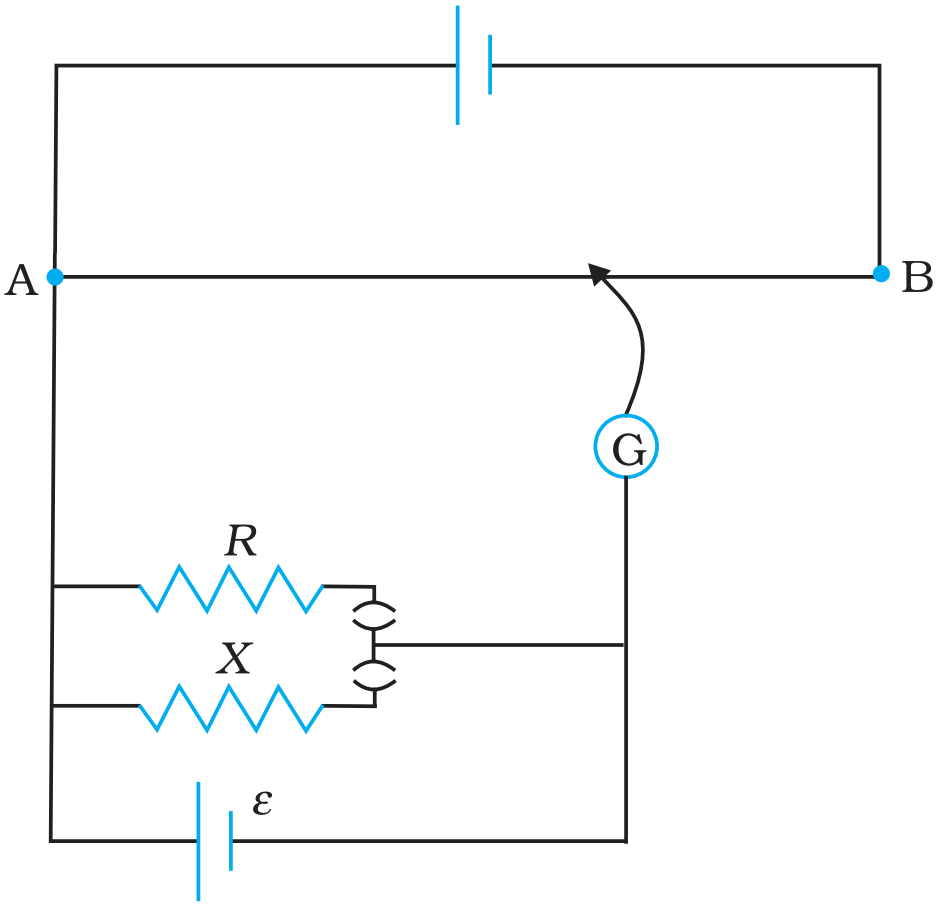
Figure shows a potentiometer circuit for comparison of two resistances. The balance point with a standard resistor $\text{R}=10.0\ \Omega$ is found to be $58.3 \ cm,$ while that with the unknown resistance $X$ is $68.5 \ cm$. Determine the value of $X$. What might you do if you failed to find a balance point with the given cell of emf $\varepsilon?$
A circular coil of one turn of radius 5.0cm is rotated about a diameter w!th a constant angular speed of 80 revolutions per minute. A uniform magnetic field B = 0.010T exists in a direction perpendicular to the axis of rotation. Find
  1. The maximum emf induced.
  2. The average emf induced in the coil over a long period.
  3. The average of the squares of emf induced over a lone period.
Is it easier to take out a nucleon from carbon or from iron? Fi-om iron or from lead?
A sample of air weighing $1.18g$ occupies $1.0 \times 10^3\ cm^3$ when kept at $300K$ and $1.0 \times 10^5Pa.$ When $2.0\ cal$ of heat is added to it at constant volume, its temperature increases by $1^\circ C.$ Calculate the amount of heat needed to increase the temperature of air by $1^\circ C$ at constant pressure if the mechanical equivalent of heat is $4.2 \times 10^7erg\ cal^{-1}.$ Assume that air behaves as an ideal gas.
A spherical conducting shell of inner radius $r_1$ and outer radius $r_2$ has a charge $Q.$
  1. A charge $q$ is placed at the centre of the shell. What is the surface charge density on the inner and outer surfaces of the shell?
  2. Is the electric field inside a cavity $($with no charge$)$ zero, even if the shell is not spherical, but has any irregular shape? Explain
Draw the electric field lines due to a uniformly charged thin spherical shell when charge on the shell is (a) positive and (b) negative.
In a diffraction pattern due to a single slit, how will the angular width of central maximum change, if
a. Orange light is used in place of green light,
b. the screen is moved closer to the slit,
c. the slit width is decreased?
Justify your answer in each case.