Question
Define the different terms used for the composition of a nucleus.

Answer

• The Composition of nucleus :
(i) Atomic number $( Z )$ :
The number of electrons in the neutral atom is called the atomic number.
OR
The number of protons in the neutral atom is called the atomic number.
(ii) Mass number (A) :
The sum of the number of protons and neutrons in the nucleus of the atom is called the atomic mass number A .
Both protons and neutrons are present in the nucleus hence it is known by the common name of nucleon.
The total number of nucleons in the nucleus of an atom is called atomic mass number A .
$\therefore A = Z + N$
(iii) Neutron number ( N $)$ :
The number of neutrons present in the nucleus of an atom is called the neutron number N .
(iv) Nuclide :
The type of nucleus is called nuclide and is represented by symbol ${ }_Z X^A$.
Where X is the chemical symbol of element, $Z =$ atomic number and A is atomic mass number.
For example :
Nuclide of gold ${ }_{79} A u^{197}$
in which 197 nucleons, 79 protons and 118 neutrons are there.

Need a full question paper?

Generate a complete, print-ready paper with questions like this in minutes — across 16+ boards, with answer keys.
Start Generating Free

Similar questions

Explain the principle, construction, working and application of moving coil galvanometer.
When an object cools down, heat is withdrawn from it. Does the entropy of the object decrease in this process? If yes, is it a violation of the second law of thermodynamics stated in terms of increase in entropy?
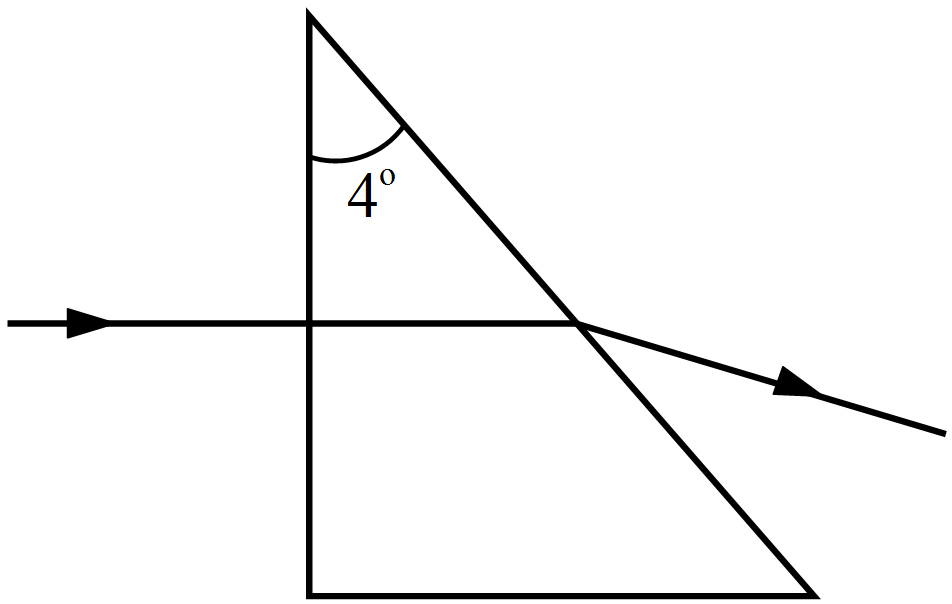
Find the angle of deviation suffered by the light ray shown in figure. The refractive index $\mu=1.5$ for the prism material.
A coil of resistance $100\Omega$ is connected across a battery of emf $6.0V$. Assume that the heat developed in the coil is used to raise its temperature. If the heat capacity of the coil is $4.0J/K,$ how long will it take to raise the temperature of the coil by $15^\circ C$?
In order to emit the electron from the metallic surface, which physical methods are used to give the minimum energy? Explain.
Two identical particles, each having a charge of $2.0 \times 10^{-4}C$ and mass of $10g,$ are kept at a separation of $10\ cm$ and then released. What would be the speeds of the particles when the separation becomes large?
radioactive isotope has a half-life of 5 years. After how much time is its activity reduced to 3.125% of its original activity?
The numerical value of ionization energy in $eV$ equals the ionization potential in volts. Does the equality hold if these quantities are measured in some other units?
A long charged cylinder of linear charge density $+\lambda_1$ is surrounded by a hollow coaxial conducting cylinder of linear charge density $-\lambda_2$. Use Gauss’s law to obtain expressions for the electric field at a point (i) in the space between the cylinders, and (ii) outside the larger cylinder.
Write a short-note on p-type semiconductors.