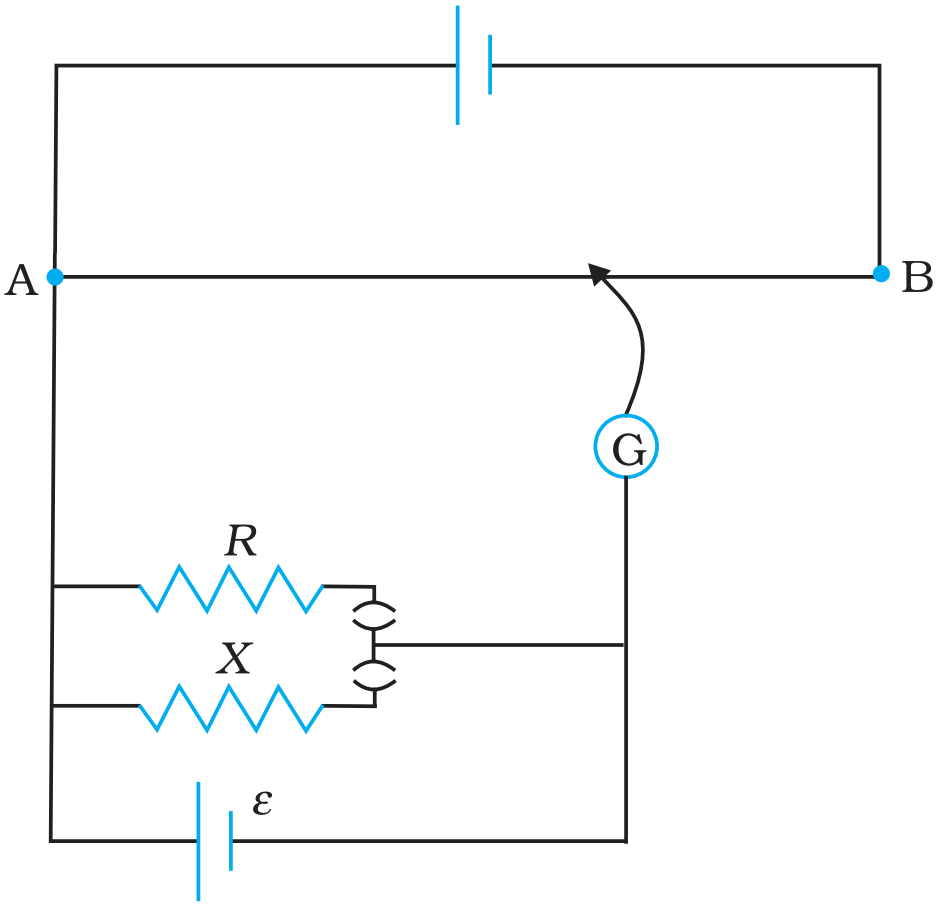
Figure shows a potentiometer circuit for comparison of two resistances. The balance point with a standard resistor $\text{R}=10.0\ \Omega$ is found to be $58.3 \ cm,$ while that with the unknown resistance $X$ is $68.5 \ cm$. Determine the value of $X$. What might you do if you failed to find a balance point with the given cell of emf $\varepsilon?$
Exercise
Download our app for free and get started
Resistance of the standard resistor, $\text{R}=10.0\ \Omega$
Balance point for this resistance $, l_1 = 58.3 \ cm$
Current in the potentiometer wire $= i$
Hence, potential drop across $R, E_1 = iR$
Resistance of the unknown resistor $= X$
Hence, potential drop across $X, E_2 = iX$
The relation connecting emf and balance point is,
$\frac{\text{E}_1}{\text{E}_2}=\frac{l_1}{l_2}$
$\frac{\text{iR}}{\text{iX}}=\frac{l_1}{l_2}$
$\text{X}=\frac{l_1}{l_2}\times\text{R}$
$=\frac{68.5}{58.3}\times10=11.749\ \Omega$
Therefore, the value of the unknown resistance, $\text{X, is}\ 11.75\ \Omega.$
If we fail to find a balance point with the given cell of emf $, \varepsilon ,$ then the potential drop across $R$ and $X$ must be reduced by putting a resistance in series with it.
Only if the potential drop across $R$ or $X$ is smaller than the potential drop across the potentiometer wire $AB,$ a balance point is obtained.
Balance point for this resistance $, l_1 = 58.3 \ cm$
Current in the potentiometer wire $= i$
Hence, potential drop across $R, E_1 = iR$
Resistance of the unknown resistor $= X$
Hence, potential drop across $X, E_2 = iX$
The relation connecting emf and balance point is,
$\frac{\text{E}_1}{\text{E}_2}=\frac{l_1}{l_2}$
$\frac{\text{iR}}{\text{iX}}=\frac{l_1}{l_2}$
$\text{X}=\frac{l_1}{l_2}\times\text{R}$
$=\frac{68.5}{58.3}\times10=11.749\ \Omega$
Therefore, the value of the unknown resistance, $\text{X, is}\ 11.75\ \Omega.$
If we fail to find a balance point with the given cell of emf $, \varepsilon ,$ then the potential drop across $R$ and $X$ must be reduced by putting a resistance in series with it.
Only if the potential drop across $R$ or $X$ is smaller than the potential drop across the potentiometer wire $AB,$ a balance point is obtained.

Download our appand get started for free
Experience the future of education. Simply download our apps or reach out to us for more information. Let's shape the future of learning together!No signup needed.*
Similar Questions
- 1View Solution
- Six lead-acid type of secondary cells each of emf 2.0 V and internal resistance $0.015\Omega$ are joined in series to provide a supply to a resistance of $8.5\ \Omega.$ What are the current drawn from the supply and its terminal voltage?
- A secondary cell after long use has an emf of 1.9 V and a large internal resistance of $380\ \Omega$ What maximum current can be drawn from the cell? Could the cell drive the starting motor of a car?
- 2View SolutionWhy are alloys used for making standard resistance coils?
- 3View SolutionThe specification on a heater coil is 250V, 500W. Calculate the resistance of the coil. What will be the resistance of a coil of 1000W to operate at the same voltage?
- 4View SolutionA voltage of 30V is applied across a carbon resistor with first, second and third rings of blue, black and yellow colours respectively. Calculate the value of current in mA, through the resistor.
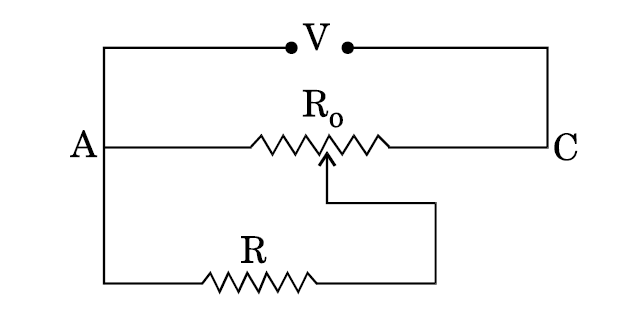
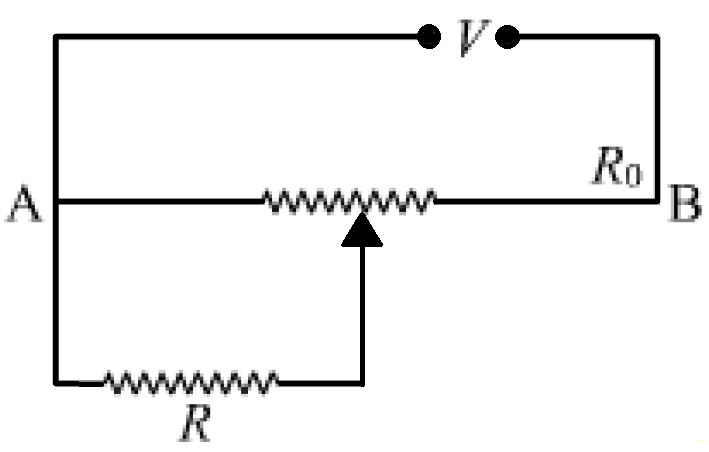
- 5A resistance of R draws current from a potentiometer. The potentiometer wire $, AB, $ has a total resistance of $R_o. A$ voltage $V$ is supplied to the potentiometer. Derive an expression for the voltage across $R$ when the sliding contact is in the middle of potentiometer wire.View Solution
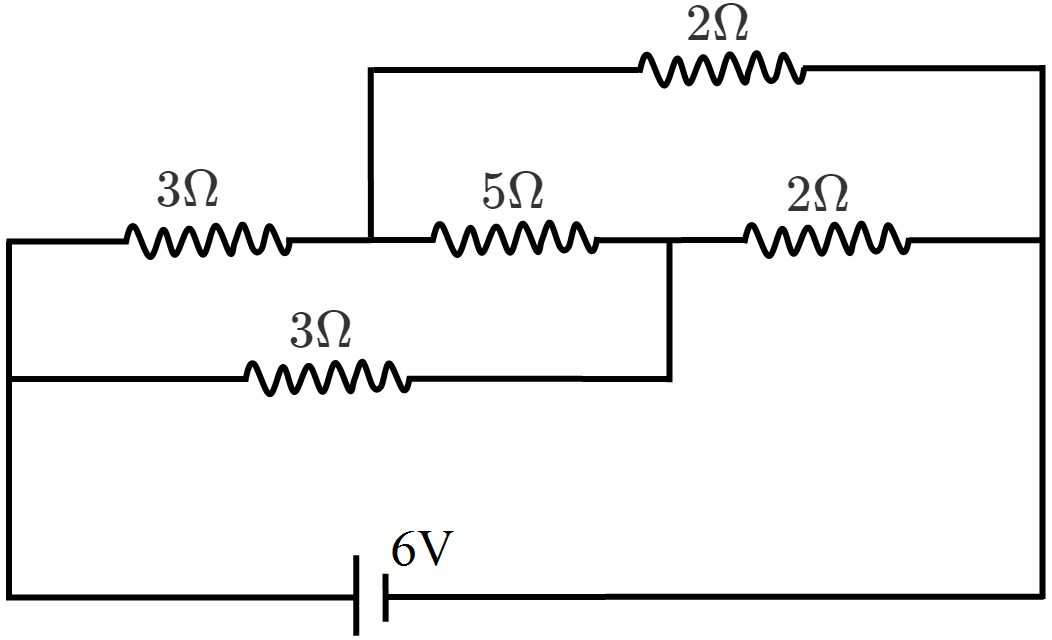
- 6View SolutionCalculate the current drawn from the battery in the given network shown here. State Kirchhoff’s loop law and name the law on which it is based.
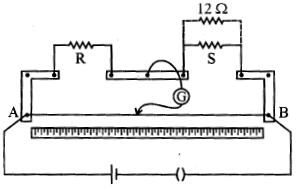
- 7View SolutionIn a meter bridge, the null point is found at a distance of 40 cm from A. If a resistance of 12 Ω is connected in parallel with S, the null point occurs at 50.0 cm from. Determine the values of R and S.
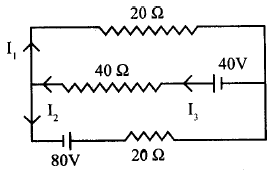
- 8View SolutionState Kirchhoff's rules of current distribution in an electrical network. Using these rules determine the value of the current I1 in the electric circuit given below.
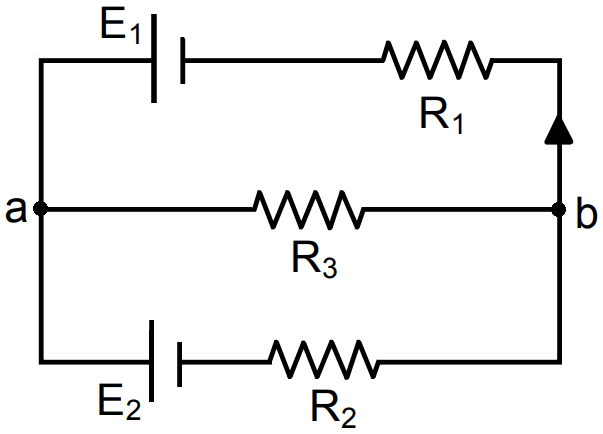
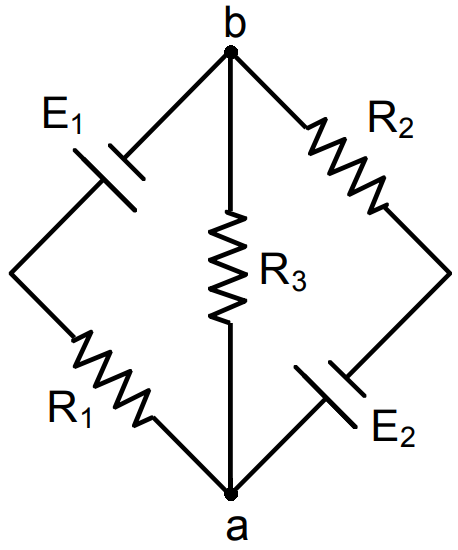
- 9Find the potential difference $V_a - V_b$ in the circuits shown in figure.View Solution
- 10A resistance of $R \Omega$ draws current from a potentiometer as shown in the figure. The potentiometer has a total resistance $R_o\Omega$ . A voltage $V$ is supplied to the potentiometer. Derive an expression for the voltage across $R$ when the sliding contact is in the middle of the potentiometer.View Solution